

Oct 27, 2026

Casey Bjorkdahl is one of the pioneering thought leaders in the SEO community. In 2010, Casey co-founded Vazoola after working for a Digital Marketing Agency for five years in New York City. Vazoola is now one of the fastest growing and most widely recognized SEO marketing firms in the country.


Search marketing has picked up a whole new vocabulary almost overnight. Agencies are now talking about GEO, AI citations, prompt coverage, answer volatility, LLM seeding, and other terms that barely appeared in client conversations a few years ago.
Keeping those concepts straight matters because they describe how brands show up when people search through AI-powered tools instead of relying only on traditional search results.
Use this glossary as a quick reference for the AI visibility terms agencies are most likely to encounter, then follow the linked resources when a topic calls for a deeper look.
As the terminology continues to evolve, our glossary is sure to grow with it, so check back with us when you’re ready to learn more.
Key Takeaways
-
GEO focuses on visibility inside AI-generated answers, where mentions, citations, and source attribution can matter alongside rankings.
-
Reliable measurement requires stable prompt sets and repeatable baselines because generated answers can change between runs.
-
Agencies can improve visibility through stronger content coverage, digital PR, co-citation signals, and consistent brand information.
-
AI visibility metrics work best when agencies track them over time instead of relying on isolated searches or single responses.
Table of Contents
Core AI Search Concepts
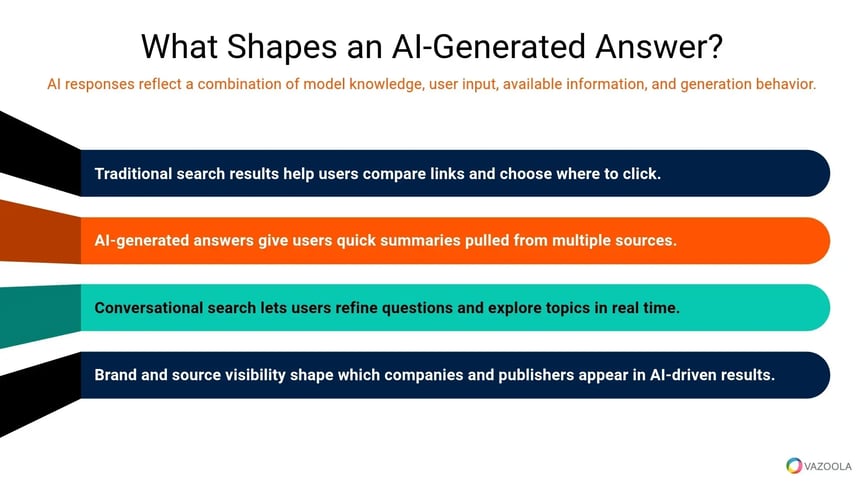
Before agencies can measure or improve AI visibility, they need a clear picture of where that visibility can happen. These foundational concepts cover the AI-powered search experiences changing how brands, sources, and information appear to users.
AI Mode
AI Mode is Google's conversational search experience, which generates synthesized responses to user queries and supports follow-up questions. Instead of treating each search as a separate interaction, it allows users to continue exploring a topic within the same conversation.
AI Overviews
AI Overviews are AI-generated summaries that appear in Google Search and may include links to supporting sources. For agencies, those citations create another opportunity for a brand or publisher to gain visibility beyond traditional organic listings.
Answer Engine
An answer engine responds to a query with a synthesized answer rather than simply returning a list of links. The category can include chat assistants and AI-enhanced search tools, giving agencies another place to monitor whether a brand appears in the information users receive.
Generative Engine Optimization (GEO)
Generative Engine Optimization, or GEO, focuses on improving how a brand and its content appear in AI-generated answers. The work can involve strengthening content quality, authority, brand signals, and third-party mentions so AI systems have more credible information to draw from when relevant questions come up.
Zero-Click Search
A zero-click search ends without the user visiting an external result because the search experience provides enough information directly. Recent reporting on AI visibility cited data suggesting about 93% of Google AI Mode searches ended without a click. The figure illustrates why agencies may need to measure visibility beyond referral traffic.
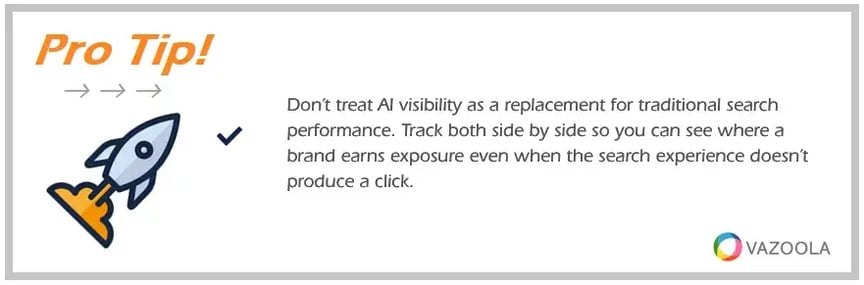
Don’t treat AI visibility as a replacement for traditional search performance. Track both side by side so you can see where a brand earns exposure even when the search experience doesn’t produce a click.
How AI Models Retrieve and Generate Answers
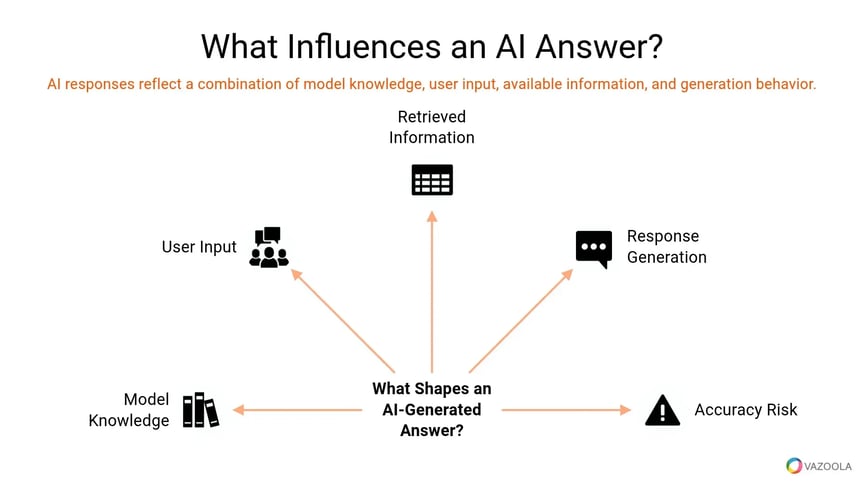
What an AI system returns can change based on the prompt, the information it was trained on, and any outside sources it retrieves. Knowing how those pieces influence a response makes it easier to understand where an answer came from and why it may vary.
Hallucination
A hallucination occurs when an AI model generates information that sounds credible but is inaccurate, unsupported, or entirely fabricated. Agencies should watch for these errors when monitoring brand-related answers, especially when responses include important facts, claims, or company details.
Large Language Model (LLM)
A large language model, or LLM, is trained on vast amounts of text so it can recognize patterns, interpret prompts, and generate human-like language. Many AI assistants and search features rely on LLMs, with each response shaped by the context, instructions, and information available at the time.
Prompt
A prompt is the question, instruction, or other input given to an AI system to guide its response. Because even small changes in wording can produce different answers, agencies need to choose prompts carefully when testing and comparing AI visibility.
Retrieval-Augmented Generation (RAG)
Retrieval-augmented generation, or RAG, allows an LLM to pull in external information when generating a response instead of relying only on what it learned during training. Because the model can retrieve current or relevant sources at query time, recently published web content may influence the answers users receive.
Training Data vs. Retrieved Data
Training data is the information a model learns from before deployment, whereas retrieved data is information a system pulls in when responding to a query. For agencies, the distinction matters because brand information can influence AI-generated answers through either the model's existing knowledge or the sources it accesses in real time.
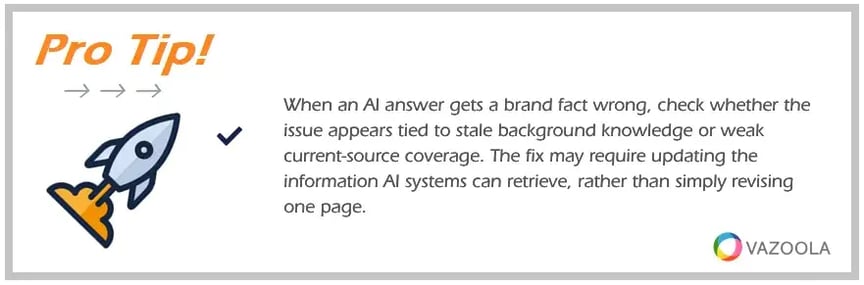
When an AI answer gets a brand fact wrong, check whether the issue appears tied to stale background knowledge or weak current-source coverage. The fix may require updating the information AI systems can retrieve, rather than simply revising one page.
Visibility and Citation Metrics
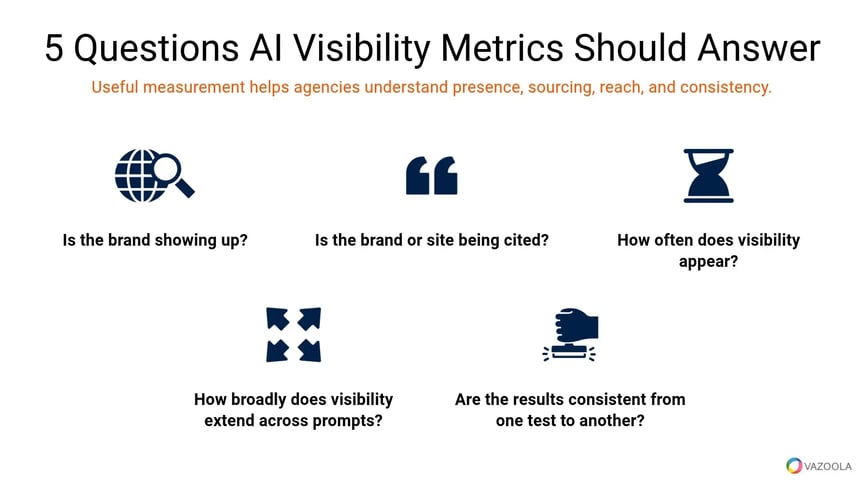
AI visibility usually requires several measurements, each addressing presence, sourcing, or consistency. Agencies can combine these metrics for a clearer performance picture.
AI Citation
An AI citation links a generated answer to a source that supports the information being presented. Tracking those citations can show which pages AI systems rely on, which gives agencies a different visibility signal than a brand mention alone.
AI Share of Voice
AI share of voice measures how often a brand appears in relevant AI-generated answers compared with competing brands. Because results can vary by prompt and platform, agencies should use a consistent set of inputs when tracking changes over time.
Brand Mention
A brand mention occurs when an AI response names a brand without necessarily citing its website. That’s why mentions and citations should be measured separately. Vazoola's guide to off-page brand mentions explores the wider role of third-party references.
Citation Frequency
Citation frequency measures how often a source is cited across a defined set of AI prompts or responses. Tracking it over time can help agencies spot recurring visibility patterns that a handful of one-off checks might miss.
Prompt Coverage
Prompt coverage measures how much of a tracked prompt set results in brand or source visibility. Broader coverage can show that a brand appears across a wider range of user needs, while narrower coverage may point to topics or questions where visibility is still missing.
Source Attribution
Source attribution identifies the source behind an AI-generated claim or piece of information. Tracking it helps agencies distinguish simple brand awareness from source-based visibility and see which websites or publishers repeatedly support the answers users receive.
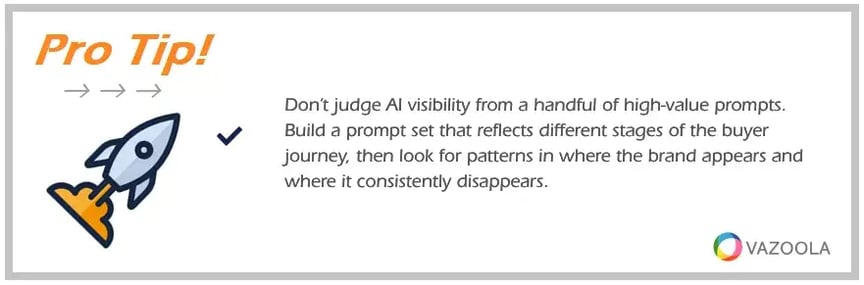
Don’t judge AI visibility from a handful of high-value prompts. Build a prompt set that reflects different stages of the buyer journey, then look for patterns in where the brand appears and where it consistently disappears.
Agency Strategy and Tactics
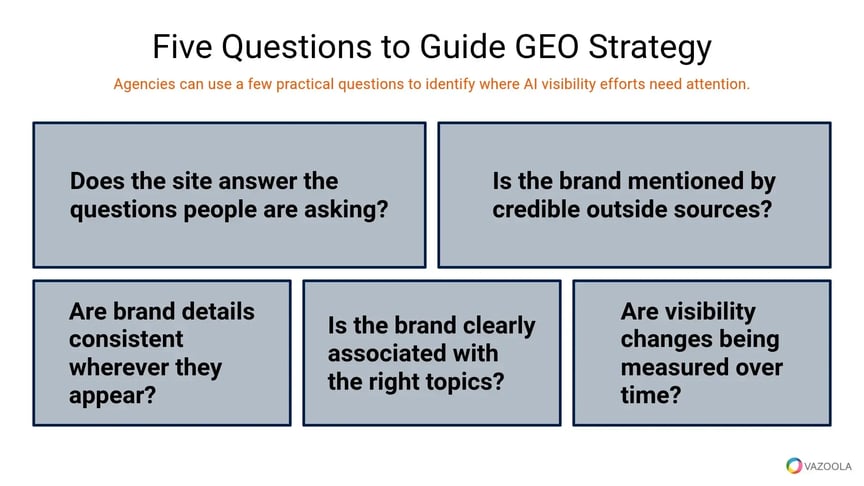
Once agencies know how a brand is appearing in AI-generated answers, the next challenge is improving that visibility. GEO tactics can strengthen the content, authority signals, and third-party associations that help AI systems understand where a brand fits and when it may be relevant.
Co-occurrence and Co-citation
Co-occurrence and co-citation describe the relationships that form when brands, entities, or sources appear together across content. Repeated pairings can strengthen topical associations, making the concept especially relevant to off-site GEO efforts and brand visibility.
Content Gap Analysis
Content gap analysis identifies questions, topics, or needs that a site does not cover well enough. For GEO, agencies can also look at the prompts competitors appear for and the sources AI systems cite, then use those gaps to guide future content priorities.
Digital PR
Digital PR helps brands earn credible mentions and coverage across third-party publications and platforms, which can strengthen off-site visibility in AI search. Vogue Business reported on industry research indicating that more than 80% of what LLMs cite about brands traces back to earned media, underscoring the value of visibility beyond a brand's own website.
LLM Consensus
LLM consensus describes repeated agreement across AI systems about a brand, entity, or topic. Agencies can look for that pattern by comparing responses across models and running the same or similar prompts more than once, rather than drawing conclusions from a single answer.
LLM Seeding
LLM seeding involves placing accurate, useful brand information in credible sources that AI systems may encounter. The goal is to improve the availability and consistency of information around a brand, rather than directly inserting content into a model.
Treat earned media as part of your AI visibility strategy, not a separate PR exercise. Repeated brand associations across trusted third-party sources can strengthen the signals agencies want AI systems to encounter.
Measurement and Tools
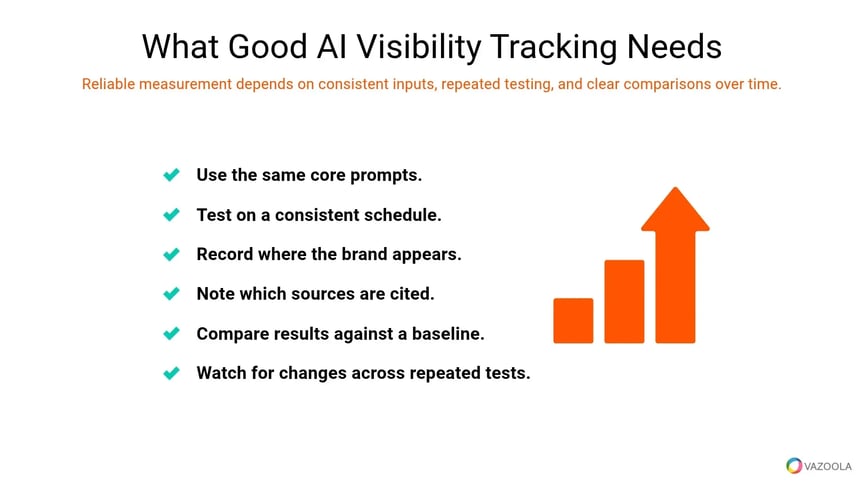
Because AI-generated answers can change from one test to another, meaningful measurement depends on consistent inputs and repeatable methods. The right tools and tracking practices give agencies the context they need to interpret those changes over time.
AI Citation Analysis Tool
An AI citation analysis tool tracks where brands appear in generated answers and which sources those answers cite. Because platforms can differ in the prompts, models, and methods they use, Vazoola's AI citation analysis tools comparison can help agencies evaluate which features best fit their reporting needs.
Answer Volatility
Answer volatility refers to how much AI-generated responses vary across repeated tests, dates, prompts, or platforms. When volatility is high, agencies need multiple observations to tell the difference between a temporary fluctuation and a meaningful visibility trend.
Baseline
A baseline establishes the starting point for future AI visibility comparisons. Agencies should document the prompts, platforms, settings, and timing used during the initial test so later changes are easier to evaluate under similar conditions.
Prompt Set / Prompt Library
A prompt set, or prompt library, is a defined collection of questions used for recurring AI visibility tests. Keeping a stable core makes trends easier to compare over time, while agencies can still add new prompts as search behavior, client priorities, or AI platforms evolve.
Run important prompt tests more than once before reporting a change to clients. A single answer can be noise, while repeated shifts across several runs are much more useful for spotting a real trend.
Putting the Glossary to Work
GEO vocabulary will continue changing as AI platforms, search behavior, and measurement practices evolve.
Keeping up with the terminology gives agencies a common language for briefing clients, comparing tools, designing tests, and explaining how AI visibility fits alongside traditional SEO.
Keep this glossary bookmarked as a reference, and use the linked guides when you need to go deeper into topics such as GEO, digital PR, citations, and brand mentions. As new concepts become part of everyday agency work, the glossary can grow along with them.