

Mar 26, 2026

Casey Bjorkdahl is one of the pioneering thought leaders in the SEO community. In 2010, Casey co-founded Vazoola after working for a Digital Marketing Agency for five years in New York City. Vazoola is now one of the fastest growing and most widely recognized SEO marketing firms in the country.


You’ve likely published strong content that ranks well, yet it still doesn’t appear when someone asks an AI tool for an answer.
That gap creates frustration for marketing managers, creators, and business owners who expect visibility to follow quality. Rankings still matter, but visibility now depends on how content appears inside AI-driven responses. That shift is partly driven by semantic search — and by a retrieval method called RAG that takes it further.
Many teams face the same issue. Strong pages exist, but they don’t always surface when users turn to AI for help.
That leads to two natural questions: Why does high-quality content disappear in AI answers? And how does AI get its information?
The shift comes down to how these systems retrieve information — a method known as retrieval augmented generation (RAG). It changes how LLMs find, cite, and assess content.
So, what exactly is RAG? And what does it mean for the way you approach content today?
Key Takeaways
-
RAG helps AI systems pull fresh, external content before generating answers.
-
Brands must appear in trusted content pools to be cited by AI tools.
-
Traditional SEO still matters, but retrieval visibility now plays a role.
-
Off-page signals such as mentions and citations carry more weight.
-
Agencies can build retrieval authority through structured content placement.
Table of Contents
Treat content as a “retrieval unit,” not just a page. AI systems extract chunks, not full pages, so structure key ideas to stand alone without surrounding context. Use clear definitions, self-contained paragraphs, and explicit entity references so any section still makes sense when pulled into an answer.
What is Retrieval Augmented Generation in Layman’s Terms?
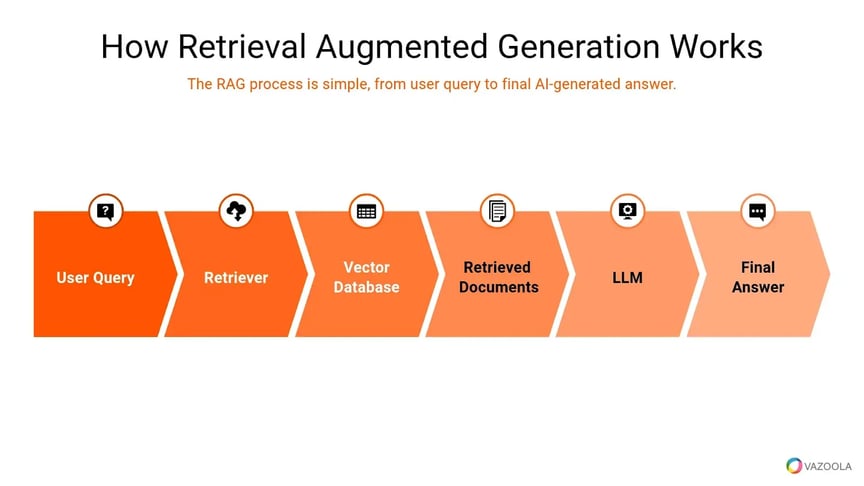
Retrieval augmented generation, or RAG, works like a research assistant.
Instead of relying only on what it already knows, an AI system searches for information before it answers a question. Think of it less as a library and more as a researcher gathering sources in real time.
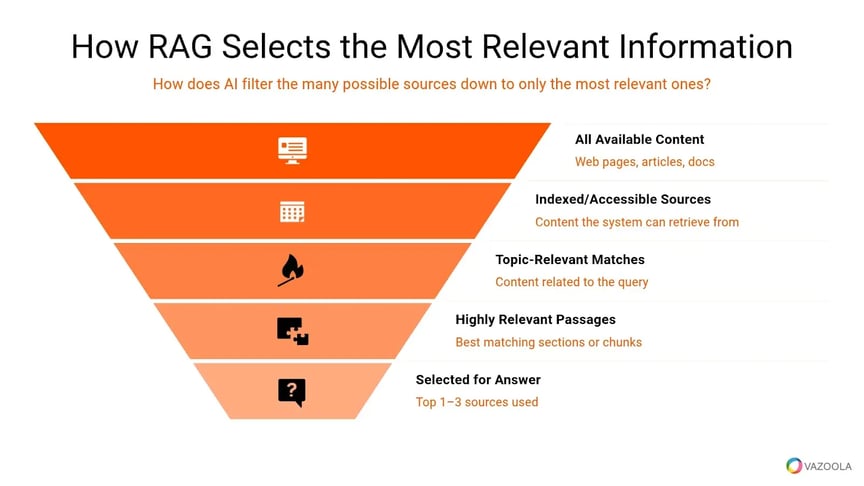
That’s because when someone asks tools like ChatGPT, Gemini, or Perplexity a question, those platforms don’t rely exclusively on what they already know.
Most AI models have a knowledge cutoff. They can’t access new information unless they retrieve it from external sources. That creates a gap for brands that publish new or updated content. If the system cannot find that content, it cannot use it.
Retrieval fills that gap. The AI searches trusted sources, pulls relevant information, and uses it to shape a response.
The process mirrors how search engines crawl and index pages. The difference lies in how results appear. Instead of a list of links, users receive a synthesized answer.
Visibility depends on inclusion in the sources these systems retrieve from. If content doesn’t exist in a retrievable pool, it won’t appear in AI-generated answers. That single idea transforms how teams should think about optimization going forward.
RAG vs SEO Comparison
Search engine optimization still drives traffic.
RAG changes the ways content gets selected and presented. Both systems rely on content quality, but they operate in different ways.
|
Element |
Traditional SEO |
RAG Systems |
|
How It Works |
Crawls and ranks indexed pages |
Retrieves and synthesizes external content |
|
Search Results |
Blue links with snippets |
Direct answers with citations |
|
Optimization Focus |
Keywords, backlinks, on-page signals |
Authority, context, and retrievable mentions |
|
Measurement |
Rankings, clicks, impressions |
Citations, visibility in AI answers |
|
Semantic Search |
Matches content by meaning and intent, not exact keywords |
Bridges traditional SEO and RAG; it’s how both systems understand context |
Users searching on Google often scan multiple results. When they ask an AI tool, they instead expect a single answer. That change reduces the number of opportunities for visibility.
The moral of the story? Content must earn a place inside the answer itself.
Track answer inclusion rate alongside rankings by testing prompts across AI tools like ChatGPT or Perplexity. Monitor whether your brand appears in synthesized answers, not just search results, since visibility now depends on being cited within the response itself.
What Does RAG Do in LLM Searches?
RAG improves how large language models generate responses. It allows them to access current, relevant, and trusted data before producing an answer.
Content Retrieval
RAG systems search external sources before generating responses. They pull data from indexed or curated content pools. High-quality content increases the chances of retrieval.
Accuracy and Reduced Hallucinations
AI models can produce incorrect information. Retrieval helps reduce that risk. External sources provide real data that grounds the response.
Research from MIT-affiliated AI studies shows that retrieval-based systems can improve factual accuracy and user trust in AI-generated answers.
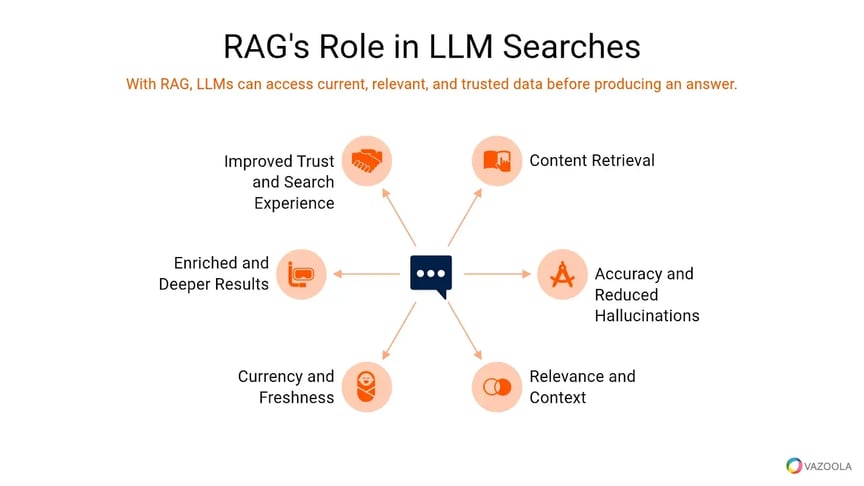
Relevance and Context
RAG improves how answers match user intent. The system selects sources that align with the question. Context improves because the AI pulls information specific to the query. This is semantic search at the LLM level; the system isn't matching keywords, it's matching meaning, intent, and entity relationships.
Currency and Freshness
Traditional models struggle with new information. Retrieval solves that issue. Systems can access recent content and incorporate it into answers. Updates matter more than ever.
Write citation-worthy sentences that are concise, factual, and easy to extract. Include clear claims, statistics, or definitions tied to recognizable entities so AI systems can lift and reuse them naturally within generated answers.
Deeper and More Enriched Results
RAG allows AI to combine multiple sources. Responses become more detailed and balanced. Content that offers depth stands a better chance of being included.
Improved Search Experience and Greater Trust
Users receive clearer answers. Citations increase trust because users can trace the source. Research from the Reuters Institute shows that trust in AI-generated answers increases when responses include citations or verifiable sources.
How Agencies Can Build Retrieval Authority for Clients
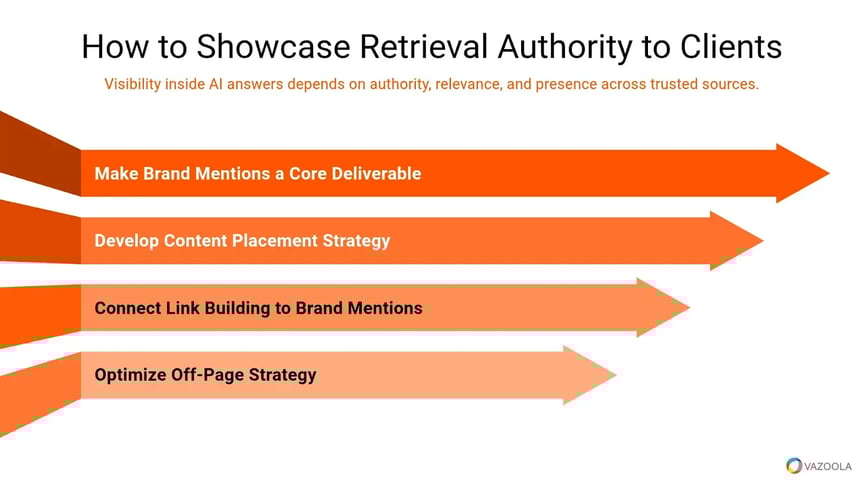
Agencies now need to think beyond rankings. Visibility inside AI answers depends on authority, relevance, and presence across trusted sources.
Brand Mentions as a Core Deliverable
Mentions signal relevance. AI systems often pull from sources that reference a brand within context. Mentions shouldn’t be treated as secondary outcomes. They should be planned and measured.
Content Placement Strategy
Placement matters as much as creation. Content must appear on platforms that AI systems trust. Industry publications, research-backed blogs, and high-authority sites improve retrieval chances.
Maintain strict entity alignment across all placements by using consistent descriptors, categories, and positioning for a brand. Conflicting labels across sources dilute retrieval signals and reduce the likelihood of being selected as a relevant source.
The Link Building and Brand Mention Connection
Links still matter, but mentions now carry equal weight. Co-occurrence and co-citation signals help AI understand relationships between brands and topics. Both signals support retrieval visibility.
A Combined Off-Page Strategy
A unified approach blends link building, digital PR, and brand mentions. Teams should align campaigns around topics, not just keywords. Consistency across multiple sources strengthens retrieval authority.
Best Practices for Implementing RAG Strategies
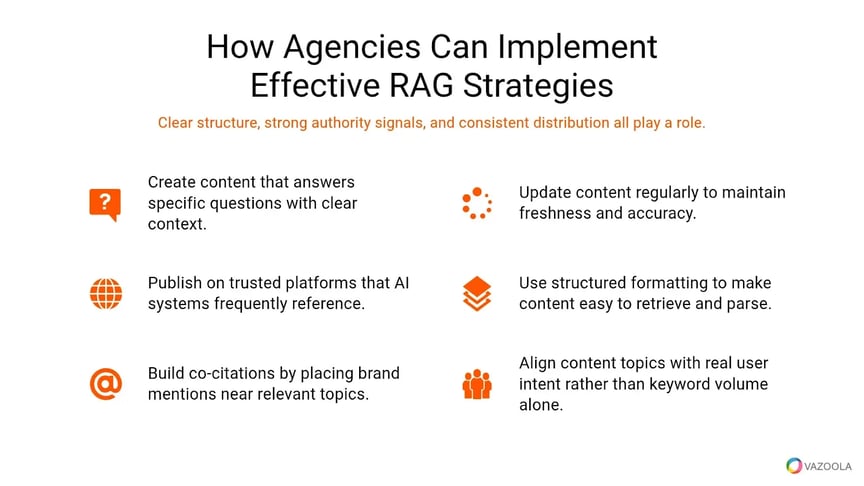
Teams can take practical steps to improve how content performs in RAG systems. Clear structure, strong authority signals, and consistent distribution all play a role:
-
Create content that answers specific questions with clear context.
-
Publish on trusted platforms that AI systems frequently reference.
-
Build co-citations by placing brand mentions near relevant topics.
-
Update content regularly to maintain freshness and accuracy.
-
Use structured formatting to make content easy to retrieve and parse.
-
Align content topics with real user intent rather than keyword volume alone.
Each step supports retrieval visibility. Together, they create a system that increases the likelihood of being cited.
RAG Is Reshaping Content Visibility—Are You Ready to Be Retrieved?
Content strategy continues to evolve—and rapidly, too. Rankings certainly do still matter, but they no longer tell the full story. Retrieval augmented generation introduces a new layer of visibility that teams simply can’t ignore.
Agencies that adapt will see stronger results across both search and AI-driven platforms. Strategies built on authority, relevance, and distribution will outperform those focused only on rankings.
Teams already producing strong content have a definite advantage. The next step involves placing that content where AI systems can find and trust it. In our experience, that shift often starts with rethinking how content earns mentions, citations, and authority across the web.
Here at Vazoola, our team focuses on helping brands build that kind of visibility through strategic placement, brand mentions, and scalable off-page campaigns that align with how AI systems retrieve information.
So the question is simple: if AI systems are deciding what gets seen, is your content positioned to be part of the answer?
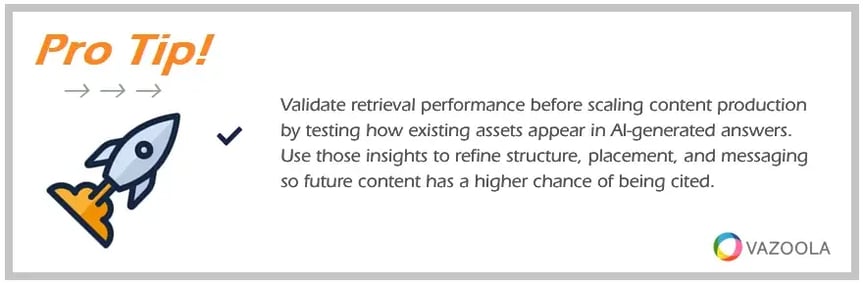
Validate retrieval performance before scaling content production by testing how existing assets appear in AI-generated answers. Use those insights to refine structure, placement, and messaging so future content has a higher chance of being cited.