

Aug 17, 2026

Casey Bjorkdahl is one of the pioneering thought leaders in the SEO community. In 2010, Casey co-founded Vazoola after working for a Digital Marketing Agency for five years in New York City. Vazoola is now one of the fastest growing and most widely recognized SEO marketing firms in the country.


A brand can say anything about itself, but AI search systems look for backup.
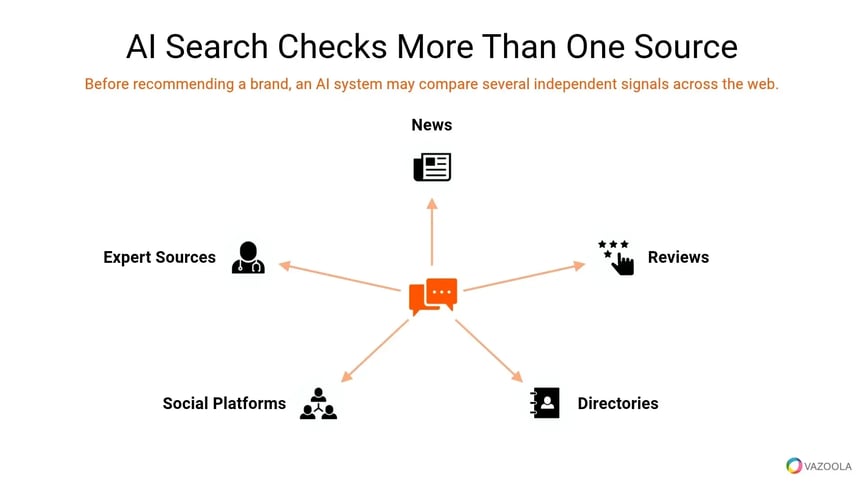
Before they place a company in an answer, AI tools may compare its claims with news coverage, reviews, directories, social platforms, expert commentary, and other accessible sources to see whether the broader web tells the same story.
That’s what’s known as LLM consensus: the agreement an AI system detects across those independent sources.
Financial Times reporting on AI search notes that AI agents seek corroborating evidence when evaluating brand claims.
LLM seeding puts information into circulation, while consensus determines whether enough independent sources support it to help the brand surface in AI-generated answers.
Key Takeaways
-
LLM consensus develops when independent sources describe a brand, product, or claim in compatible ways.
-
A single mention can establish awareness, but repeated corroboration creates a stronger signal.
-
No verified formula guarantees that a specific number of mentions will produce inclusion in AI answers.
-
Linked and unlinked mentions can both reinforce how AI systems understand a brand.
-
Agencies should measure source diversity, descriptive consistency, recommendation frequency, and cross-platform visibility.
Table of Contents
What Does LLM Consensus Mean?
LLM consensus is the agreement AI systems find across independent sources about a brand, product, or claim. It develops when publications, reviews, directories, expert interviews, and online discussions repeatedly connect the same brand with similar services, qualities, or areas of expertise.
The term isn't a documented ranking factor that works the same way across every large language model. ChatGPT, Claude, Gemini, Perplexity, and other platforms rely on different training data, search tools, source pools, and methods for choosing information.
LLM consensus also differs from traditional link authority. A backlink connects one webpage to another. Consensus reflects a wider pattern of agreement across the web, whether every mention includes a link or not.
Several factors can strengthen that pattern:
-
Source independence: The information appears on websites the brand doesn't own or control.
-
Topical relevance: Sources mention the brand in connection with its products, expertise, or audience.
-
Descriptive consistency: Multiple sources describe the brand’s services or strengths in similar ways.
-
Source diversity: Supporting information appears in publications, reviews, forums, databases, and other channels.
LLM seeding places information into the wider digital ecosystem. Consensus shows whether independent sources support the same basic message.
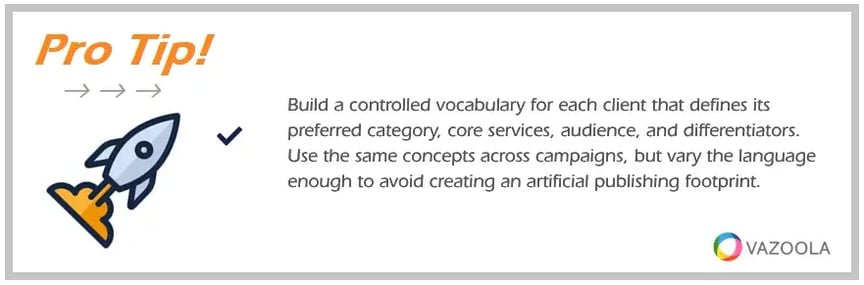
Build a controlled vocabulary for each client that defines its preferred category, core services, audience, and differentiators. Use the same concepts across campaigns, but vary the language enough to avoid creating an artificial publishing footprint.
The Research Behind the Consensus Effect
Research supports the broader idea behind LLM consensus: AI visibility depends on patterns across sources, not one universal signal.
The available data suggests that third-party coverage matters and source preferences differ by platform. Visibility in one AI system does not guarantee visibility in another.
As reported by Axios, Muck Rack analyzed more than 1 million prompts across ChatGPT, Claude, and Gemini. Its research on external sources informing AI answers found several patterns:
-
Third-party content dominated citations: About 96% of cited links came from communications and corporate affairs content, including journalism, government sources, academic research, corporate publishing, and user-generated material.
-
Source preferences varied by platform: ChatGPT cited news more heavily, while Claude leaned further toward academic, government, and technical sources.
-
Cross-platform overlap remained limited: MentionLayer’s AI SEO statistics for 2026 report that only 11% of cited domains appear across multiple AI platforms.
-
Brand mentions showed a stronger correlation with AI visibility: The same MentionLayer roundup reports that brand mentions correlate three times more strongly with AI visibility than backlinks.
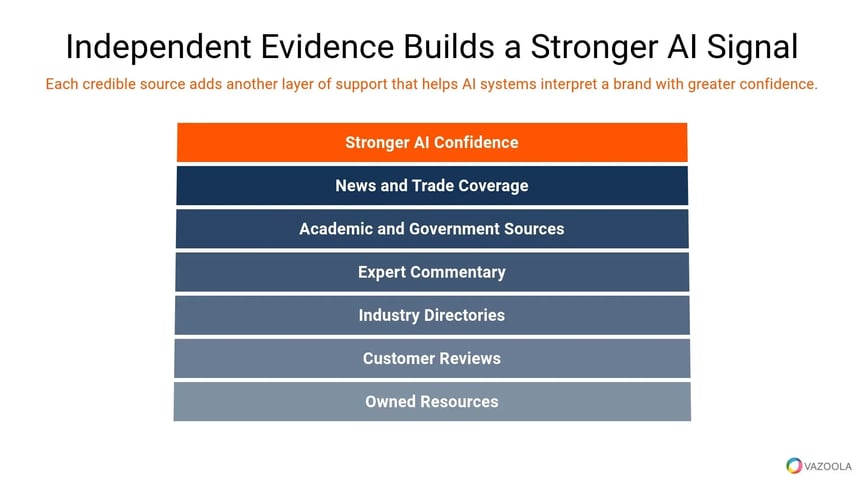
MentionLayer’s analysis of the consensus layer in AI search also reports that brands appearing across five or more independent source types receive recommendations more often than brands present in only one or two.
Agencies should treat five sources as a directional benchmark, not a guaranteed threshold, because the analysis doesn’t establish a universal formula.
Why One Brand Mention Is Rarely Enough
One relevant mention can introduce a brand to a topic, but it can’t establish broad agreement on its own.
A placement may sit behind a paywall, fall outside an AI platform’s search index, or describe the brand too vaguely to connect it with a clear category. Even a strong article may have limited influence when other sources describe the company differently.
Agencies shouldn’t treat consensus as a numbers game. Ten websites republishing the same press release don’t necessarily count as 10 independent signals. A smaller group of original articles, interviews, reviews, and expert references may create a stronger pattern because each source provides its own support.
Those mentions also need to reinforce a clear idea. They might highlight the company’s specialty, product category, audience, or proven result. Unrelated name-drops may increase visibility without helping AI systems understand what the brand represents.
Evaluate placements by how much new evidence they add, not just by domain authority or audience size. A niche source that independently verifies a specific capability may strengthen consensus more than another broad mention from a prominent publication.
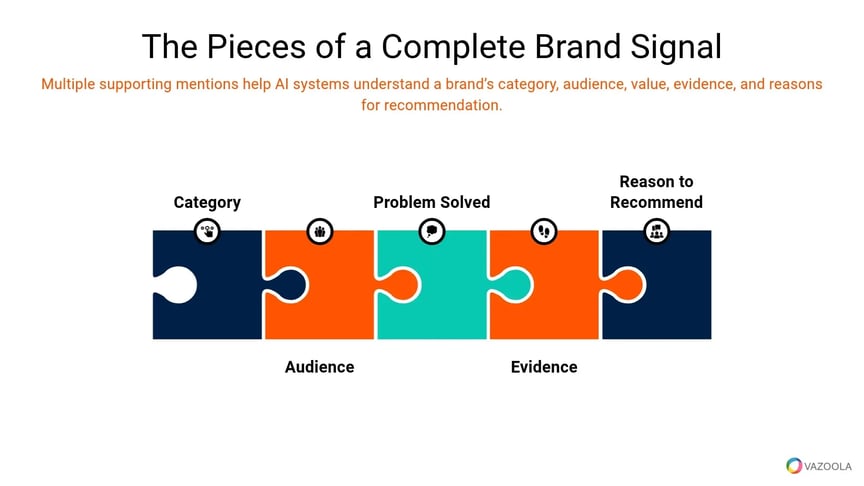
A useful mention should answer at least one practical question:
-
What does the brand do?
-
Who does it serve?
-
Which problem does it solve?
-
What evidence supports its claims?
-
Why might someone recommend it?
Mentions that answer those questions help AI systems connect the brand with a clear identity, category, and purpose.
How to Win LLM Consensus for a Brand
Agencies don’t need to replace their digital PR or content process. Instead, they need to organize those efforts around a clear plan for building and measuring agreement.
-
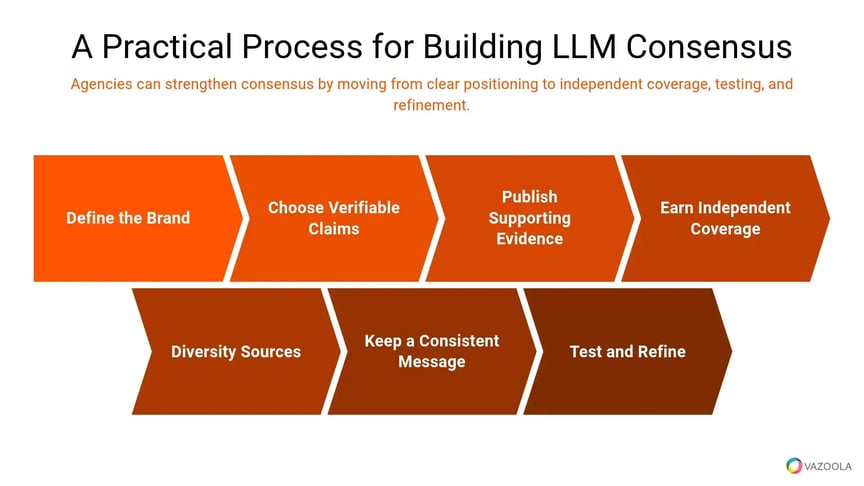
Define the brand clearly: Establish the preferred brand name, category, audience, main offering, and distinguishing qualities. Fix conflicting descriptions before trying to earn more coverage.
-
Choose claims that others can verify: Focus on product capabilities, original research, proven expertise, and measurable results. Broad claims such as “best in the industry” provide little value without evidence.
-
Publish supporting information on owned channels: Create clear definitions, data, executive insights, and proof points. Owned content gives publishers and AI systems an accessible reference point for those details.
-
Earn independent coverage: Use off-page brand mentions to reinforce important claims through relevant publications, interviews, directories, reviews, and online discussions.
-
Use a mix of sources: A balanced campaign may include trade journalism, expert commentary, original research, reputable databases, and user-generated content.
-
Keep the message consistent: Every source doesn’t need to use the same wording. The descriptions should still point to the same category, audience, services, and strengths.
-
Test and improve the results: Search for the brand across several AI platforms using different prompts. Review weak, inaccurate, or conflicting answers, then strengthen missing evidence through content and digital PR for AI search.
The framework should support existing campaigns rather than replace them. Digital PR helps agencies earn the coverage, while consensus shows whether those efforts have created a clear and recognizable pattern.
How to Measure Consensus Signals
Traditional ranking reports can’t show the full picture of AI visibility. Agencies need measurements that reveal how AI-generated answers describe, mention, and recommend brands.
A practical LLM consensus dashboard might track:
-
Mention frequency: How often the brand appears across selected prompts.
-
Recommendation frequency: How often the model recommends the brand instead of simply naming it.
-
Source diversity: How many independent websites and source types support the brand’s claims.
-
Descriptive consistency: Whether AI tools connect the brand with the intended category, audience, or benefit.
-
Sentiment: Whether the model presents the brand positively, neutrally, or negatively.
-
Citation frequency: How often the model cites the brand’s website or outside coverage.
-
Cross-platform agreement: Whether similar descriptions appear across ChatGPT, Claude, Gemini, Perplexity, and other tools.
-
Competitive share of voice: How often the brand appears compared with its competitors.
Agencies should also separate mentions from citations. An AI model can recommend a brand without linking to its website. It can also cite a company article while recommending a competitor. Both results matter, but they represent different types of visibility and influence.
Repeated testing is important because LLM answers can change from one search to the next. One successful response doesn’t prove stable visibility, while one missing mention doesn’t prove failure. Rather, agencies should repeat important prompts, vary the wording, and track the results over time.

Separate navigational prompts, category prompts, comparison prompts, and problem-based prompts when tracking AI visibility. Combining them into one score can hide whether a brand is merely recognized or actively recommended during buying decisions.
Common LLM Consensus Mistakes
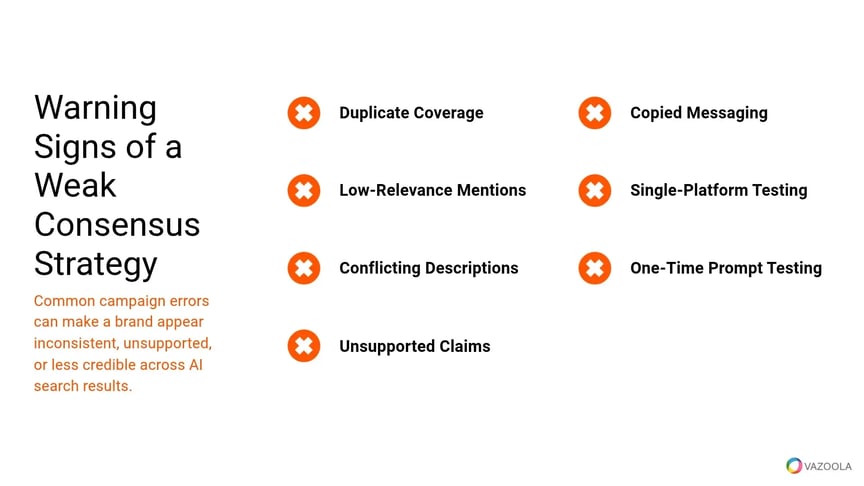
A high number of mentions can create the illusion of progress. Syndicated announcements, copied biographies, and low-quality directory listings may repeat a brand name without adding meaningful support.
Common mistakes include:
-
Counting several copies of the same press release as independent agreement.
-
Prioritizing quantity over relevance or source quality.
-
Pushing identical descriptions across multiple publishers.
-
Sharing unsupported statistics, awards, or performance claims.
-
Testing only one AI platform.
-
Treating one prompt response as a stable result.
-
Ignoring outdated listings or conflicting brand descriptions.
-
The strongest campaigns prioritize clear brand understanding over raw visibility. Accurate, useful confirmation provides more value than manufactured repetition.
FAQs About LLM Consensus Optimization
What’s the minimum number of sources an LLM needs for consensus?
No verified minimum applies to every brand, topic, or AI platform. Agencies should focus on earning enough relevant, independent mentions to create a clear and repeatable pattern instead of chasing an arbitrary number.
Relevance, independence, accessibility, and consistency can matter as much as the total number of mentions.
Does LLM consensus work the same across ChatGPT, Claude, Perplexity, and other models?
No. Each platform uses different models, search tools, source pools, and methods for building answers. One system may rely heavily on current news, while another may favor academic research, forums, or its own search index.
Can you build brand consensus through mentions, or must they be linked?
Yes. A clear and relevant unlinked mention can strengthen the connection between a brand and a topic.
Links still help with discovery, attribution, referral traffic, and traditional SEO. AI systems, however, can also understand text that names and describes a brand without linking to its website.
How long do results take to start showing up?
No standard timeline exists. Results depend on publication schedules, crawling, indexing, search access, model updates, existing signals, and competing information.
Agencies should measure progress over weeks and months instead of expecting immediate changes. New coverage may appear quickly in one search-connected platform but take longer to influence another.
Use cross-platform answer tracking to document where AI platforms disagree, not simply whether they mention the brand. Repeated differences can reveal which claims need stronger sourcing, clearer evidence, or better alignment across public-facing assets.
Build a Brand Story That Survives the Cross-Check
LLM consensus changes how agencies should define success. One article, citation, or recommendation can help, but lasting visibility comes from independent sources telling a clear and supportable story about the brand.
The strongest result is a brand description that remains accurate when an AI system checks one source against another.
Ready to make your brand easier for AI systems to recognize, understand, and recommend?
Vazoola’s brand mentions service can help you earn credible, independent coverage that strengthens consensus signals across the web.
Start building a brand story that holds up wherever AI search looks next.
Treat consensus building as an evidence program rather than a publicity campaign. Each new placement should either confirm a priority claim, correct a conflicting description, or expand the number of independent source types supporting the brand.