

Aug 18, 2026

Casey Bjorkdahl is one of the pioneering thought leaders in the SEO community. In 2010, Casey co-founded Vazoola after working for a Digital Marketing Agency for five years in New York City. Vazoola is now one of the fastest growing and most widely recognized SEO marketing firms in the country.


Link building has an image problem lately.
Clients have heard the rumors that backlinks don’t matter anymore, Google no longer values them, or AI search has made traditional rankings obsolete. Some have actually paid for campaigns that produced a long spreadsheet filled with links and no meaningful business results.
Their hesitation isn’t hypothetical, and it isn’t unreasonable, either. Agencies and marketing leaders hear these objections in real sales calls, strategy meetings, and performance reviews.
The best response is a clear explanation of what modern link building does, what the evidence supports, and how it fits into a broader authority strategy.
Key Takeaways
-
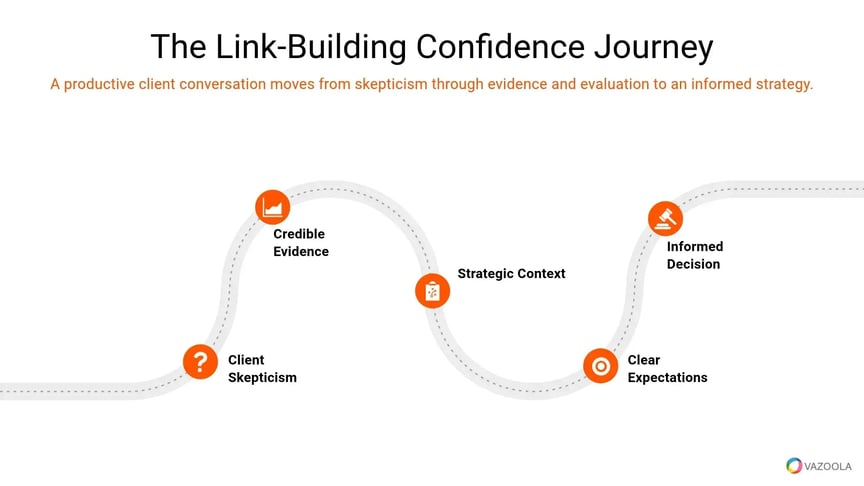
Client skepticism often comes from poor past experiences, conflicting advice, or unclear reporting.
-
Google still uses link analysis and PageRank as part of its core ranking systems.
-
Relevant, credible links usually offer more value than a large volume of weak placements.
-
Effective client conversations connect link building to competitive gaps, business goals, and measurable outcomes.
Table of Contents
-
Do Backlinks Still Impact Rankings? Here’s What the Data Says
-
How to Talk to Clients About Link Building (The Conversation Script)
Why Clients Question Link Building
Clients rarely question link building without a reason.
Some previously worked with agencies that placed links on irrelevant blogs, empty directories, or websites created mainly to sell placements. Others received reports that celebrated link totals but never connected those links to rankings, traffic, leads, or revenue.
Conflicting industry commentary makes the issue even harder to understand. One expert says links are dead, then another treats them as the solution to every SEO challenge. Neither position gives a client a realistic picture of how search performance works.
AI search has introduced yet another concern. Clients see generated summaries occupying more space in search results, and they understandably wonder whether earning traditional rankings still matters.
Available data on search behavior doesn’t ease clients’ minds, either.
CALLOUT BOX: Users clicked on traditional search results 8% of the time when an AI summary was displayed, compared to 15% of the time when it wasn’t. — Pew Research Center
Pew Research Center found that users clicked a traditional search result during 8% of visits that displayed an AI summary, compared with 15% of visits without one. Search behavior is certainly changing, but the shift makes third-party authority and visibility more important, not less relevant.
Some clients have also tried link building before and seen little improvement. The problem may not have been link building itself.
Weak sources, irrelevant placements, poor target-page selection, or a lack of supporting on-page work can all limit a campaign’s impact.
Quality matters more than ever, which is why weak link building often fails while relevant, well-planned campaigns can still produce meaningful results.
Do Backlinks Still Impact Rankings? Here’s What the Data Says
Skeptical clients usually want more than reassurance that links still matter. They want to know what Google says, what campaign data shows, and how backlinks contribute to results when so many other ranking factors are involved.
The evidence supports a measured answer: Backlinks still influence search performance, but their value depends heavily on their relevance, quality, and strategic use.
The Correlation Between Links and Rankings (What Studies Show)
Google doesn’t publish the exact weight assigned to every ranking factor. However, the company’s documentation provides a straightforward answer to the central question.
Google’s guide to its ranking systems explains that its systems analyze how pages link to one another. The guide also confirms that PageRank remains part of Google’s core ranking systems.
Links aren’t the only factor. Content quality, intent alignment, technical accessibility, usability, and other signals also shape performance. A strong backlink won’t rescue a page that offers little value, but excellent content can still struggle when competing pages have much stronger third-party authority.
Agencies can strengthen the argument by pairing outside research with campaign-specific evidence.
An anonymized case study can show the client’s starting position, the types of links earned, changes in referring domains, ranking movement, and traffic growth. The example should also explain what other SEO work happened during the same period, so the client doesn’t receive an oversimplified account.
A simple table can help clients distinguish between evidence that shows campaign activity and evidence that shows results.
|
Measurement |
What It Tells the Client |
|
New referring domains |
Whether the site is earning authority from additional sources |
|
Source relevance |
Whether links come from publications connected to the client’s topic |
|
Target-page rankings |
Whether priority pages are becoming more competitive |
|
Organic traffic |
Whether improved visibility is attracting more search visitors |
|
Leads or conversions |
Whether search gains are supporting business outcomes |
Why Link Building Quality Matters More Than Quantity
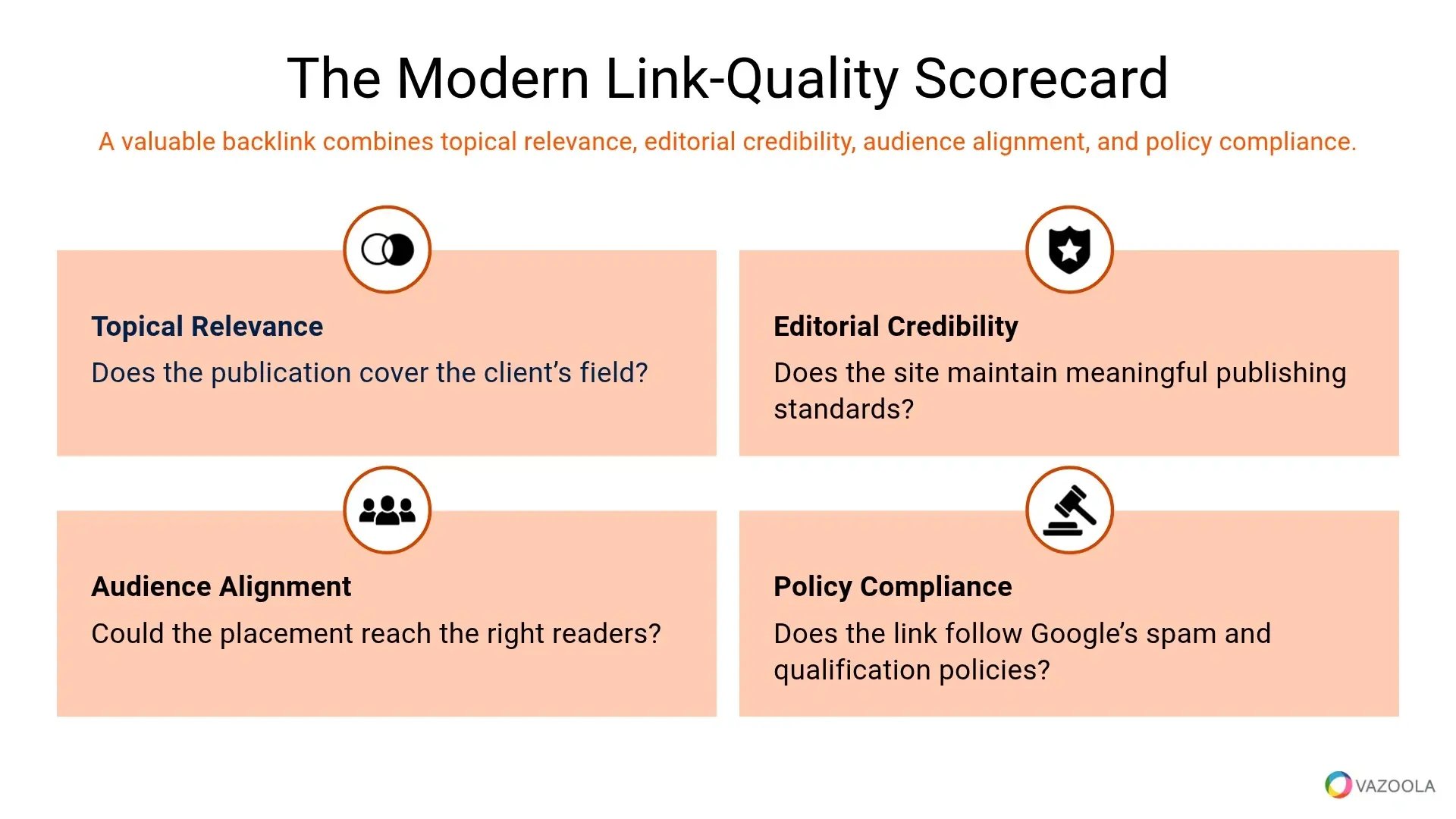
Modern link building isn’t about collecting the highest possible number of placements. It focuses on topical relevance, editorial quality, audience overlap, and source credibility.
A link from a respected publication that covers the client’s field sends a clearer signal than several links from unrelated directories or thin blogs. The placement should make sense to a human reader before anyone evaluates its potential SEO value.
Quality also helps explain why a client’s previous campaign may have failed. A provider can technically deliver dozens of backlinks without strengthening the authority of an important page. The sources may have lacked relevance, received little traffic, or existed mainly to publish paid content.
Digital PR can support the same broader objective. It can generate editorial links, brand mentions, expert citations, and third-party recognition. Together, those signals can strengthen a brand’s off-page authority and support its visibility in AI search.
Quality, however, requires policy compliance. Links created primarily to manipulate rankings may violate Google’s spam policies, regardless of the publishing site’s metrics.
The Real Cost of Not Doing Link Building
Clients often ask how much link building costs. A stronger conversation also considers the cost of doing nothing.
Suppose a direct competitor earns five relevant referring domains each month while the client earns none. After a year, the competitor could have 60 new referring domains supporting its content, brand, and search visibility. The client would then need to close a much larger gap before competing for the same terms.
The opportunity cost can affect more than one keyword. Stronger authority can help competitors support product pages, service pages, research, thought leadership, and future content. Their earlier investment may continue working while the client remains dependent on on-page changes alone.
 Use a backlink analysis tool to compare referring-domain growth across three direct competitors. Look for consistent new placements, links to priority pages, and repeated coverage from industry-relevant sources.
How to Talk to Clients About Link Building (The Conversation Script)
Instead of a word-for-word rebuttal, use a conversation structure that validates the concern, introduces evidence, and connects the tactic to the client’s larger goals.
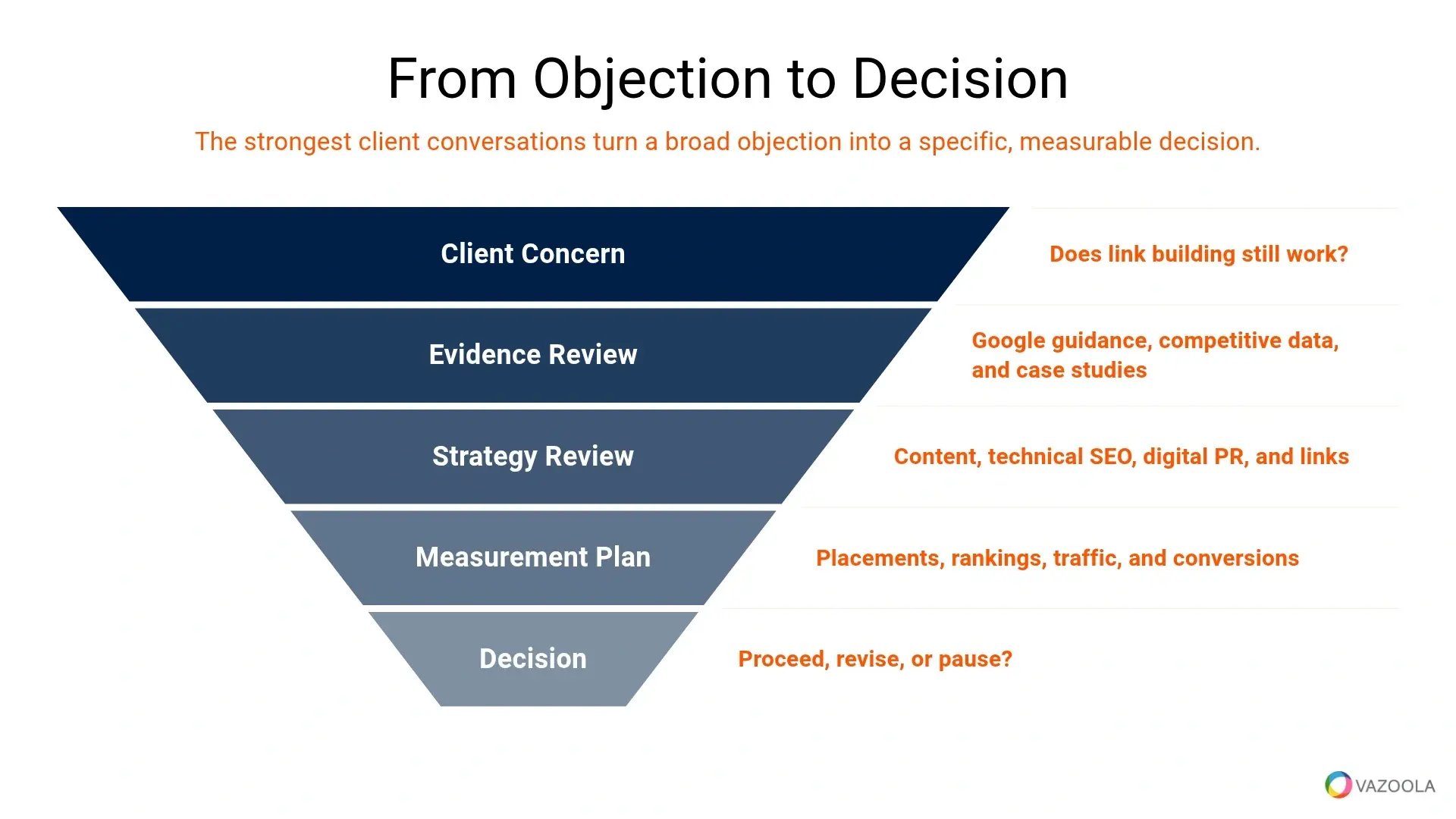
Step 1: Acknowledge Their Concern (Don’t Dismiss It)
Start by agreeing that the client should ask about ROI. A response such as, “You’re right to question whether link building will contribute to measurable growth,” lowers the tension immediately.
Acknowledgment doesn’t mean conceding that link building has no value, but it does show the client that the agency understands the risk and won’t hide behind vague claims about authority.
Step 2: Show Them Proof (Data + Case Study)
Use one verified data point and one relevant campaign example. Too many statistics can make the conversation feel rehearsed, while a single unsupported success story can sound like an exception.
Explain the client’s starting point, the target page, the competitive challenge, the type of links earned, and the outcome. An anonymized example might show how a page moved from position four to position two after several months of targeted link acquisition and supporting SEO work.
Keep the explanation precise. Don’t imply that the links alone caused every improvement unless the available data supports that conclusion.
Step 3: Reframe Link Building as Part of Comprehensive Off-Page Strategy
Don’t sell link building as an isolated service that fixes every search problem. Show how it works alongside content, technical SEO, brand mentions, digital PR, and other off-page authority signals.
A useful frame is simple: Links aren’t everything, but they’re foundational. They help credible third parties connect the client’s brand and content to relevant topics.
The same authority strategy can support visibility as search evolves. Links, citations, media coverage, and expert mentions can strengthen the external recognition surrounding a brand without turning every discussion into a promise about AI results.
Step 4: Set Realistic Expectations
Links don’t work like an on-off switch. A strong campaign may take several months before rankings show meaningful movement, and competitive industries may take longer.
Clients should know what will be measured during that period. Reports can track new placements, referring-domain growth, source relevance, target-page rankings, organic traffic, and conversions. Clear leading indicators help the client see progress before the final business outcomes appear.
.webp?width=881&height=291&name=PRO%20TIP%20Agree%20on%20reporting%20definitions%20before%20the%20campaign%20begins%20(1).webp) Agree on reporting definitions before the campaign begins. Decide what counts as a relevant link, which pages matter most, and which outcomes will determine whether the strategy is working.
Agree on reporting definitions before the campaign begins. Decide what counts as a relevant link, which pages matter most, and which outcomes will determine whether the strategy is working.
How to Answer the 4 Most Common Link Building Objections
Most objections sound reasonable because they contain part of the truth. Google does use many signals, bad link building does fail, AI is changing search behavior, and manipulative tactics can be spammy. Effective responses acknowledge the valid concern before explaining what the objection leaves out.
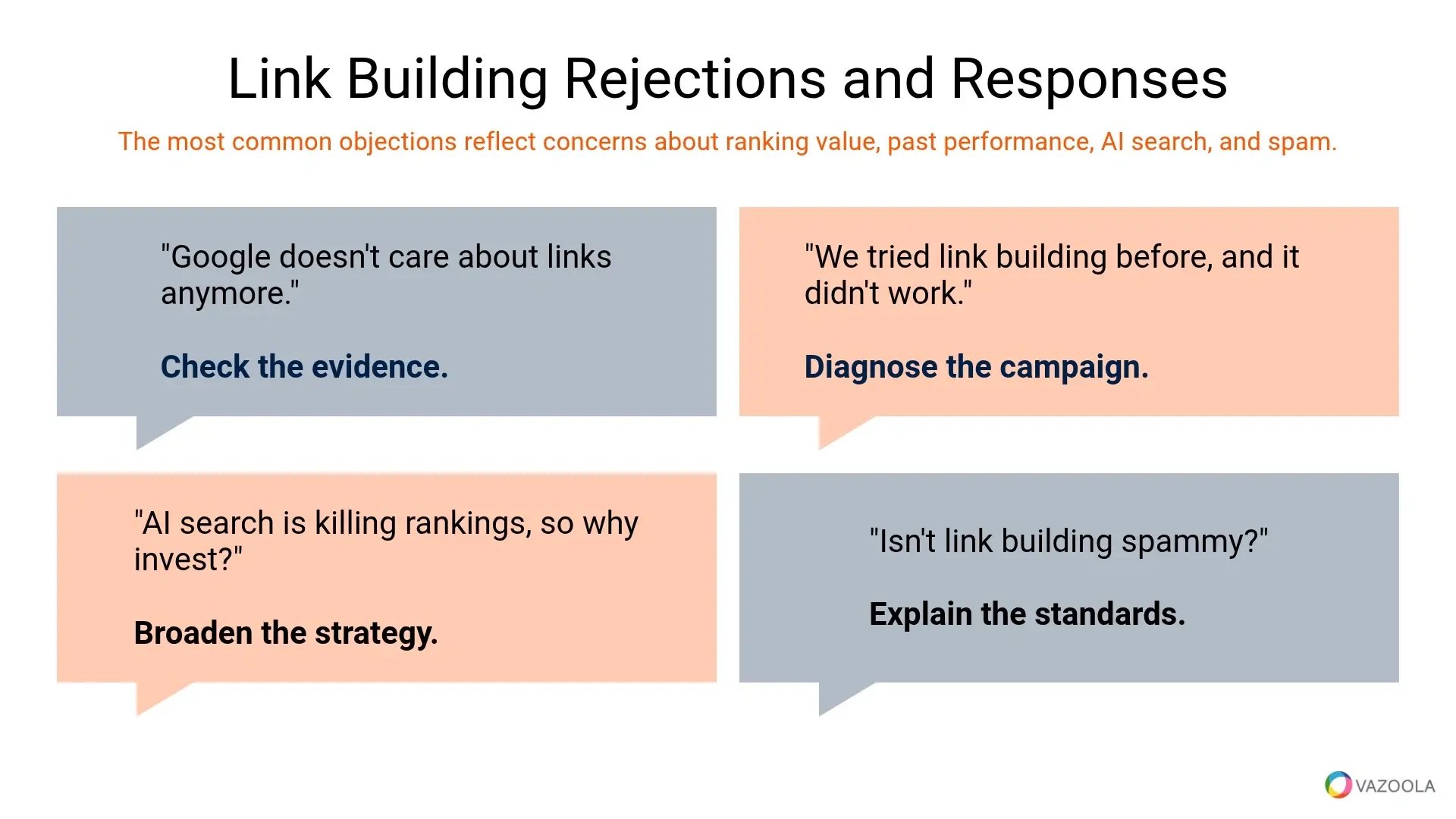
“Google Doesn’t Care About Links Anymore”
Google uses many ranking signals, but its own documentation still identifies link analysis and PageRank as parts of its ranking systems. Links don’t guarantee visibility, yet saying Google no longer considers them goes further than the evidence supports.
The better explanation is that links matter within a larger system. Their value depends on the source, relevance, target page, competitive environment, and quality of the content they support.
“We Tried Link Building Before and It Didn’t Work”
Ask what the previous provider built, where the links pointed, and how the campaign measured success. A report showing 50 new links doesn’t reveal whether any of them came from credible, relevant websites.
Previous failure may also reflect poor timing or weak foundations. Link building won’t solve major technical issues, missing search intent, or uncompetitive content.
“AI Search Is Killing Organic Rankings, So Why Invest in Links?”
AI search is changing click behavior, but brands still need credible sources, external recognition, and discoverable content. Links and editorial mentions can expand the third-party coverage and recognition surrounding a business.
Agencies shouldn’t promise that every backlink will produce an AI citation. The stronger position is that link building supports the authority foundation needed across traditional search, digital PR, and emerging discovery experiences.
“Isn’t Link Building Spammy?”
Manipulative link schemes can violate Google’s spam policies. Responsible link building focuses on relevant editorial opportunities, useful resources, expert contributions, legitimate outreach, and properly qualified sponsored relationships.
A simple test can clarify the distinction. Would the placement still offer value if ranking algorithms didn’t exist?
A relevant article that introduces the brand to the right audience may pass that test. A keyword-stuffed link on an unrelated site probably won’t.
 Keep a small portfolio of representative placements ready for client conversations. Showing two or three relevant, editorially sound examples usually explains quality faster than a long discussion about domain metrics.
When Link Building Is the Right Move (And When It’s Not)
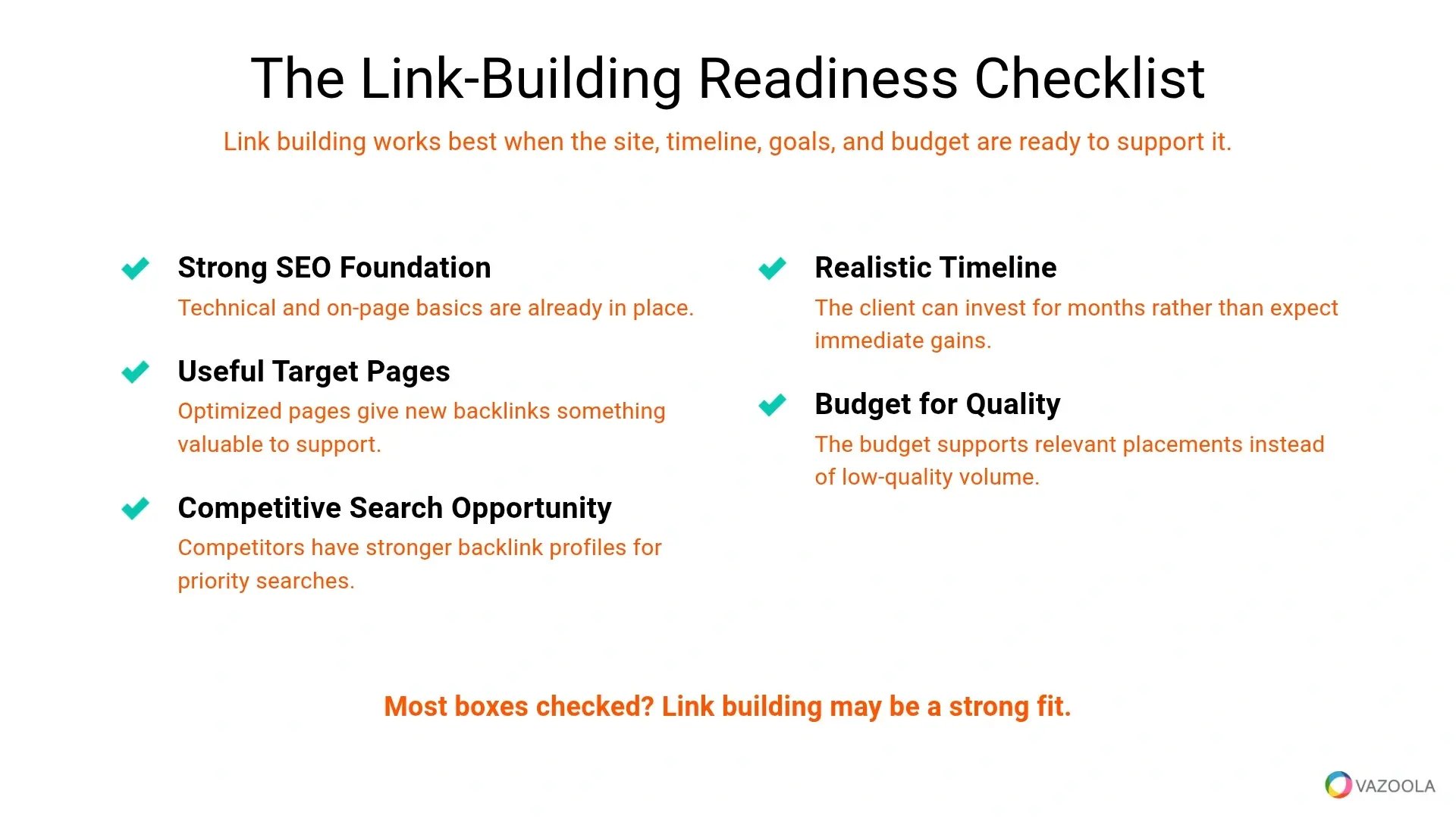
Link building works best when it supports a site that already has a solid SEO foundation. It’s less effective when agencies use it to compensate for weak content, unresolved technical problems, or unrealistic timelines.
Explaining when to recommend the tactic, and when to hold back, shows clients that the strategy is based on fit rather than a sales quota.
Good Fit for Link Building
Link building is often a strong fit when the client already has useful content, sound technical SEO, and clear target pages. The client should also operate in a competitive space where stronger domains consistently outrank otherwise comparable pages.
A realistic timeline matters here. Clients prepared to invest for six to 12 months can evaluate the strategy more fairly than clients expecting dramatic results within a few weeks.
The client should also value quality over speed. A smaller number of relevant, credible links may accomplish more than a large volume of easy placements.
When to Pump the Brakes
Link building may not be the best starting point when a site has serious technical problems, weak content, or poorly optimized priority pages. Fixing those issues first gives future links something worthwhile to support.
A client that needs results within 60 days may also need a different primary channel. Paid media, conversion improvements, or other short-term tactics may better match the immediate goal.
Budget can create another limitation. Cheap, high-volume link packages often reproduce the same problems that made clients skeptical in the first place. Waiting until the client can support a credible campaign may be better than lowering standards to hit a monthly number.
Honesty strengthens the recommendation. Telling a client to pause link building can build more trust than pushing the tactic before the business is ready.
Moving From Skepticism to Strategy
Resist slipping into lecture mode when clients ask, “Does link building work?” Give them a clear explanation of what link building can accomplish, what it can’t fix, and how their progress will be measured.
The strongest conversation connects backlinks to content quality, digital PR, competitive authority, and emerging search visibility. Agencies broadening that discussion can learn how to sell AI visibility to existing SEO clients so they can explain how link building supports a wider authority strategy.
Vazoola helps agencies and marketing teams pursue relevant placements with clear goals and measurable reporting. The next step is identifying which pages need greater authority and which publishers can credibly support them.