

Jul 13, 2026

Casey Bjorkdahl is one of the pioneering thought leaders in the SEO community. In 2010, Casey co-founded Vazoola after working for a Digital Marketing Agency for five years in New York City. Vazoola is now one of the fastest growing and most widely recognized SEO marketing firms in the country.


A strange thing is happening in digital marketing.
Two companies can target the same audience, publish similar content, and pursue the same keywords. Yet one consistently appears in Google results, gets mentioned in industry publications, and shows up in AI-generated answers. The other barely gets noticed.
So, what gives?
The difference often comes down to content coverage.
Traditional content gap analyses were designed to uncover keywords and topics competitors rank for that you don't. That still matters. Yet a growing share of discovery now happens through ChatGPT, Gemini, Claude, Perplexity, and other AI platforms.
A content strategy focused on rankings alone can leave major visibility opportunities untapped.
The same gaps keeping a site from ranking are often keeping a brand out of AI-generated answers. In this guide to content gap analysis, we explain how to identify both, prioritize the opportunities that matter most, and build a stronger visibility strategy across search and AI.
Key Takeaways About Content Gap Analyses
-
Content gap analysis reveals missing topics, keywords, and audience questions that competitors cover but your site does not.
-
Search gaps and AI visibility gaps often overlap, making them valuable opportunities to prioritize.
-
Effective gap analysis SEO focuses on topics and intent, not just individual keywords.
-
Regular audits help improve rankings, brand visibility, and authority across search engines and AI platforms.
Table of Contents
What a Content Gap Analysis Actually Tells You
What is a content gap? A content gap is any topic, keyword, or audience question your competitors cover and you don't. It can show up as a missing page, a thin page, or an absence from the sources search engines and AI platforms pull from when they answer a question.
What is a content gap analysis? At its core, a content gap analysis is a structured comparison between the content currently available on a website and the content needed to rank, earn visibility, and get cited.
Traditionally, marketers used SEO gap analysis to identify keywords competitors ranked for while their own sites did not. Content gap analysis tools like Ahrefs and Semrush made the process straightforward by highlighting ranking opportunities across competing domains.
Studies continue to show that competitor keyword analysis remains one of the most effective ways to uncover untapped traffic opportunities.
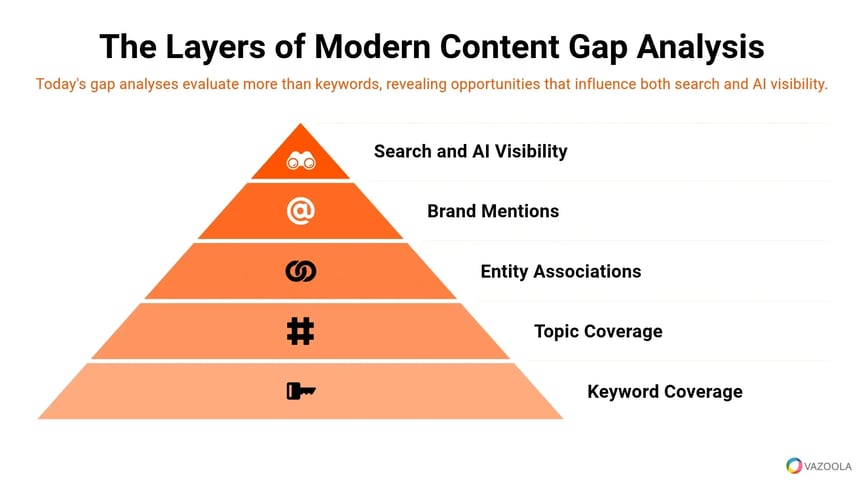
Still, today's version goes further. Modern content gap analyses examine not only keyword gaps but also topic coverage, entity associations, and brand presence within the content ecosystems that AI systems use to formulate their answers.
The shift reflects changing user behavior. According to a 2025 survey from the Reuters Institute, a growing share of users now turn to AI chatbots for news and information discovery, particularly among younger audiences.
As discovery channels expand beyond traditional search engines, marketers need to understand not only where they rank but also where their brands appear in AI-generated responses that surface information differently than traditional search results.
The Two Gaps That Matter Now
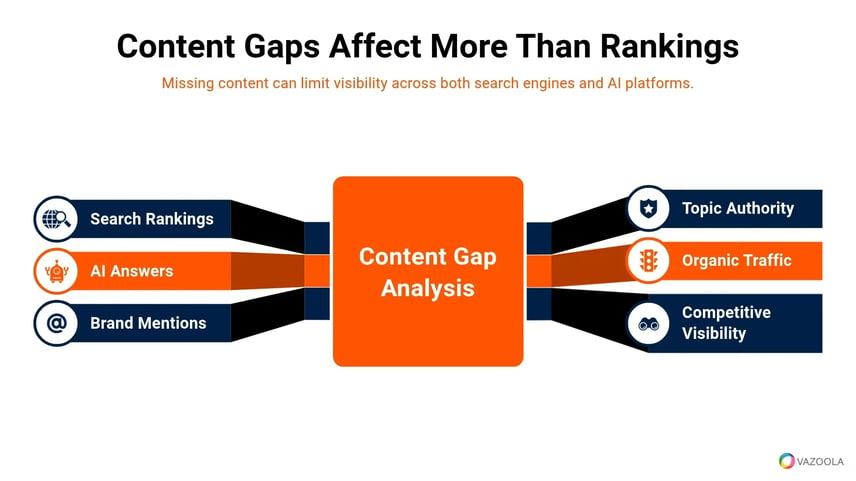
Most content gap analyses focus exclusively on rankings. That approach still provides value, but it overlooks another growing source of visibility: AI-generated answers.
Understanding both types of gaps helps marketers identify opportunities that impact search performance and AI visibility at the same time.
The Search Gap
Search gaps remain the foundation of most content strategies.
These gaps typically fall into three categories:
-
Keyword gaps where competitors rank and your site does not.
-
Topic gaps where entire subject areas are missing from your content library.
-
Intent gaps where user needs are underserved across informational, commercial, or navigational searches.
Many organizations focus heavily on keywords while overlooking broader topic coverage. Search engines increasingly reward comprehensive topical authority rather than isolated pages targeting individual terms.
The AI Visibility Gap
AI visibility introduces a different challenge.
Large language models often associate brands with specific topics based on the content, citations, mentions, and sources available across the web. If a brand rarely appears in authoritative discussions around a topic, it becomes less likely to appear in AI-generated responses related to that topic.
A 2025 seoClarity study found that 94% of keywords with Google AI Overviews had at least one citation overlap with the top 20 organic search results. The finding reinforces an important point: AI visibility is often connected to the authority, relevance, and topic signals brands build through search long before someone enters a prompt.
Many marketers assume technical fixes such as schema markup or page speed improvements will solve the problem. Technical SEO helps, but visibility gaps frequently stem from missing content, missing authority, and missing brand mentions.
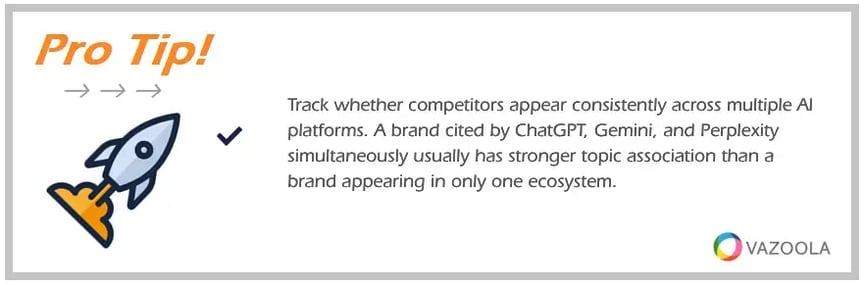
Track whether competitors appear consistently across multiple AI platforms. A brand cited by ChatGPT, Gemini, and Perplexity simultaneously usually has stronger topic association than a brand appearing in only one ecosystem.
How to Run a Search-Focused Content Gap Analysis
A search-focused content gap analysis helps uncover opportunities competitors are already capturing.
The process is straightforward when approached systematically, and it often reveals high-value topics that deserve immediate attention.
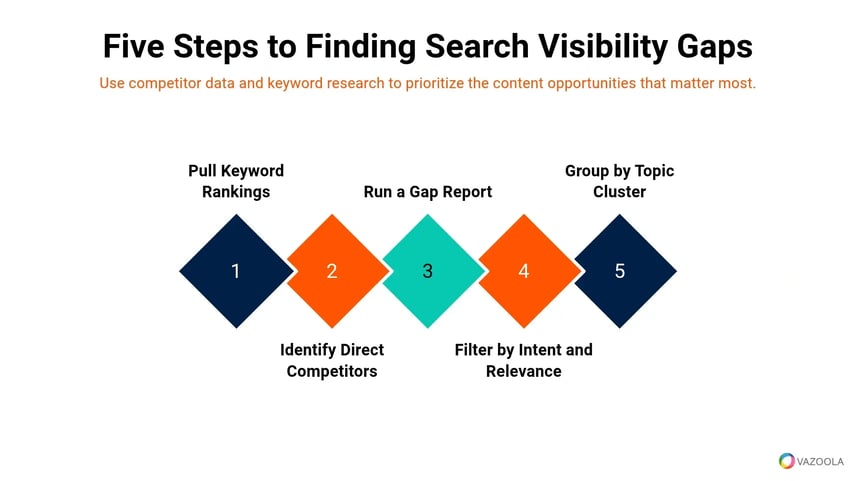
Follow these five steps to identify and prioritize the most meaningful gaps.
Step 1: Pull Current Keyword Rankings
Begin with data from Google Search Console, Ahrefs, or Semrush.
Document current rankings, impressions, and clicks. Establishing a baseline makes it easier to identify meaningful opportunities later.
Step 2: Identify Three to Five Direct Competitors
Choose competitors that target the same audience and rank for similar topics.
Avoid comparing against massive publishers that operate on a completely different scale. Focus on realistic competitors competing for the same visibility.
Step 3: Run a Gap Report
Most major SEO tools include keyword gap reports.
Look for keywords where competitors rank within positions 1 through 20 while your site does not rank at all. These opportunities often represent the quickest wins.
For teams evaluating platforms, resources for agency content analysis marketing tools can help identify solutions that support competitive gap analysis and keyword research workflows.
Step 4: Filter by Intent and Relevance
Not every keyword deserves attention.
Some terms generate traffic but have little commercial value. Others attract audiences that do not align with business goals. Prioritize relevance over volume.
Step 5: Group Gaps by Topic Cluster
Individual keywords rarely deserve standalone pages.
Group related terms into broader themes and content clusters. Topic-level planning creates stronger content assets and helps build authority across entire subject areas.
How to Run an AI Visibility Gap Analysis
Search rankings tell only part of the story.
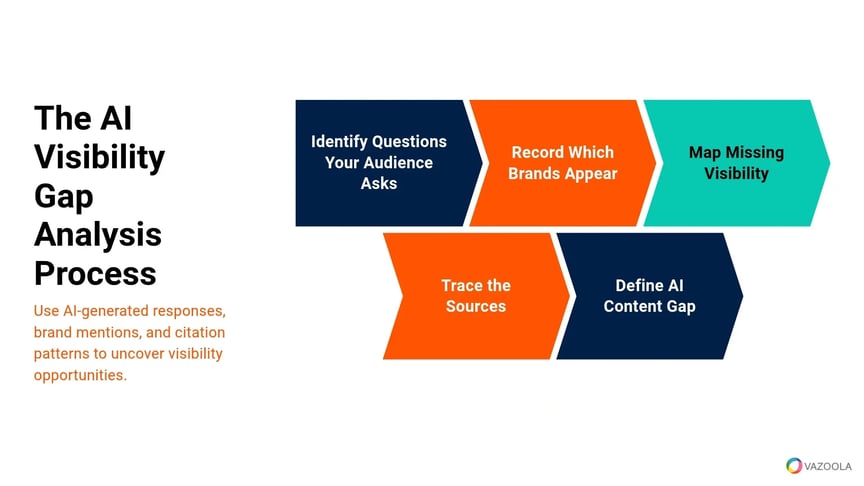
Brands increasingly need to understand how they appear in AI-generated responses and recommendation engines. An AI visibility gap analysis helps identify where competitors are earning mentions and where your brand is absent from important conversations.
Step 1: Identify the Questions Your Audience Asks AI Platforms
Start with prompts commonly entered into ChatGPT, Perplexity, Claude, Gemini, and similar tools.
Focus on questions prospects ask before making decisions. These often reveal different opportunities than traditional keyword research.
Step 2: Record Which Brands Appear
Run the prompts and document which companies receive mentions, citations, or recommendations.
Patterns often emerge quickly. Some brands appear repeatedly because they are strongly associated with specific topics.
Step 3: Map Missing Visibility
Compare cited brands against your own visibility.
Look for recurring situations where competitors appear but your brand does not. Those gaps often reveal authority deficits rather than content deficiencies alone.
Step 4: Trace the Sources
Examine the content and sources supporting those competitor mentions.
Look for industry publications, research reports, expert roundups, media coverage, and authoritative resources that reference competitors.
Step 5: Define the AI Content Gap
The missing mentions, missing topics, and missing authoritative placements become the AI visibility gap.
Many organizations find value in strategies focused on brand mentions and LLM seeding because both help strengthen topic associations that influence AI-generated responses.
Prioritizing What to Build First
Once gaps have been identified, the next challenge is deciding where to invest resources. Some opportunities can drive meaningful business results, while others may generate traffic without supporting broader goals.
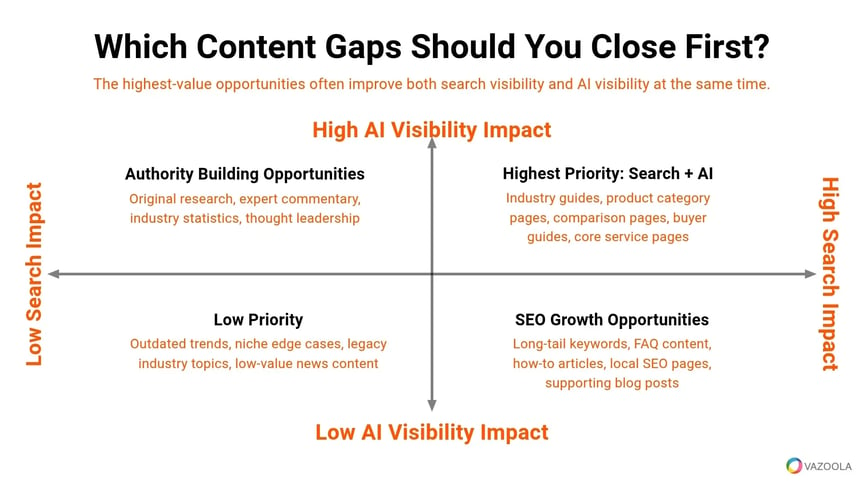
A prioritization framework helps separate high-impact opportunities from distractions since not every gap deserves immediate action.
Evaluate opportunities using three factors:
-
Search volume.
-
AI citation frequency.
-
Commercial relevance.
When a topic appears in both search and AI analyses, it becomes a high-priority opportunity.
Search-only gaps often require content creation, optimization, and link acquisition.
AI-only gaps frequently require brand visibility efforts, digital PR campaigns, and strategic mention placements.
A simple decision framework works well:
-
High search volume + High AI visibility opportunity = Highest priority.
-
High search volume + Low AI impact = SEO-focused initiative.
-
Low search volume + High AI impact = Authority-building initiative.
Closing the Gap: What to Actually Do With the Results
Finding gaps is only useful if the insights lead to action. The next steps depend on whether the opportunity is primarily a search gap, an AI visibility gap, or a combination of both.
Organizations that act systematically often see stronger results than those chasing isolated keywords or trends.
For Search Gaps
Start by strengthening the content foundation.
Create missing content, expand thin pages, and update outdated resources. Comprehensive content generally performs better than fragmented coverage of related topics.
Next, support those pages through internal linking and backlink acquisition. Authority remains a major ranking factor across competitive industries.
For AI Visibility Gaps
AI visibility requires a broader approach.
Seek opportunities to earn mentions within existing authoritative content covering target topics. Publish original research, expert insights, and unique perspectives that AI systems can easily reference.
Digital PR campaigns, editorial placements, brand mentions, and white-label link building services can strengthen topic associations over time and improve visibility beyond owned properties.
When closing a major gap, publish supporting assets alongside the primary page. FAQs, expert commentary, original data, and industry examples help establish topical depth faster than a single piece of content.
How Often to Run a Content Gap Analysis
Content gaps aren’t static. Competitors publish new content, search behavior evolves, and AI systems continually incorporate new information. Regular reviews help ensure opportunities don’t remain undiscovered for long.
Search-focused analyses work well on a quarterly schedule or after major competitor content initiatives.
AI visibility audits benefit from monthly reviews. Citation patterns, answer formats, and source preferences can evolve quickly as AI systems update and new content enters the ecosystem.
Track performance over time by monitoring:
-
Keyword rankings
-
Organic traffic growth
-
Topic coverage expansion
-
Brand mentions
-
AI citations
-
Referral traffic from earned placements
Create a weighted scoring model instead of relying on search volume alone. Many teams use a formula combining traffic potential, conversion potential, ranking difficulty, and AI visibility opportunity to prioritize investments more accurately.
Build a Strategy That Closes Both Gaps
The most effective content strategies no longer separate SEO from AI visibility.
Search gaps reveal where content is missing. AI visibility gaps reveal where authority and recognition are missing. Together, they create a more complete view of how audiences discover information.
Organizations that close both gaps gain more than rankings. They increase the likelihood of appearing wherever people search for answers.
Vazoola helps organizations address both sides of the equation through backlink acquisition strategies that support search visibility and brand mention campaigns that strengthen AI visibility.
As search and AI continue to converge, the brands that identify and close both gaps will be the ones most likely to remain visible.
Measure success using visibility share, not rankings alone. A page can rank well yet fail to generate citations, mentions, or conversions. The strongest strategies track search presence and AI presence as complementary metrics rather than separate initiatives.