

Jun 18, 2026

Casey Bjorkdahl is one of the pioneering thought leaders in the SEO community. In 2010, Casey co-founded Vazoola after working for a Digital Marketing Agency for five years in New York City. Vazoola is now one of the fastest growing and most widely recognized SEO marketing firms in the country.


A few years ago, agency pitches focused almost entirely on rankings, backlinks, and traffic growth.
Those days are gone.
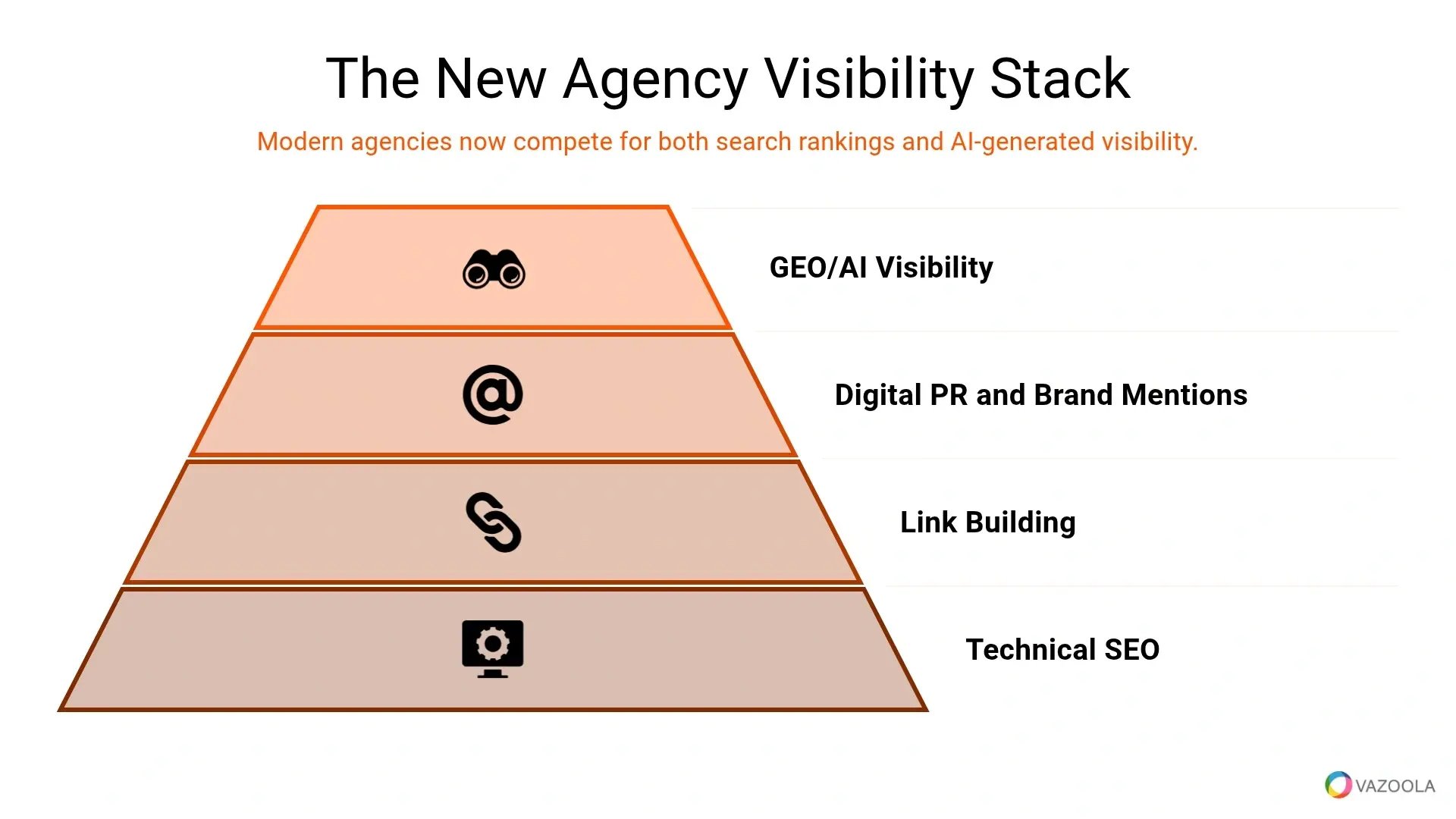
Now—once a client asks, “Will our brand appear in ChatGPT answers?”—the conversation changes fast. Many agencies feel pressure to bolt generative engine optimization (GEO) strategies onto existing services as if it requires an entirely separate operation.
Would you believe that most already have the foundation in place?
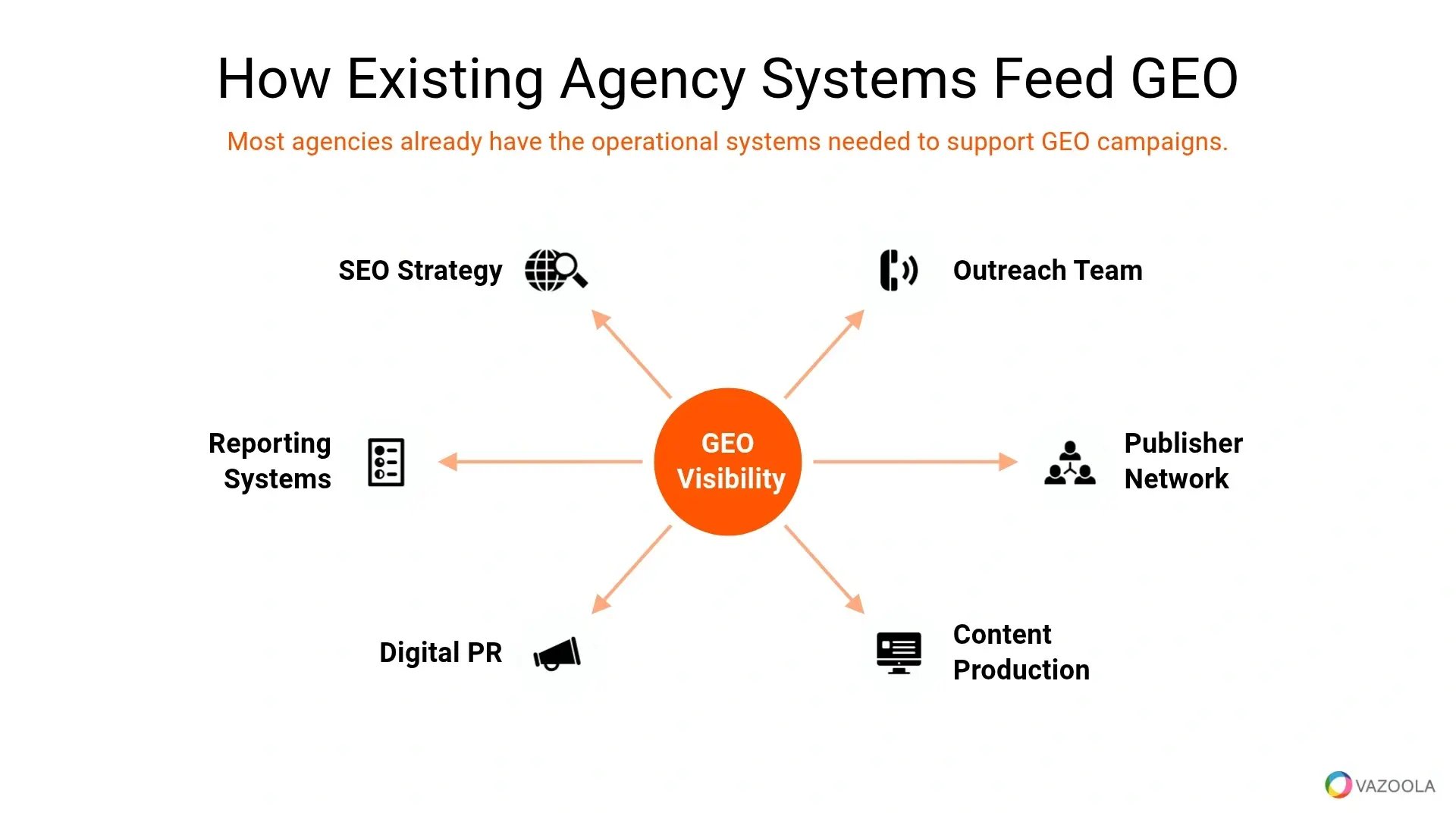
Strong outreach systems, editorial relationships, and scalable content production already support much of what link building and GEO for agencies actually require. The real shift is refining briefs, adjusting placement priorities, and expanding reporting beyond just traditional SEO metrics.
According to recent industry coverage from Solutions Review, agencies moving early on GEO gain a real competitive advantage since many competitors still haven’t adapted their service offerings to AI search visibility.
That early positioning advantage matters in crowded agency markets where clients increasingly ask about AI discoverability during both pitches and renewals.
Key Takeaways About GEO for Agencies
-
Link building and GEO share many of the same operational foundations.
-
Agencies usually need process adjustments, not an entirely new department.
-
Brand mentions and entity associations matter as much as backlinks in AI search.
-
Agencies that combine both services early may gain a positioning advantage before GEO becomes standard.
Table of Contents
Why Link Building and GEO Are a Natural Fit
The overlap between traditional SEO authority signals and AI citation signals is larger than agencies might expect. There’s no question that backlinks still matter. High-authority mentions also still matter. And, yes, context still matters, too.
GEO simply expands how those signals are interpreted across generative search systems.
Large language models pull information from authoritative content, editorial mentions, publisher trust, and contextual relevance. Strong link-building campaigns already contribute to many of those signals. A well-placed guest contribution on an authoritative industry publication can support both Google rankings and AI-generated citations at the same time.
Most agencies already possess the raw materials needed for a generative engine optimization agency offering:
-
Publisher outreach systems
-
Existing editorial relationships
-
Content production workflows
-
Quality-control standards
-
Reporting frameworks
What does this mean to agencies? Many teams are closer to GEO offerings than they realize.
What GEO Actually Requires (And What You Already Have)
How closely do GEO requirements already align with traditional link-building operations?
|
GEO Requirement |
Existing Link-Building Equivalent |
|
High-authority editorial placements |
Existing publisher network |
|
Brand mentions in context |
Guest post copy already being produced |
|
Entity association |
Adapted anchor text strategy |
|
Scalable content production |
Existing content pipeline |
|
Consistent visibility signals |
Ongoing outreach cadence |
The gap between link building and GEO is much narrower than the phrase “new service” suggests. Agencies already skilled at off-page SEO possess most of the operational foundation.
Map the exact services, categories, and phrases clients should consistently be associated with before outreach starts. Agencies that standardize brand language across placements often create stronger long-term entity associations inside AI systems.
What Changes When You Add GEO (And What Doesn't)
Of course, it’s only natural that some adjustments are necessary when transitioning to GEO services. Agencies should avoid overselling GEO as “SEO with a new label,” or even “SEO for AI search.” Certain workflows genuinely need refinement.
Several tactics remain largely unchanged:
-
Publisher outreach
-
Content creation
-
Placement vetting
-
Editorial standards
-
Monthly reporting cadence
Other parts, on the other hand, require meaningful adaptation.
Content briefs should now include brand mention placement alongside anchor text direction. Writers need instructions for contextual mentions, topical alignment, and entity reinforcement instead of focusing only on links.
Placement targeting also shifts slightly. Publications frequently surfaced in AI systems become more valuable. Outreach teams increasingly prioritize editorial trust and crawl frequency instead of relying only on Domain Authority metrics.
Measurement evolves, too. Traditional KPIs like referring domains and rankings still matter, but agencies also need visibility tracking around mentions, citations, and AI-generated responses.
Agencies already succeeding with white-label outreach systems have a natural advantage when adapting services for newer visibility models.
Demand Local notes that digital PR campaigns now influence not only traditional rankings, but also how often brands appear in AI-generated answers and summaries. That shift helps explain why contextual brand mentions have become more valuable alongside standard backlink acquisition.
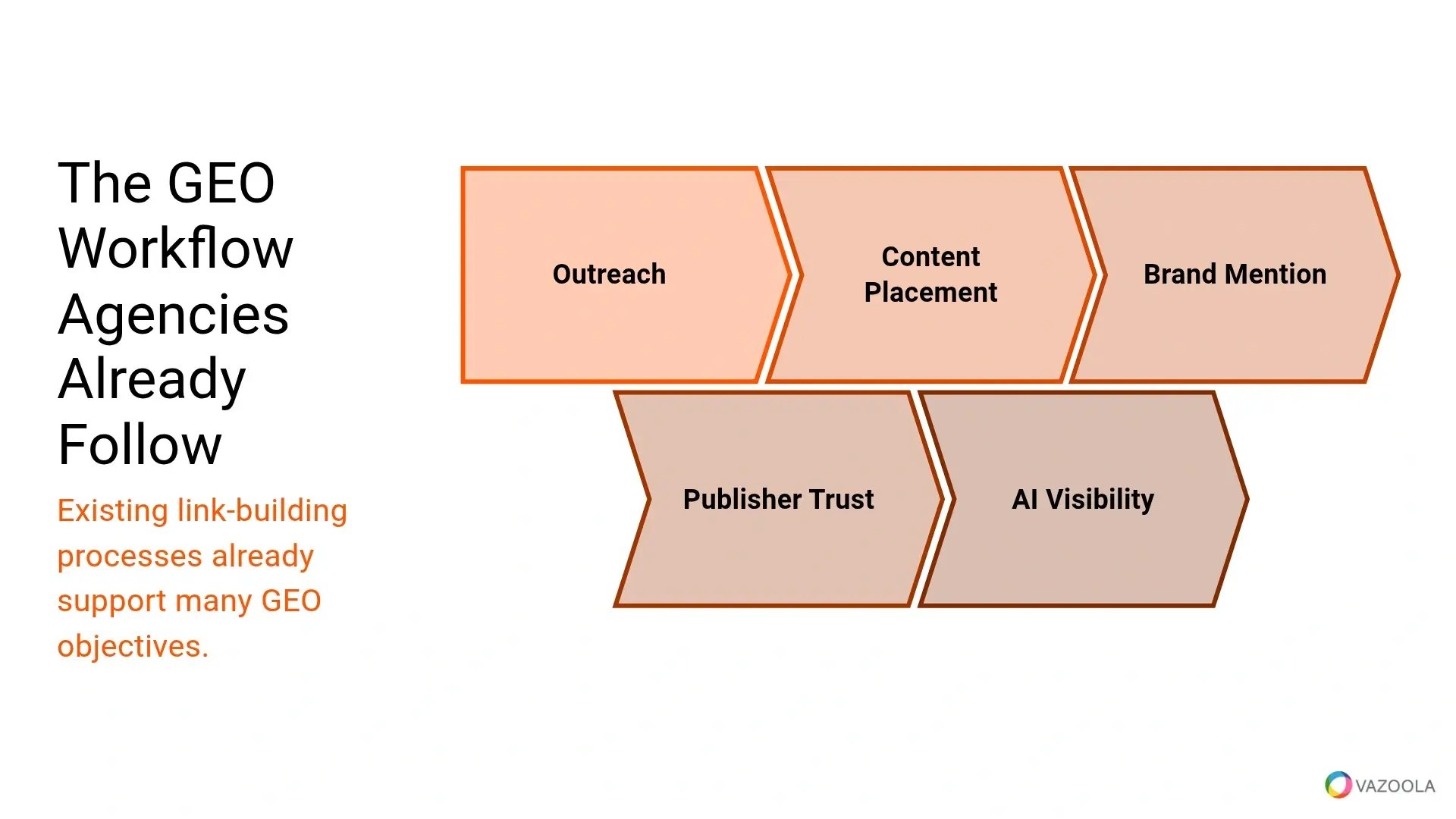
The Shift From Link-Only Thinking to Full Visibility Strategy
Link building optimizes for link equity, whereas GEO optimizes for brand association.
That distinction changes campaign strategy more than any agency tools or dashboard ever will.
Agencies that begin briefing writers to mention brands naturally inside relevant conversations have already made the core transition. Everything after that becomes refinement, reporting, and process optimization.
A contextual mention inside a trusted publication may help AI systems associate a brand with a category, topic, or solution set—even when no hyperlink exists.
Many agencies still think almost exclusively in backlinks, but GEO expands the focus toward contextual authority.
A publication syndicated to Yahoo, MSN, Apple News, or industry aggregators may contribute more AI visibility than a niche site with slightly better authority metrics. Wider distribution increases the odds of repeated brand exposure across search and AI ecosystems.
How to Package and Sell Link Building and GEO Together
Most agencies follow one of two approaches successfully:
-
Some bundle GEO directly into existing link-building retainers.
-
Others create a separate AI visibility add-on.
Bundling often works best for agencies already running mature outreach operations. Existing campaigns simply expand to include contextual mentions, entity reinforcement, and publication targeting adjustments.
Separate service tiers may work better for clients actively asking about AI visibility for agencies or competitive positioning inside AI-generated answers.
One mistake appears frequently across the industry: Agencies overcomplicate the pitch.
Clients usually don’t care about retrieval-augmented generation pipelines or LLM architecture diagrams. They care about visibility, authority, and market presence. Simpler messaging closes more deals.
Agencies looking for client-facing communication strategies around AI search can also reference Vazoola’s related resource on talking to SEO clients about AI visibility without unnecessary hype.
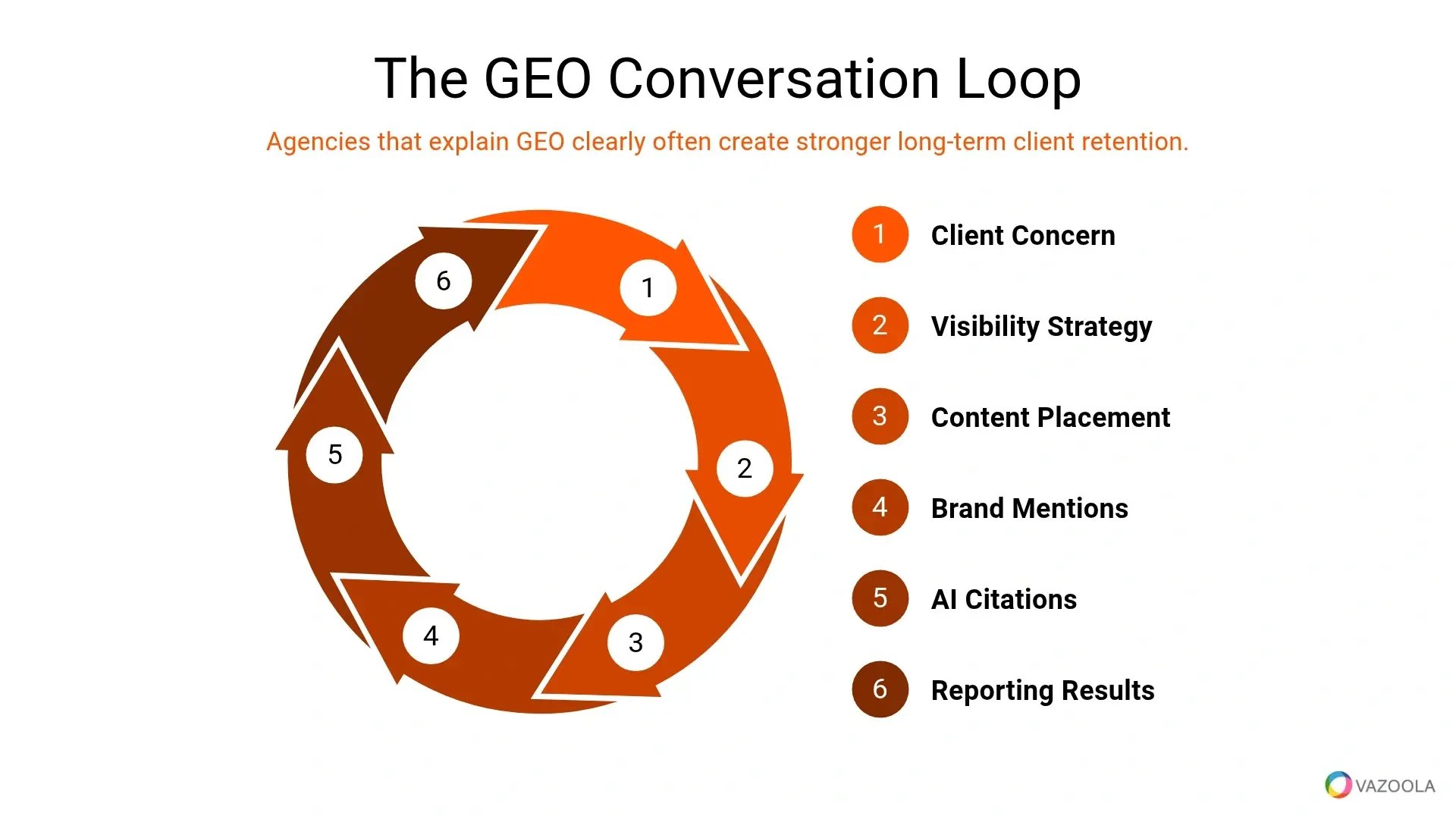
How to Handle the "What's the ROI?" Question
Measurement in GEO is still developing. Clients know that. But agencies can build trust when they acknowledge uncertainty instead of pretending the ecosystem is fully standardized.
Several reporting metrics still provide value:
-
Brand mention frequency
-
Citation appearances across AI platforms
-
Share-of-voice comparisons
-
Publisher visibility trends
-
Branded search growth
The framing really matters here.
GEO resembles long-term authority building more than direct-response advertising. Brand association compounds over time in much the same way domain authority compounds slowly through sustained link acquisition.
That means some campaigns may appear quiet for months before visibility accelerates quickly.
Run recurring prompts in ChatGPT, Perplexity, Gemini, and Claude to identify which publishers appear most often for important industry questions. Those patterns can help outreach teams refine publisher targeting with real visibility data instead of assumptions.
What Changes in Your Campaign Brief When You Add GEO
Small briefing adjustments often create major downstream differences. Agencies don’t need to rebuild campaign workflows from scratch. Most teams simply expand the existing brief structure to support both SEO and AI visibility goals.
A traditional link-building brief might focus almost entirely on the target URL, preferred anchor text, DR minimums, and niche relevance requirements.
By comparison, a GEO-expanded brief still includes those elements, but it also adds instructions around brand mention language, entity association goals, and the types of editorial publications most likely to influence AI visibility.
Many agencies now prioritize high-authority publications that appear frequently in AI-generated answers or are commonly crawled by large language models.
|
Campaign Element |
Traditional Link-Building Campaign |
Link Building and GEO Campaign |
|
Primary goal |
Earn relevant backlinks that support rankings, authority, and referral visibility. |
Earn relevant backlinks while building stronger brand associations for AI search systems. |
|
URL direction |
Identify the target page the placement should support. |
Identify the target page and clarify which broader topic or service the brand should be tied to. |
|
Anchor text |
Provide the preferred anchor text and variation rules. |
Provide anchor text guidance plus natural brand mention language. |
|
Placement quality |
Set minimum authority, niche relevance, and editorial standards. |
Set those same standards while prioritizing publications likely to be crawled, cited, or trusted by AI systems. |
|
Content brief |
Focus the article around the publisher’s audience and the target keyword topic. |
Focus the article around the publisher’s audience, the keyword topic, and the client’s entity association goal. |
|
Reporting |
Track links, referring domains, authority metrics, and traffic impact. |
Track those same metrics alongside brand mentions, citation checks, and share-of-voice trends. |
The difference may look small on paper, but those additions fundamentally change how outreach teams select publishers, how writers structure content, and how campaigns reinforce long-term brand visibility across AI systems.
After all, a writer told only to insert an anchor may produce technically acceptable SEO copy. A writer instructed to reinforce topical authority and category association, however, creates content far more aligned with GEO outcomes.
Agencies Offering Both Are Already Pulling Ahead
The window where link building and GEO function as a differentiator likely won’t remain open forever. Market demand already continues its shift toward integrated visibility strategies that combine traditional rankings with AI discoverability.
Early adopters gain several advantages:
-
Stronger publisher relationships
-
Better reporting systems
-
Refined campaign workflows
-
Better client retention
-
More differentiated positioning
Agencies that wait too long may eventually face a market where GEO becomes a baseline expectation instead of a premium service.
At Vazoola, our team has seen how agencies can expand into link building and GEO without operating two completely separate systems. Strong outreach infrastructure, quality editorial placements, and contextual brand visibility already move agencies much closer to AI-era visibility than many realize.
Is your agency ready to strengthen both traditional search performance and AI visibility?
Explore Vazoola’s link-building and brand mentions services to scale those efforts more efficiently. The agencies shaping how brands appear inside tomorrow’s AI-driven search experiences are already building those systems today.
 Agencies often wait until a service feels fully defined before rolling it out. GEO moves too quickly for that approach. Teams that quietly test brand mentions, AI-focused placements, and citation tracking inside existing campaigns usually build stronger systems long before competitors finish reworking their sales decks.