

Jun 22, 2026

Casey Bjorkdahl is one of the pioneering thought leaders in the SEO community. In 2010, Casey co-founded Vazoola after working for a Digital Marketing Agency for five years in New York City. Vazoola is now one of the fastest growing and most widely recognized SEO marketing firms in the country.


A strange thing is happening in search results right now. More content is being published every day, so why does the internet feel flatter than ever?
There’s little doubt that AI tools can produce polished, technically correct articles within seconds. But when you open several search results on the same topic, the structure often feels nearly identical. The wording changes slightly. The information rarely does.
Readers still want useful answers from sources that sound informed, experienced, and human, and Google’s helpful content guidance still points in that direction. The difference is that average content is no longer difficult to create.
Generic completeness used to stand out because many brands struggled to publish detailed content consistently. Now AI can generate “good enough” articles endlessly.
So, how do you create content that stands apart?
Here at Vazoola, our team increasingly sees the strongest-performing content lean into specificity, depth, and perspective instead of simply covering the topic thoroughly.
Key Takeaways on AI Helpful Content
-
Helpful content now depends less on basic completeness and more on differentiation.
-
AI-generated content raised the amount of average content competing for visibility.
-
Specificity, depth, and perspective have become stronger ranking and engagement signals.
-
Content with unique insight earns links and authority more naturally.
-
Strong editors and strategists now focus on originality instead of simply covering topics.
Table of Contents
AI Didn't Raise the Standard. It Lowered the Value of Average.
A decade ago, creating a decent blog post required real time, budget, and labor. Many companies struggled just to publish content consistently. As a result, content that was organized, complete, and readable often stood out.
AI changed that equation almost overnight.
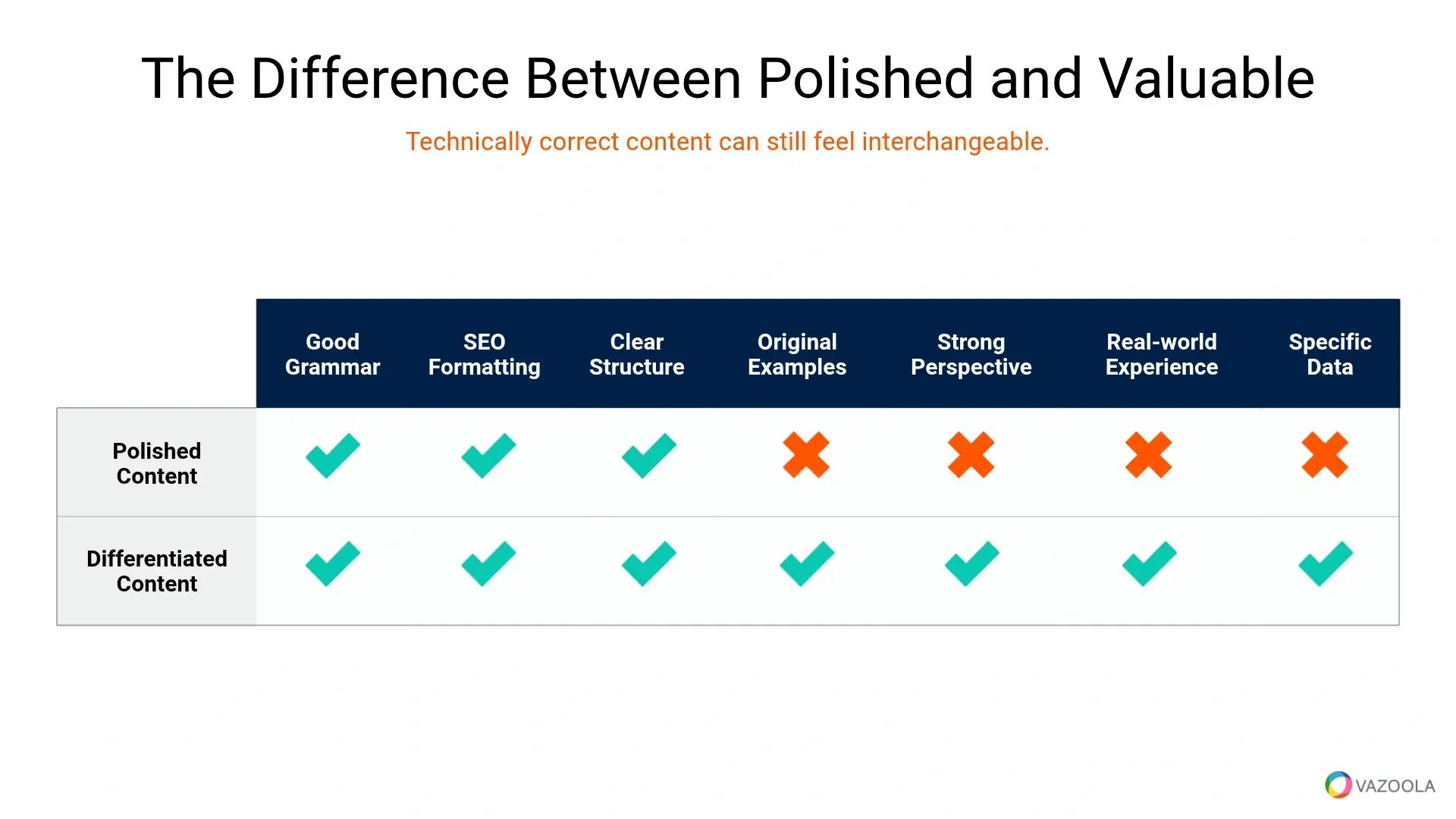
Average content became fast and cheap to produce. Thousands of articles can now cover the same topic using nearly identical structures, examples, and conclusions.
Searchers still need useful answers, but now they face an overwhelming amount of interchangeable material.
Google’s systems were already built around rewarding people-first content. The problem is that “people-first” looks very different once AI can instantly create baseline coverage.
Today, strong content usually delivers three things standard AI-generated writing struggles to reproduce consistently:
-
Specificity
-
Depth
-
Perspective
Those elements now separate content readers remember from content they skim and forget.
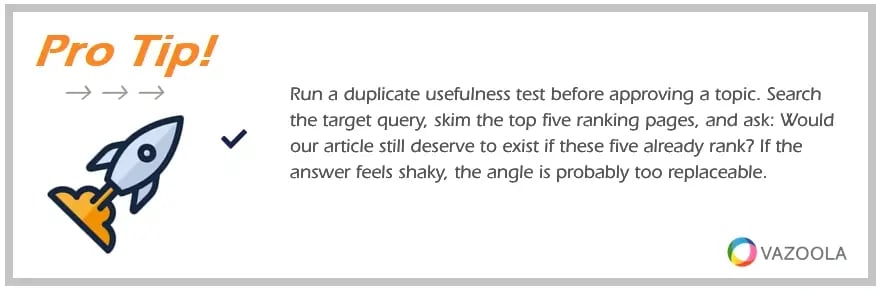
Run a duplicate usefulness test before approving a topic. Search the target query, skim the top five ranking pages, and ask: Would our article still deserve to exist if these five already rank? If the answer feels shaky, the angle is probably too replaceable.
What Google’s Helpful Content Update Actually Said (And What It Didn’t Anticipate)
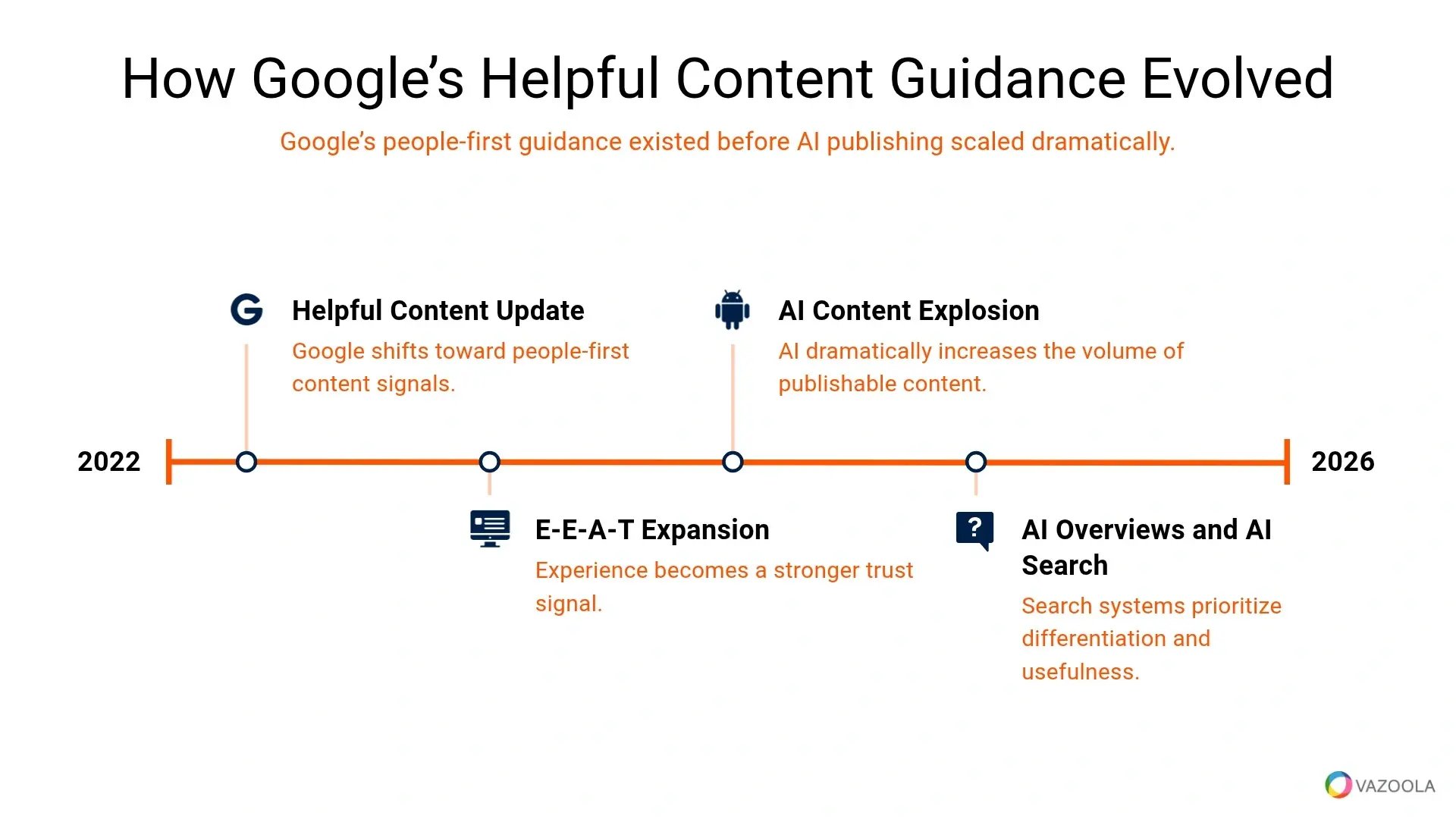
Google introduced the Helpful Content Update (also called Google HCU) in 2022 to reduce low-value, search-engine-first content. The update emphasized original information, expertise, and user satisfaction over content written purely to chase rankings.
The broader framework later evolved into E-E-A-T: experience, expertise, authoritativeness, and trustworthiness.
Google repeatedly stressed that content should help people first instead of manipulating algorithms. Google also clarified that AI-generated content itself was not automatically against guidelines. After all, its systems are built to reward high-quality content regardless of how it’s produced.
Of course, what Google couldn’t fully anticipate at the time was the sheer scale of AI-assisted publishing.
Back then, AI-generated content was still relatively limited. Today, marketers can create hundreds of articles in the time it once took to produce a handful. Google’s original guidance still applies, but the competitive environment surrounding it changed dramatically.
Search engines now evaluate far more content that looks technically correct on the surface. In fact, Google reported that people had already used AI Overviews billions of times through Search Labs before the feature even rolled out more broadly in the U.S.
That just goes to show how quickly AI-assisted search moved from experiment to mainstream behavior.
Why Surface-Level Content Fails Now Even When It’s Technically Fine
Modern articles can fail for reasons that are easy to overlook. The content may technically answer the query, yet it still blends into the larger flood of AI-assisted publishing.
Understanding why requires looking at how content quality standards shifted once average content became easy to produce.
Average Content No Longer Stands Out
Many struggling articles aren’t inherently bad.
They answer the topic, they include headings, and they use readable formatting. Their grammar looks clean, and the basic SEO practices are all in place.
A few years ago, that often worked.
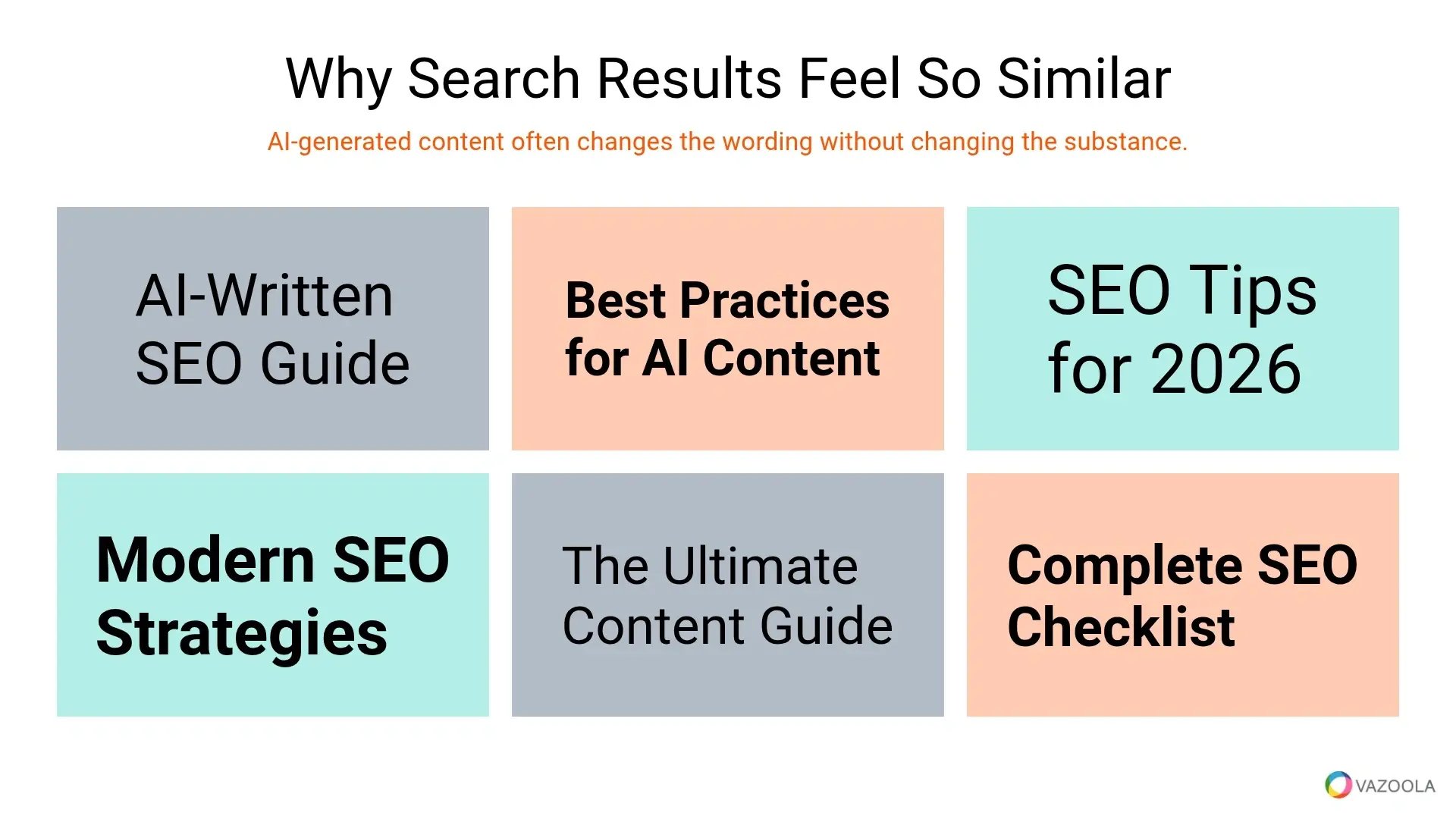
Now those same articles compete against thousands of nearly identical versions generated with AI assistance. The issue isn’t necessarily factual quality. It’s interchangeability.
Review your content library for template fatigue. Many brands unintentionally publish the same article structure repeatedly because briefs, outlines, and AI prompts follow identical patterns. Rotating content formats, openings, and section flow can make a noticeable difference.
What “Technically Fine” Content Usually Looks Like
Technically fine content often follows a few predictable patterns:
-
Generic examples
-
Recycled introductions
-
Broad advice with no real context
-
Summaries of what already exists on page one
-
No firsthand insight or practical experience
Readers recognize the similarities quickly. Search systems more often appear to recognize it, too.
Content that simply covers a topic is no longer enough when AI can produce endless versions of that same coverage.
Content Specificity Is the New Completeness
Completeness used to signal quality.
If an article covered every subtopic, marketers assumed it demonstrated expertise. AI changed that quickly because comprehensive coverage became easy to automate.
Specificity is now the stronger differentbacklinks ator.
Compare these two examples:
A generic answer might say businesses should “improve internal linking and create high-quality content.”
A specific answer, on the other hand, might explain how a SaaS company increased organic demo requests by 22% after restructuring internal links around high-intent feature pages and rewriting weak comparison content.
Both answers are correct, technically speaking. Only one feels grounded in reality.
Specific details are harder to fake convincingly at scale. Real examples, numbers, tradeoffs, timelines, and decision-making patterns create signals AI still struggles to replicate consistently.
Our team at Vazoola increasingly sees stronger results when content briefs push writers toward specifics instead of broad coverage. Strong briefs now ask questions like:
-
What exact example should appear in this section?
-
What metric or outcome supports the point?
-
What real-world tradeoff belongs here?
-
What scenario would only someone familiar with the topic mention?
That shift changes the entire texture of a piece.
Ask subject matter experts for the details they almost left out. The most valuable specificity often comes from offhand comments buried in interviews, Slack messages, or client conversations. Tiny operational details can feel more credible than polished summaries.
Content Depth Means Answering the Question Behind the Question
Many marketers still confuse depth with word count.
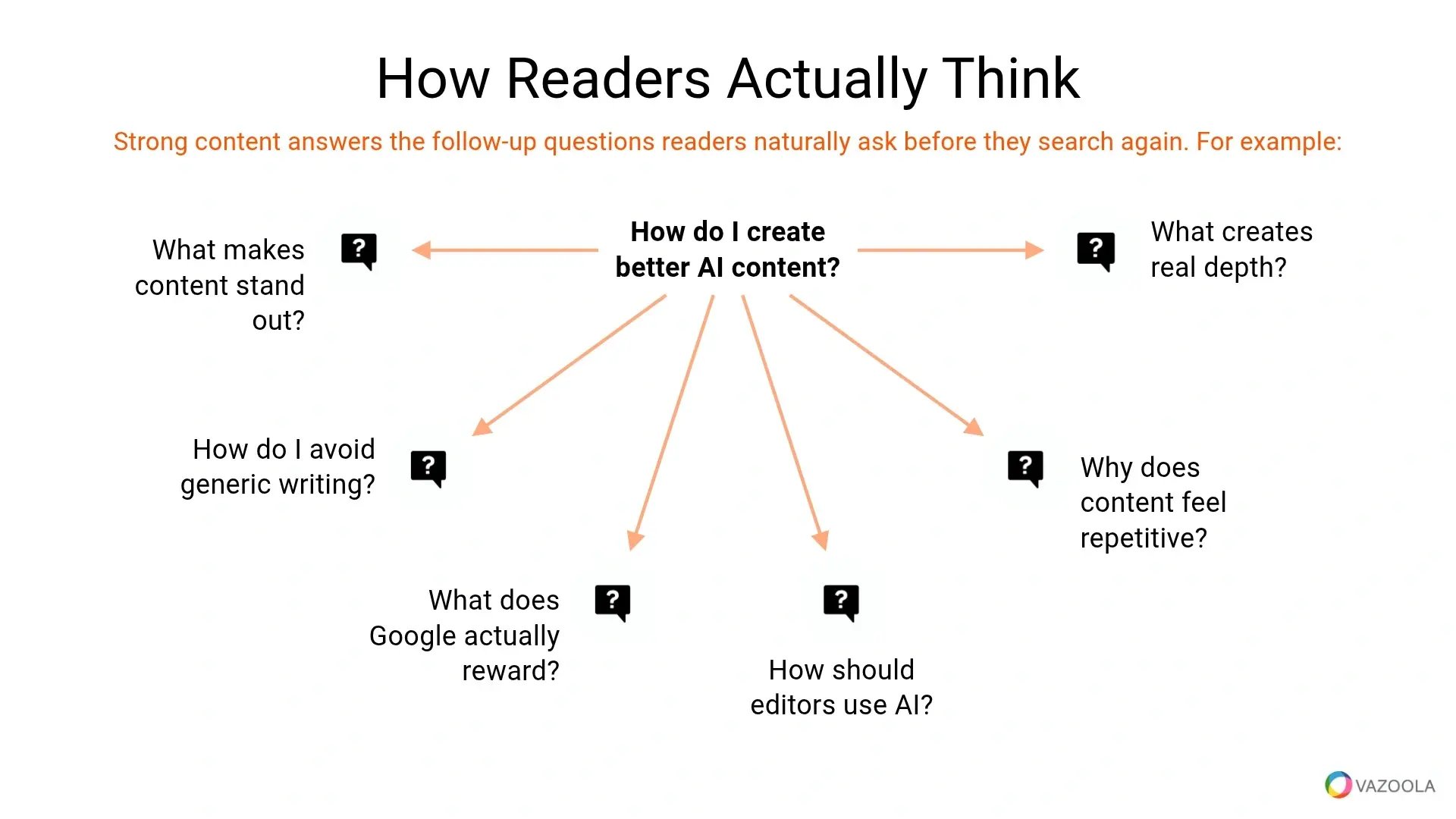
Depth is not adding extra filler sections or repeating definitions with different phrasing. Instead, it answers the follow-up questions readers naturally ask after receiving the obvious answer.
For example, a surface-level article about AI content might explain how to use AI tools responsibly. A deeper article addresses what happens when multiple competitors use identical prompts, how editors should refine AI drafts, and why certain types of content collapse into sameness faster than others.
Readers rarely stop after the first answer. They keep searching because they still lack context.
In essence, strong content anticipates that next search.
Writers with practical experience usually handle this better because they understand the hidden tradeoffs. They know where projects fail, where advice breaks down, and what details beginners overlook.
That practical layer matters more today because AI-generated content often stays trapped at the obvious-summary level.
Perspective Is What AI Can’t Manufacture (At Scale)
Perspective has become one of the clearest dividing lines between memorable content and disposable content. Readers may not consciously analyze it, but they quickly recognize when an article simply repeats industry talking points instead of contributing something original.
Why AI Content Often Sounds the Same
Many AI-generated articles sound polished because they summarize consensus effectively. The systems are trained on existing public information, which naturally pushes outputs toward safe, typical conclusions.
But original perspective works differently.
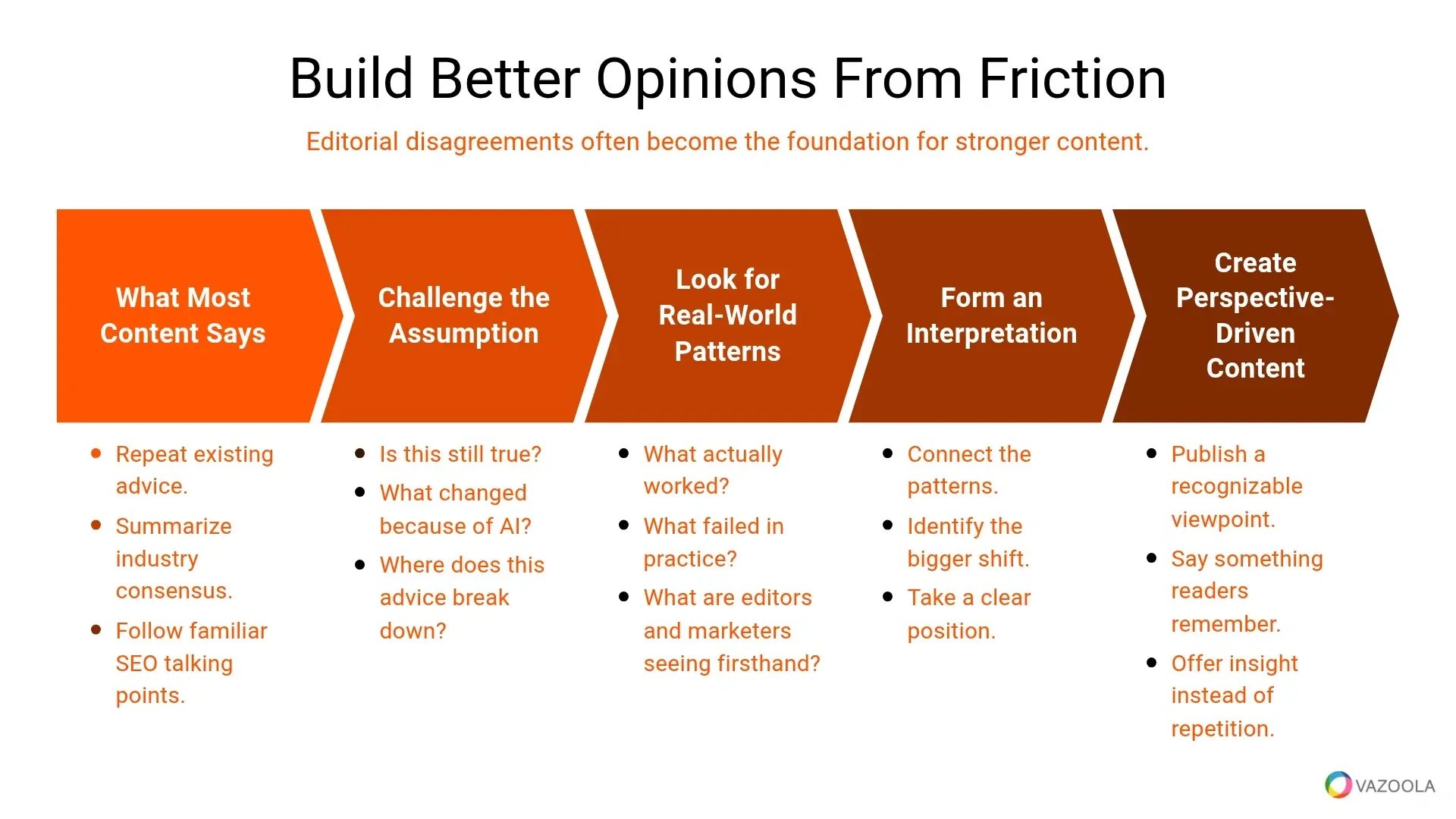
Perspective means taking a position, interpreting trends instead of simply summarizing them.
Create an internal disagree file. Encourage writers and strategists to save examples of industry advice they believe is incomplete, outdated, or oversimplified. Those disagreements often become the foundation for stronger editorial perspectives.
What Real Perspective Looks Like in Practice
What is real perspective, and how do you communicate it?
Consider a few recent Vazoola articles discussing LLM seeding and AI visibility. They succeed because they argue a clear point: Brands increasingly need structured authority signals beyond traditional SEO alone. The content doesn’t simply repeat industry summaries. It advances a viewpoint.
That distinction matters.
Readers remember content with a clear perspective because it gives them something to react to. Even when readers disagree slightly, they engage more deeply with content that feels authored instead of assembled.
How to Brief Writers for Stronger Opinions
Strong content briefs should encourage writers to contribute perspective intentionally. Editors can ask:
-
What is the actual argument of this piece?
-
What trend or assumption are we challenging?
-
What observation comes from experience instead of research aggregation?
-
What would make this article recognizable without the logo attached?
Those questions often produce stronger content than another checklist of SEO requirements.
What AI-Era Content Means for Your Link-Building Strategy
The connection between helpful content and link building is becoming more direct.
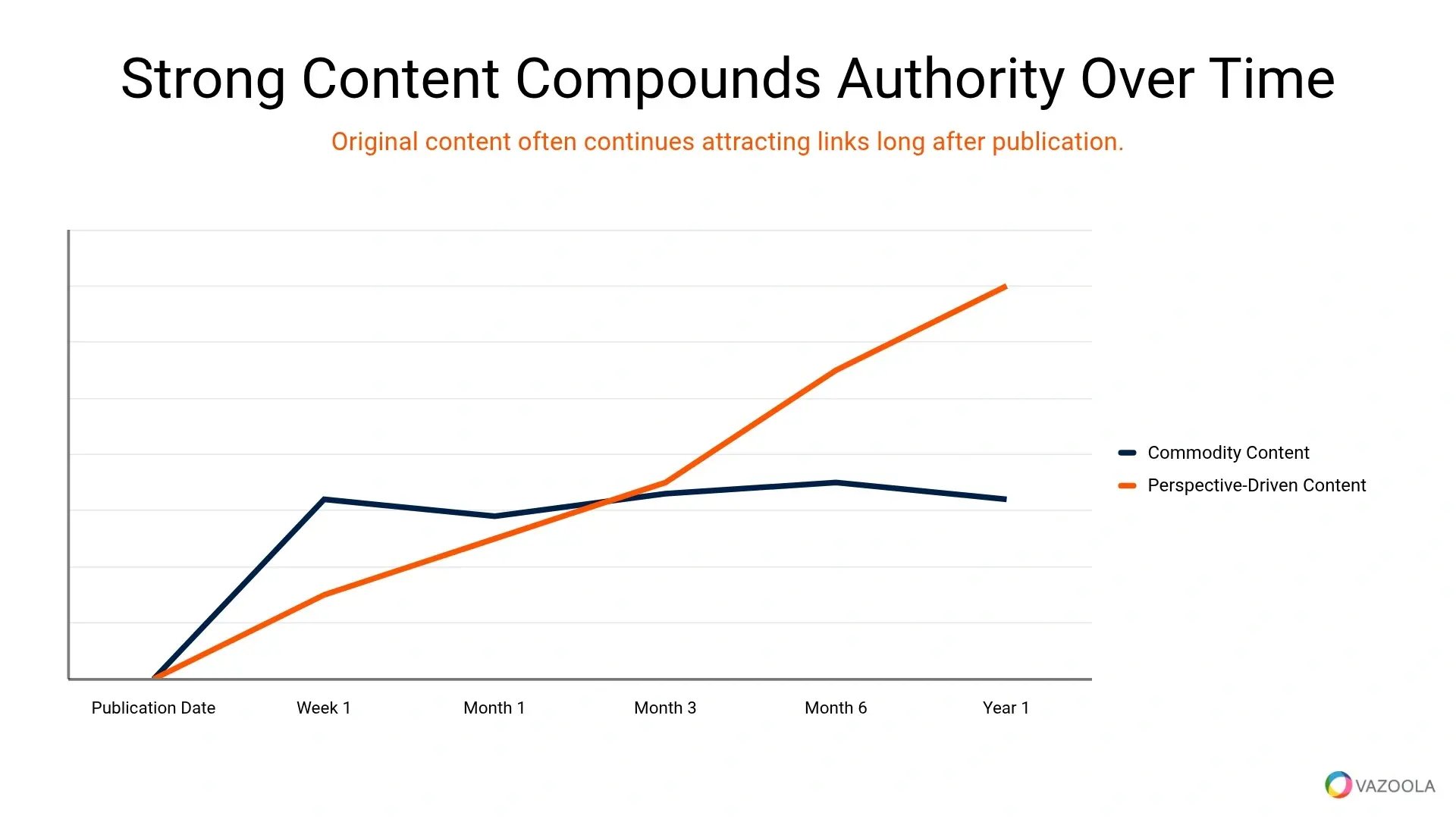
Generic content rarely earns links naturally because readers have already seen versions of it elsewhere. Articles with specificity, depth, and perspective create stronger reasons for publishers, journalists, and creators to reference them.
Ahrefs found that most No. 1-ranking pages earned followed backlinks from new referring domains at a monthly pace between 5% and 14.5%. That figure illustrates how strong pages can keep compounding authority after they rank. The most effective content compounds authority because people keep finding reasons to cite it.
That trend becomes even more important in an AI-heavy search environment.
Search systems increasingly need reliable signals separating original thinking from lookalike summaries. Links still help reinforce authority, but content now needs genuine substance behind those links.
A forgettable article might technically target the right keywords. A memorable article gives other people something worth discussing.
A Quick Distinctiveness Test Before You Publish
Before publishing a new article, editors and strategists should pause and pressure-test the draft.
Ask these questions:
-
Could AI have written this piece without any original information?
-
Does the article say anything readers could not find in the first three search results?
-
Is there at least one specific example, number, or scenario unique to this piece?
-
Does the article take a clear position instead of summarizing consensus?
-
Would readers remember anything from this article an hour later?
Brands struggling to stand out in increasingly crowded search results often don’t need more content. They need more distinctive content.
If your team is trying to build authority with content that earns meaningful visibility, links, and engagement instead of blending into the flood of AI-generated sameness, connect with Vazoola to develop a smarter long-term content strategy built around differentiation rather than volume alone.
Remember, helpful content didn’t stop mattering. Average content simply stopped being rare.
That difference is becoming the entire game.
Read the article backward before publishing. Start with the conclusion, then skim each section in reverse order. Repetitive phrasing, weak transitions, and filler become much easier to spot when the piece loses its natural reading flow.