

Jul 29, 2026

Casey Bjorkdahl is one of the pioneering thought leaders in the SEO community. In 2010, Casey co-founded Vazoola after working for a Digital Marketing Agency for five years in New York City. Vazoola is now one of the fastest growing and most widely recognized SEO marketing firms in the country.


Every SEO campaign has a moment when the calendar says progress, but Google hasn’t gotten the memo.
What’s happening?
The work is live, and the strategy is moving. But the client still sees the same competitors sitting above them.
That’s when they ask the question that can change the tone of the whole call: “Why aren’t we ranking yet?”
“SEO takes time” simply isn’t a good enough response. The client wants proof that the campaign is moving, a clear reason for the delay, and confidence that the agency knows when to wait and when to act. p
The best response delivers all three.
Key Takeaways
-
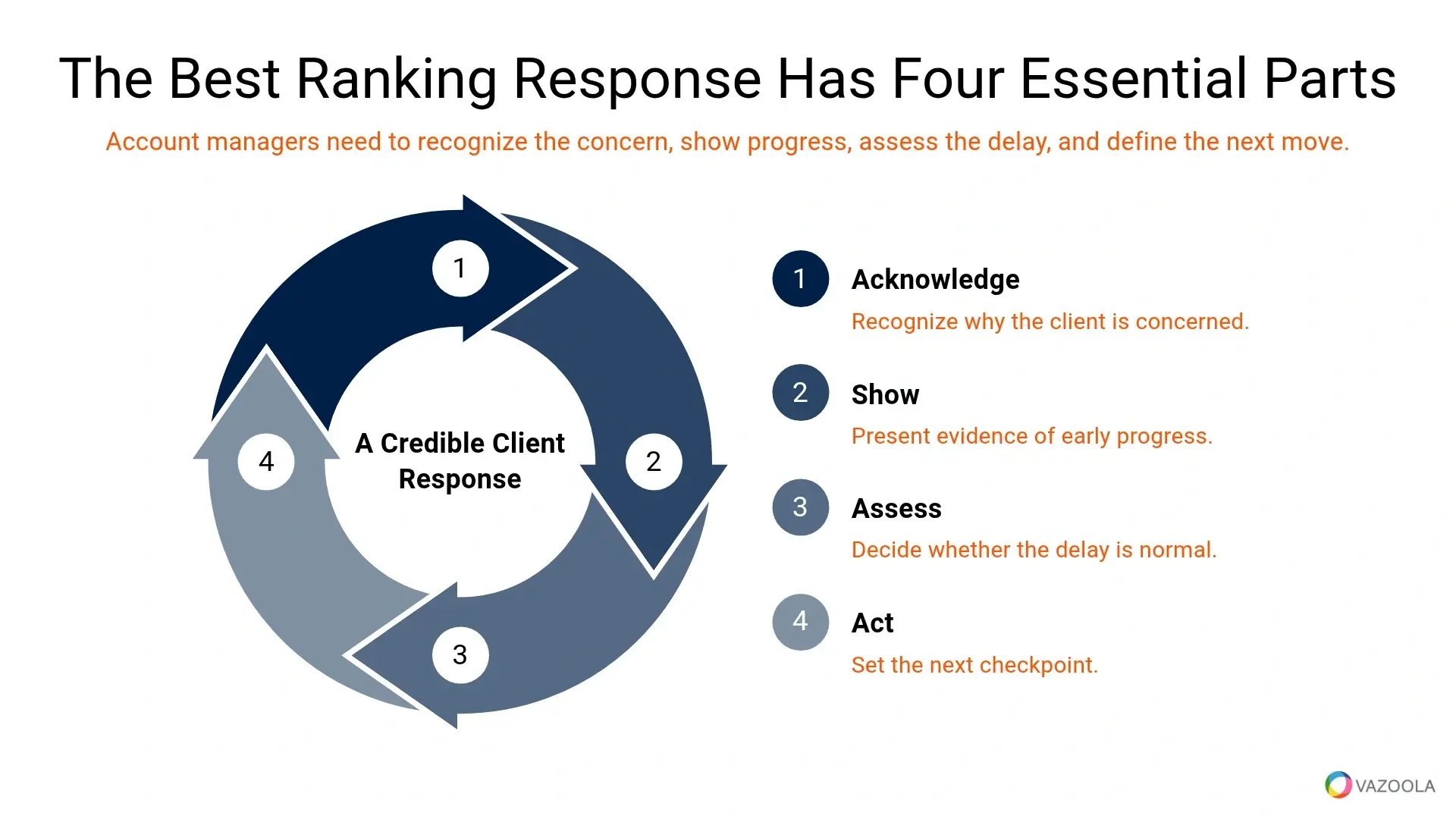
Acknowledge the concern before explaining the timeline.
-
Show leading indicators before target keywords reach strong positions.
-
Measure the ranking timeline from when pages, links, and technical improvements became visible to search engines.
-
Use rank tracking, Search Console data, link reports, and competitor analysis together.
-
Separate normal ranking lag from technical or strategic problems.
-
End with a clear checkpoint and next action.
Table of Contents
Why Clients Start Questioning SEO Progress
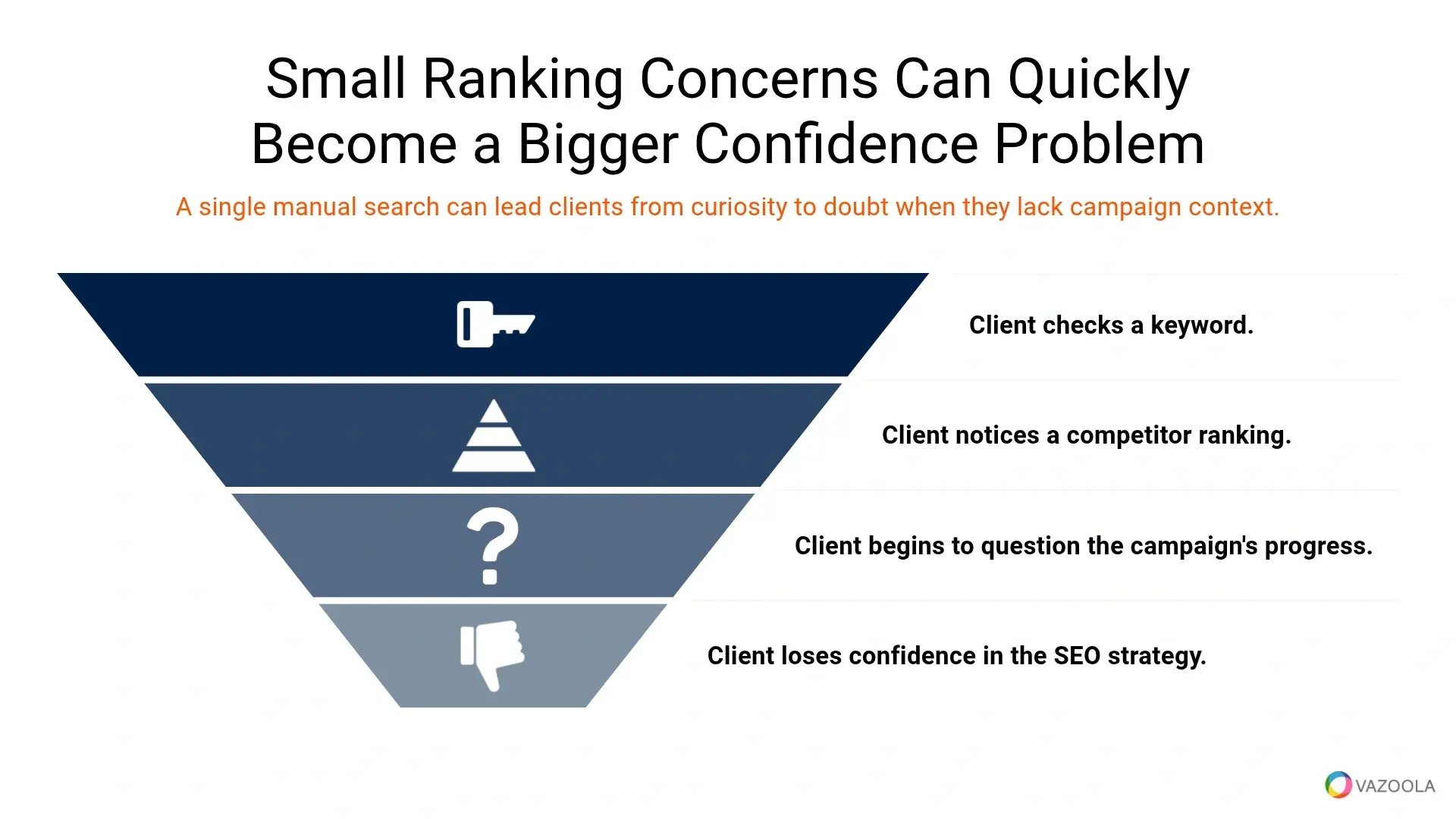
Clients ask about rankings because they want visible proof that their investment is working. Audits, content briefs, technical fixes, and outreach reports feel abstract when an important keyword remains on page three. Rankings often become shorthand for the entire campaign.
Personal searches frequently trigger the concern.
A client enters one target phrase, sees a competitor above them, and assumes the campaign has stalled. Location, device, personalization, and normal volatility can all make one search an incomplete measure of progress.
The payment schedule adds more pressure. SEO invoices arrive at predictable intervals, but organic gains tend to develop unevenly. Clients see a steady expense beside an uncertain outcome, and that’s why they start questioning the value.
Competitor movement can raise the stakes. A competing page may benefit from years of authority, stronger links, fresher content, or a better match for search intent. The client sees the position, but they don’t see the history behind it.
The Real Ranking Timeline
SEO doesn’t follow one universal countdown. Site authority, technical health, competition, content quality, search intent, crawl frequency, and backlink strength can all affect the pace of progress.
New and revised pages must be discovered, crawled, indexed, evaluated, and compared with other results. Google notes that crawling and indexing depend on many factors, and neither comes with a guaranteed timeline. Its crawling and indexing guidance explains how pages enter Google Search.
Clients who want a fuller explanation can review our guide to how long it generally takes for SEO to start working. Campaigns focused on authority growth may follow a separate schedule because links must go live, get discovered, and begin supporting target pages. A related guide we created explains how long link-building results can take.
Keep this discussion brief during a status call. A long explanation of search algorithms can sound evasive. Just name the factors affecting the campaign, then move to the evidence.
Set separate expectations for new pages, refreshed pages, and established pages. They rarely move at the same pace, so one campaign-wide timeline can create confusion later.
How to Respond When a Client Asks Why They Aren’t Ranking in SEO
So, what do you do when your client starts wondering about their lack of rankings?
A strong response should acknowledge the concern, establish what the data shows, and explain what happens next. Your goal should be reassuring the client without minimizing their issue or guaranteeing a specific outcome.
Show the Leading Indicators Before Rankings Move
Rankings often follow earlier signs of progress. Leading indicators show whether search engines have discovered the work, started evaluating it, and begun surfacing the site for more queries.
Useful indicators may include:
-
Indexed priority pages: The intended URLs have entered Google’s index and can appear in search.
-
Rising impressions: Pages are appearing more often, even when clicks remain limited.
-
Broader keyword coverage: Target pages have started ranking for related or long-tail searches.
-
Improved average positions: Groups of relevant keywords are moving in the right direction.
-
Live, indexed backlinks: Acquired links have been published and discovered.
-
Resolved technical issues: Crawl barriers, redirects, canonical conflicts, and internal-linking gaps have been addressed.
-
Connect each indicator to its role. Stronger internal linking helps search engines find and understand priority pages, while a relevant backlink may support authority. Meanwhile, rising impressions suggest that Google has started showing the site more often.
Completed tasks shouldn’t stand alone as proof. Publishing six articles shows activity, but six indexed articles earning more impressions show traction.
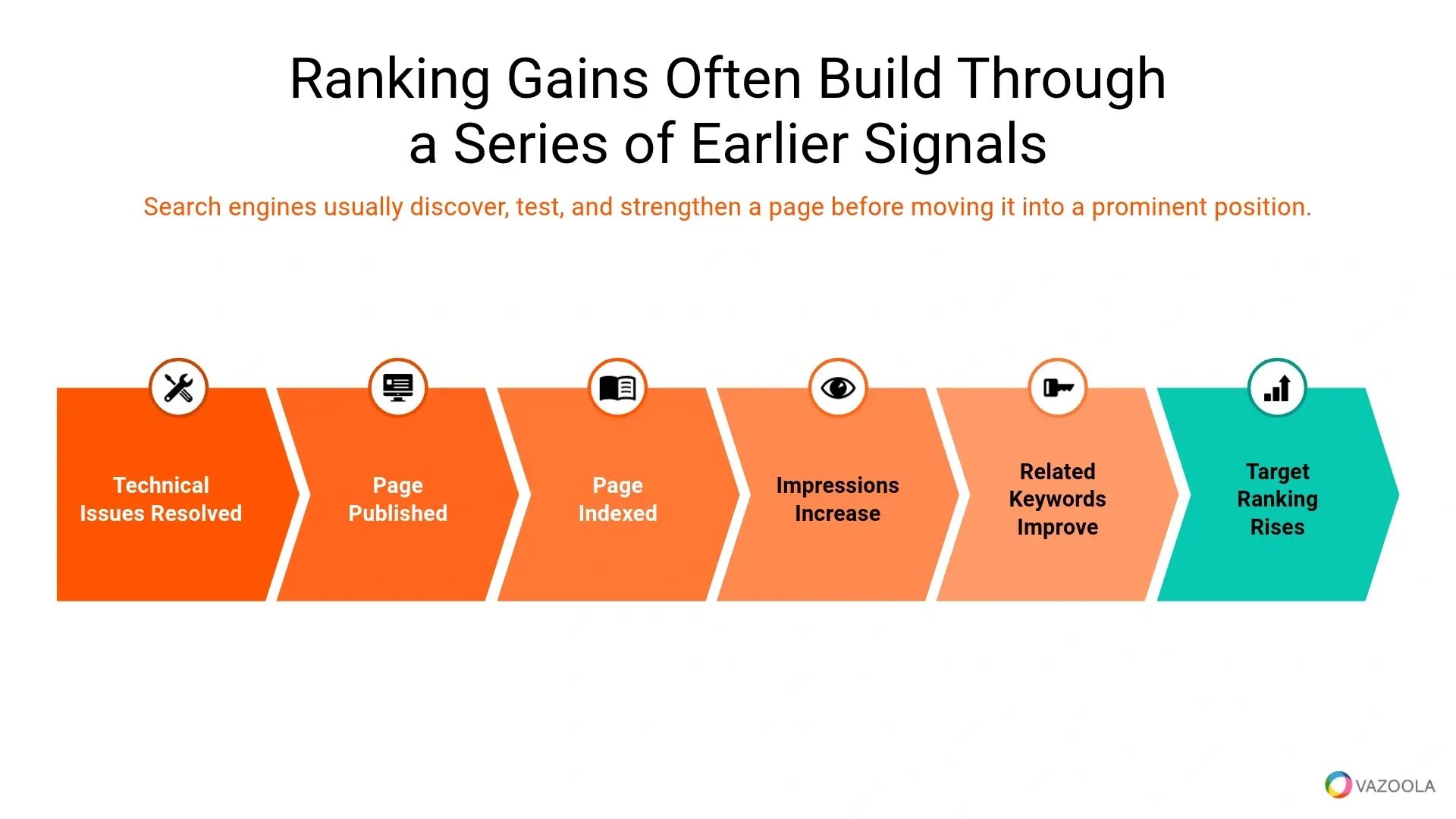
Explain Why the Ranking Clock Starts Later Than the Client Thinks
Clients often measure the campaign from the day the contract began. Search engines can only evaluate changes after they become accessible online.
Research, approvals, technical work, content production, and outreach may take several weeks before meaningful signals begin accumulating.
The practical timeline often looks like this:
Contract begins → research and production → changes go live → pages are crawled and indexed → authority signals accumulate → rankings respond.
Make sure you use actual dates to explain where the campaign sits in that sequence. The engagement may have started eight weeks ago, while the revised landing pages entered the index only three weeks ago. Supporting links may have gone live even more recently.
A milestone-based explanation gives the client more than a request for patience. It shows what has been completed, when the ranking clock effectively began, and which signals should appear next.
Add the publish, indexation, and link-live dates to client reports from the start. You won’t have to reconstruct the timeline when a client asks why results haven’t arrived.
Tell Normal Ranking Lag From an Actual Red Flag
Some campaigns need more time, while others need a correction.
Account managers should examine several signals together before deciding which situation they face. One slow-moving keyword usually won’t provide enough information.
|
Signal |
Normal Ranking Lag |
Possible Red Flag |
|
Indexing |
Priority pages are indexed |
Important pages remain excluded |
|
Impressions |
Visibility rises gradually |
Impressions remain flat |
|
Keyword movement |
Long-tail terms begin improving |
No relevant terms show progress |
|
Target pages |
Intended URLs gain visibility |
Wrong URLs rank or compete |
|
Technical health |
Major barriers have been resolved |
Crawl, canonical, or server errors persist |
|
Backlinks |
Relevant links go live and get indexed |
Links remain undiscovered or support the wrong pages |
|
Competitor movement |
Rankings fluctuate across several sites |
Competitors improve while the client declines broadly |
Normal lag usually includes movement beneath the headline ranking. A page might move from position 70 to position 35, gain impressions, or appear for more specific searches before approaching page one.
Red flags often show up across several metrics. A priority page that remains unindexed, earns no impressions, and shows no relevant keyword visibility deserves investigation.
Several weak signals make a stronger case for action than one disappointing ranking.
Back the Conversation With Rank-Tracking Data, Not Just Reassurance
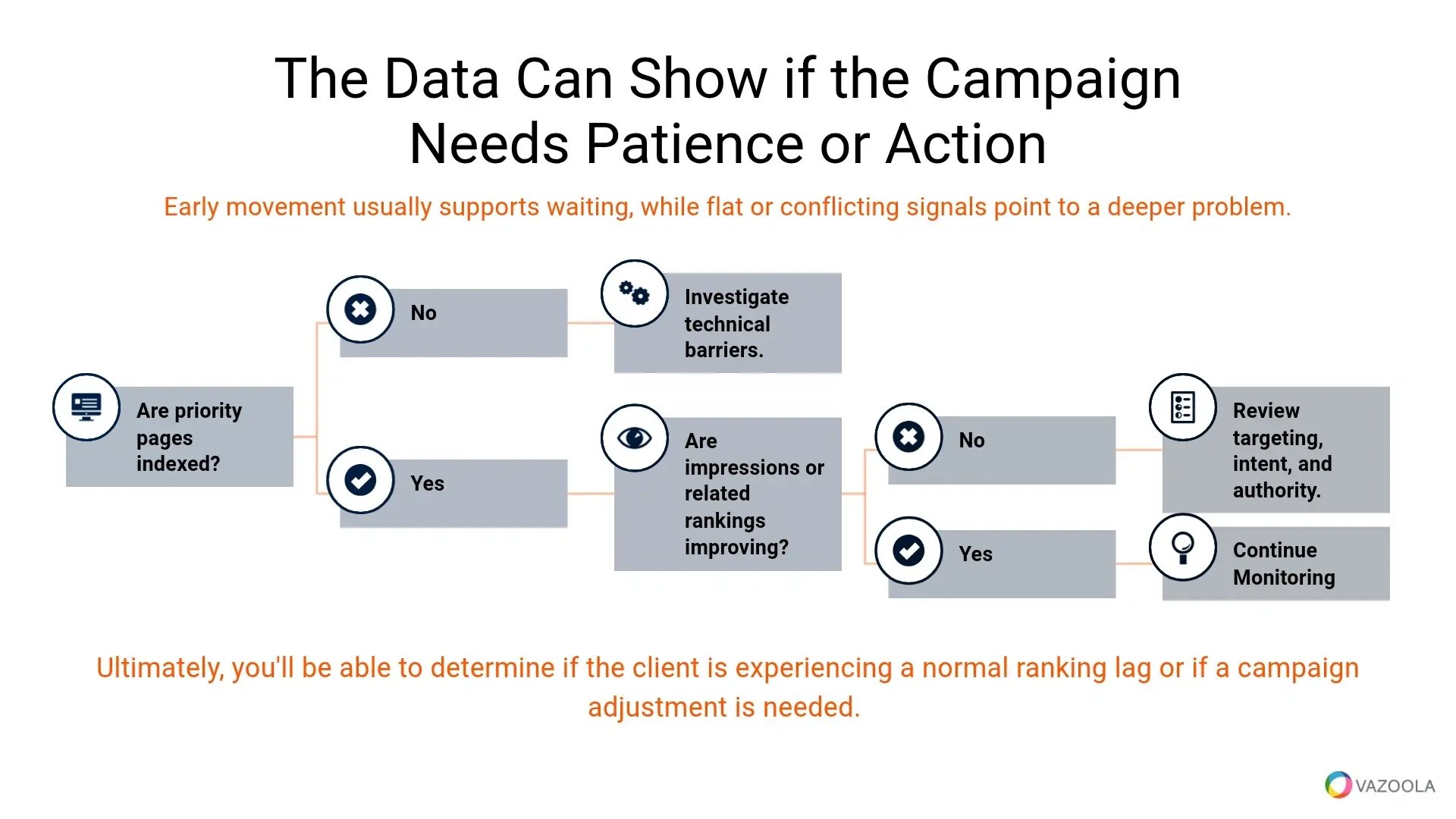
Reassurance carries more weight when data supports it. Use the same rank-tracking platform, locations, devices, and reporting periods so comparisons remain consistent. Manual searches can create confusion because results may vary from one user to another.
Bring a focused set of evidence into the conversation:
-
Rank-tracking trends across related keyword groups
-
Search impressions, clicks, and average positions
-
Performance changes for priority pages
-
Live and indexed backlink counts
-
Competitor movement during the same period
-
Results compared with the campaign baseline
Google’s Search Console Performance report provides clicks, impressions, click-through rates, and average positions over time. Those metrics can show whether visibility is expanding beyond the handful of terms tracked by a third-party platform. Page- and query-level views may also reveal early gains hidden by sitewide totals.
Be careful you don’t overwhelm the client with every available metric. Choose the data that explains the campaign’s current stage and directly answers the question. A few connected signals say more than a crowded dashboard.
Finish with a clear checkpoint. State which metric the team expects to move, when it will be reviewed, and what would trigger a strategy change. A specific decision point sounds more credible than an open-ended request to wait.
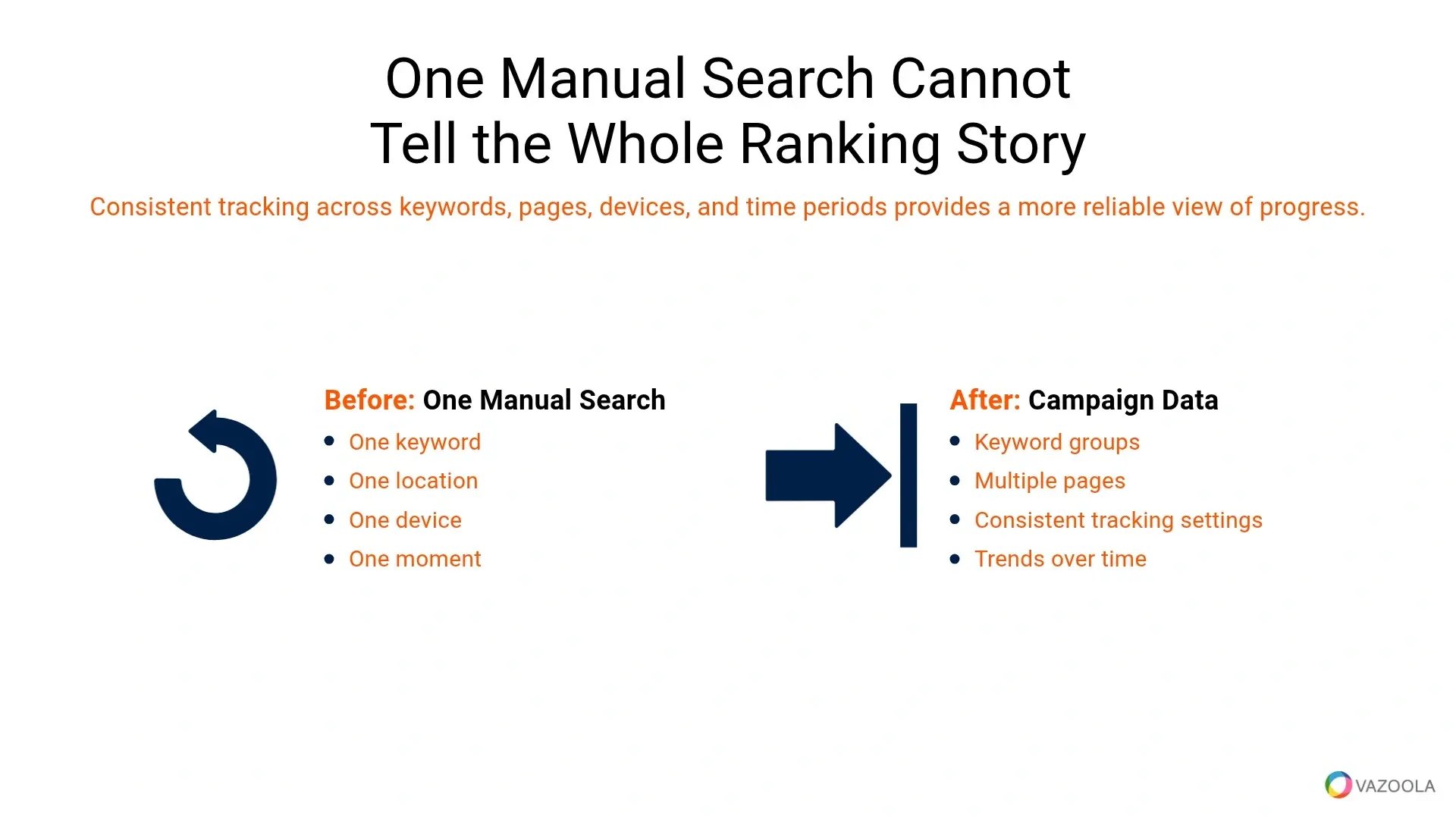
When ‘Why Aren’t We Ranking?’ Signals a Real Problem
Not every ranking concern comes down to impatience. Technical barriers, targeting errors, and strategic miscalculations can prevent a campaign from gaining traction. Agencies protect client trust when they spot those problems early.
Warning signs worth investigating include:
-
Priority pages remain excluded from Google’s index.
-
Search impressions stay flat over several reporting periods.
-
The wrong URLs appear for target queries.
-
Multiple pages compete for the same keyword and intent.
-
Previously stable pages decline across several keyword groups.
-
Links repeatedly support low-priority or irrelevant pages.
-
Search results favor a different page type than the one being optimized.
-
Technical problems persist after the agency reports resolving them.
Any indexing barriers need immediate attention. Issues like robots directives, incorrect canonical tags, server errors, accidental noindex settings, and weak internal links can stop a page from competing. More content or links won’t make up for a page Google can’t properly access or index.
Keyword cannibalization can also weaken results. Several pages aimed at the same intent may compete against one another and leave search engines unsure which URL to prioritize. That’s why consolidating overlapping content or clarifying each page’s purpose may create a stronger signal.
Search intent deserves equal scrutiny, too. An educational blog post may struggle for a commercial query when the leading results consist of service, product, or category pages. The target URL needs to match what searchers actually want.
Further, campaign difficulty may have been underestimated. A newer site with limited authority may not compete quickly against established domains for broad, valuable terms. Instead, long-tail targets, stronger supporting content, or sustained authority building often offer a more realistic path.
Frequently Asked Questions
How long should a client reasonably wait before expecting rankings to move?
Early indicators may appear within several weeks, but stronger ranking gains often take months. Competitive keywords, new sites, major technical repairs, and authority-building campaigns may require more time. Expectations should reflect when priority changes became visible to search engines, not only when the contract began.
Can rankings actually drop temporarily before they improve?
Rankings can fall while Google recrawls pages and reevaluates them against competing results. A brief decline doesn’t automatically mean the campaign has failed. Review the duration, affected pages, technical health, search demand, and broader ranking patterns before changing course.
Does checking rankings too frequently give a misleading picture of progress?
Frequent manual searches can exaggerate normal fluctuations. Search results may vary based on location, device, personalization, and other factors. Consistent weekly and monthly tracking provides a clearer view of direction.
What’s the difference between not ranking yet and not ranking at all?
“Not ranking yet” usually means the page is indexed and showing early visibility but hasn’t reached a valuable position. It may already earn impressions or rank for related searches. “Not ranking at all” may point to an indexing issue, intent mismatch, weak authority, or incorrect target page that needs investigation.
Track the ranking questions clients ask repeatedly and answer them proactively in future reports. A short explanation delivered early often prevents a tense conversation later.
Turn Ranking Questions Into Stronger Client Relationships
A ranking question puts the agency’s judgment on display.
Clients want to know whether the team understands the delay, can spot a real problem, and has a clear next move. A direct answer backed by evidence can strengthen the relationship even before the rankings arrive.
Share leading indicators early, explain timeline changes clearly, and flag problems before the client finds them.
Agencies that need help building authority can use Vazoola’s professional link-building services as part of a broader SEO strategy. Clearly communicating, setting realistic expectations, and offering a firm next step will keep the conversation moving.
Invite the client to agree on the next decision point instead of simply giving them one. Shared checkpoints turn ranking discussions into collaborative planning rather than agency defense.