
Feb 04, 2026

Casey Bjorkdahl is one of the pioneering thought leaders in the SEO community. In 2010, Casey co-founded Vazoola after working for a Digital Marketing Agency for five years in New York City. Vazoola is now one of the fastest growing and most widely recognized SEO marketing firms in the country.



Most of today’s searches start out as actual questions, not just keywords. People type full queries. They add context and adjust their wording until they get the solution they need.
A shift has begun among marketing teams in response to this phenomenon. They now find that long-tail keywords better reflect how people think, speak, and of course search. Teams don’t try to force square pegs into round keyword holes.
It’s of little consequence how many keywords a page targets. What matters most is whether a page helps someone with a decision. People aren’t just searching for facts anymore. Instead, they’re seeking reassurance before making a choice.
When content answers real questions with focus and care, however, it earns attention in ways that broad, surface-level pages simply can’t. It’s a subtle shift, but it changes how every piece of content needs to be planned, written and, ultimately, evaluated.
Treat long-tail keywords as a byproduct when you analyze intent, not as the starting point. Start with whatever decision or uncertainty the user is experiencing, then observe how they naturally phrase it.
Key Takeaways
-
AI engines expand a single query into several related searches before they rank results.
-
Long-tail keywords reflect the ways people search when they want real answers, not definitions.
-
Long-tail search intent aligns content with a purpose instead of mere phrasing.
-
Topic groups reduce overlap. They make updates easier to manage.
-
Visibility grows even when clicks hold steady. That means performance metrics need context.
Table Of Contents
How Search Has Evolved: Then vs. Now
It’s not hard to identify the shift to long-tail keyword preferences. Here’s how:
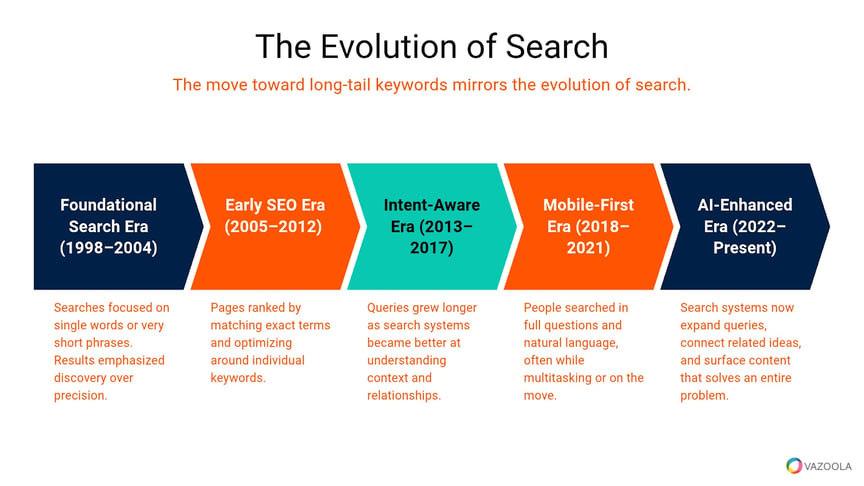
A typical query in 2022 might read, “email outreach,” But a more modern version of the same search could look like, “how to write a follow-up email after no reply for B2B outreach.”
The difference is obvious — you can see the second query carries context. It shows the user’s urgency and expectations.
The move toward long-tail content has accelerated as mobile devices and voice search change how people interact with search engines.
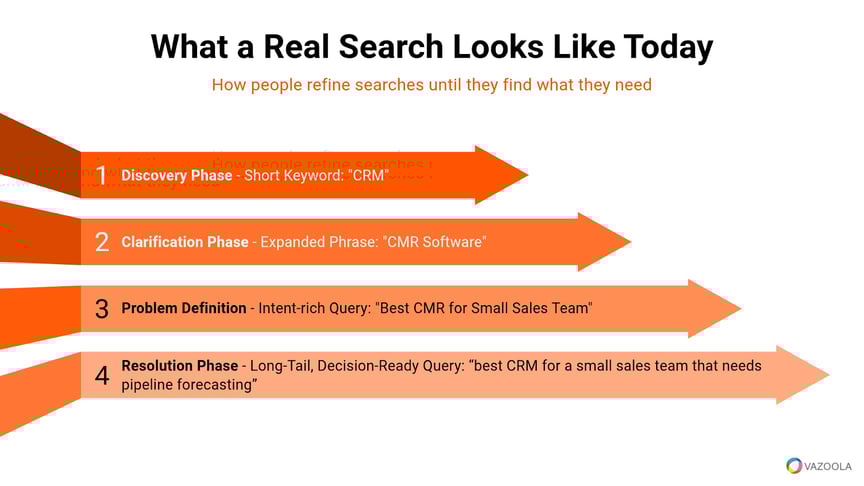
Short topics now appear as full questions. A search may start out as, “CRM,” but a long-tail keyword example might eventually become “best CRM for a small sales team that needs pipeline forecasting.” That longer query completely reshapes what a useful answer will look like.
Modern search results can also change their order and frequency as AI transforms organic rankings. When pages offer context and intent alignment, they’re more likely to surface than those built around exact matches alone.
Building Blocks Behind Today’s Search Results
Before you get to putting long-tail keywords to work in your SEO strategy, let’s slow down and define what forms modern search. A few concepts can explain how people now seek answers online, how content teams organize information, and even how AI decides what pages deserve its attention.
What Are Long-Tail Keywords?
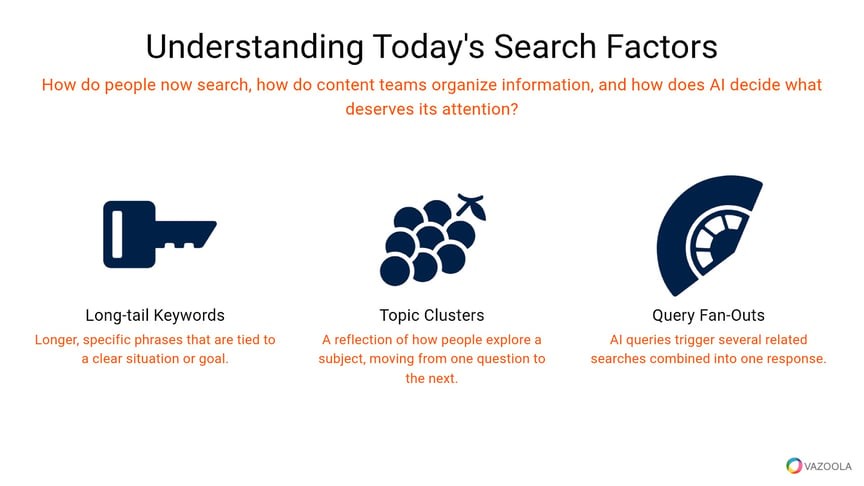
Long-tail keywords are defined as sentence-like phrases, typically with four or more words, that reflect a specific intent or question. They attract lower search volume, but more qualified, high-intent traffic.
Long-tail keywords are longer. No surprise there. But they’re also more specific phrases tied to a clear situation or goal. Searchers use them when they want an answer that fits their precise reality, not just another surface-level overview.
For instance, a short term like “running shoes” shows interest. However, a long-tail keyword example like “best running shoes for flat feet for marathon training” tells search engines about intent and context.
You can usually spot long-tail queries by how much context they carry. The wording sounds natural. And the query includes details that remove guesswork. The phrasing can show if someone is researching, comparing, or ready to act.
For content teams, long-tail keywords offer breathing room. They take pressure off chasing vanity terms that might look good on paper but are unlikely to make much difference.

Write the first three sentences of a page as if no one will scroll. If relevance is not unmistakable immediately, the page is already underperforming.
How Do Topic Clusters Support Real Search Behavior?
Topic clusters are a reflection of how people explore a subject as they move from one question to the next.
A central topic anchors the cluster, through a pillar page for example. Then the supporting pages answer related long-tail questions grouped by intent. Internal links bridge the pages so readers can traverse the subject without hitting a dead end.
Search engines read this structure as depth, not redundancy.
Plus, clusters make maintenance easier. Teams can improve one related set of pages over time instead of rewriting dozens of similar posts.
Why Does a Query Fan Out in the World of AI?
What is a query fan out, you may ask?
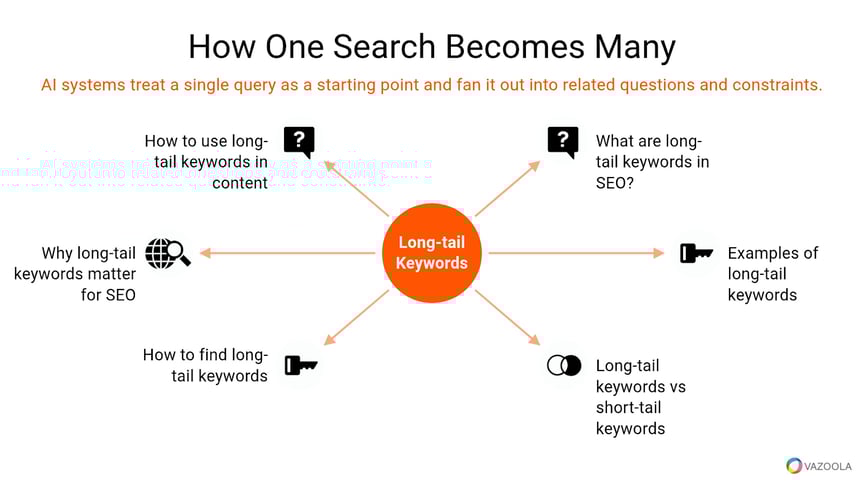
Query fanout refers to how a single search or prompt is expanded into multiple related queries. Behind the scenes, search engines or LLMs use them to gather broader context, supporting information, and varied perspectives before generating an answer.
AI often breaks a single question into several related searches before responding. One query can trigger several related searches, which are then combined into a single response. The process helps systems explore context and not rely on exact wording.
Google employed AI models in experimental search modes to support this approach. According to Google Search Central, AI-powered search systems expand queries to generate more complete summaries.
For content teams, this means narrow pages struggle to compete. Indeed, pages perform better when they answer the main question… and the natural follow-ups someone might ask next.
Modern Long-Tail Keyword Discovery
How do you find long-tail keywords, anyway?
Many teams still treat long-tail keyword research like a spreadsheet exercise, which makes it easy to miss how people actually phrase their questions.
Strong long-tail keyword research comes from observation before guesswork. The work isn’t like flipping switches. It’s connecting the dots across real conversations.
Successful teams notice how intent shifts between early research and comparison time. They understand how questions and related ideas link across a topic.
Use An AI-Aware Keyword Platform
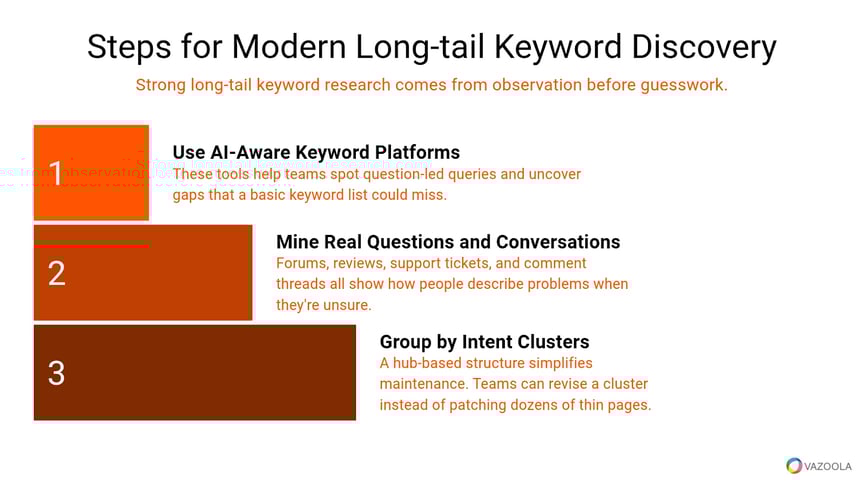
Some platforms analyze factors like phrasing patterns or intent categories. They might utilize generative SERP features, as well. The long-tail keyword tools help teams spot question-led queries and uncover gaps that a basic keyword list could miss.
Intent filters also can help clarify the search priorities. By filtering, teams can separate learning-focused searches from the comparison-driven variety. Then they can plan their content accordingly.
Mine Real User Questions And Conversations
Real user language remains one of the richest sources of long-tail keywords. Forums, reviews, support tickets, and comment threads all show how people describe problems when they feel stuck or they’re just unsure.
Q&A features in search results can also help. Related questions often reveal what someone will ask next. Preserving that wording makes content sound direct and relevant.
Evaluate long-tail opportunities by how well they collapse follow-up questions, not by how narrowly they match a phrase. Pages that resolve “what next” perform better in AI-expanded results.
Group By Intent Clusters Instead Of One Page Per Variant
Creating one page per keyword variation causes clutter. Pages compete with each other. Links can lose clarity, and it’s harder to manage updates. Intent clusters solve problems by grouping related questions under one clear concept.
A hub-based structure likewise simplifies maintenance. When priorities shift, teams can revise a cluster instead of patching dozens of thin pages.
How to Write for Long Queries Without Overthinking It
Pages often lose users before the first scroll – long before search engines have a chance to reward them.
Readers should know within seconds whether pages match their searches. They want to recognize relevance within the first few lines of copy. Pages that beat around the bush and delay the point frequently lose trust. They leave readers feeling like they were led down the garden path.
Further, headings should support scanning without forcing phrasing. The goal is to guide the reader, not repeat the query.
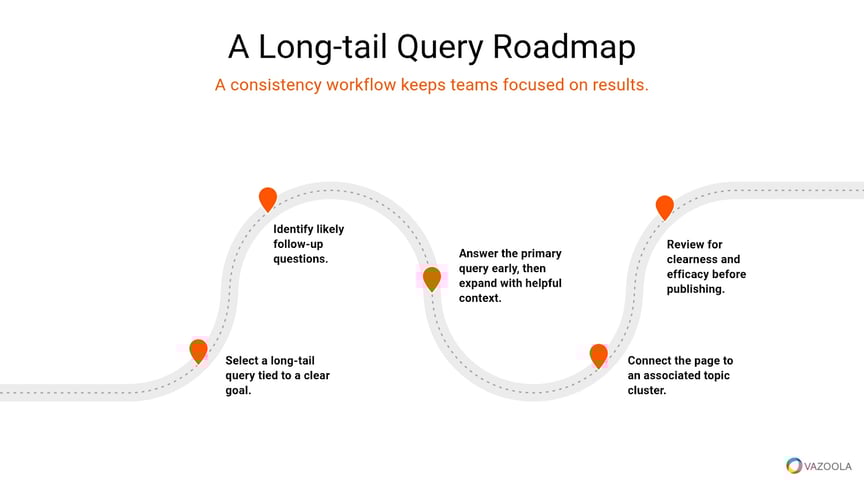
A consistent workflow keeps teams focused:
-
Select a long-tail query tied to a clear goal.
-
Identify likely follow-up questions.
-
Answer the primary query early, then expand with helpful context.
-
Connect the page to an associated topic cluster.
-
Review for clearness and efficacy before publishing.
Remember, format really matters. Short paragraphs reduce fatigue, and descriptive subheads improve navigation. Tables also help when comparisons matter. For their part, FAQs work best when they address real follow-ups.
Measuring Visibility Beyond the Click
Search visibility no longer guarantees a click. More and more, AI summaries surface ideas while users never leave the results page. That changes how success can be evaluated.
Teams can track impressions, engagement signals, share of voice, and citation presence to evaluate long-tail SEO success. Rising impressions paired with stable clicks can still signal progress when the content appears more often in AI-assisted placements.
Measurement works best at the cluster level. A topic hub could earn visibility across a variety of long-tail queries even when individual rankings move.

Use internal links to signal progression, not hierarchy. Links should reflect how understanding deepens, not how pages sit in a sitemap.
Where Long-Tail Content Wins the SEO Game
There’s simply no doubt that user queries continue to grow longer and get more conversational. Because AI search merges related questions before ranking content, it only raises the expectations for coverage.
Long-tail content earns visibility by answering real problems with focused guidance. Strong pages feel simple and grounded, while still offering genuinely helpful guidance. But they still cover the angles readers really do care about without trying to boil the ocean.
So, what’s your long-tail keyword strategy? If you’re unsure, an experienced SEO partner like Vazoola can help. Contact us today or try some of our free SEO tools.