

Jun 19, 2026

Casey Bjorkdahl is one of the pioneering thought leaders in the SEO community. In 2010, Casey co-founded Vazoola after working for a Digital Marketing Agency for five years in New York City. Vazoola is now one of the fastest growing and most widely recognized SEO marketing firms in the country.


It wasn’t all that long ago when keyword research meant staring at endless spreadsheets while manually sorting phrases into rough categories that only partially made sense.
Now AI can build massive keyword clusters, surface semantic relationships, and generate entire research sets before a strategist finishes a cup of coffee. These faster workflows sound impressive until agencies realize many of those polished keyword lists still miss the nuance that actually drives rankings and conversions.
AI may have accelerated keyword research dramatically, but it also created a false sense of confidence. Many AI-generated recommendations appear strategic while quietly misunderstanding search intent, page purpose, and real-world SERP behavior across search, whether the goal is SEO, AEO, or GEO.
Teams still need human judgment to decide what belongs on a pricing page, what deserves a long-form guide, and what searchers truly want from a query.
When they revisit foundational processes like keyword research tips, teams often discover that AI improves efficiency without replacing strategy.
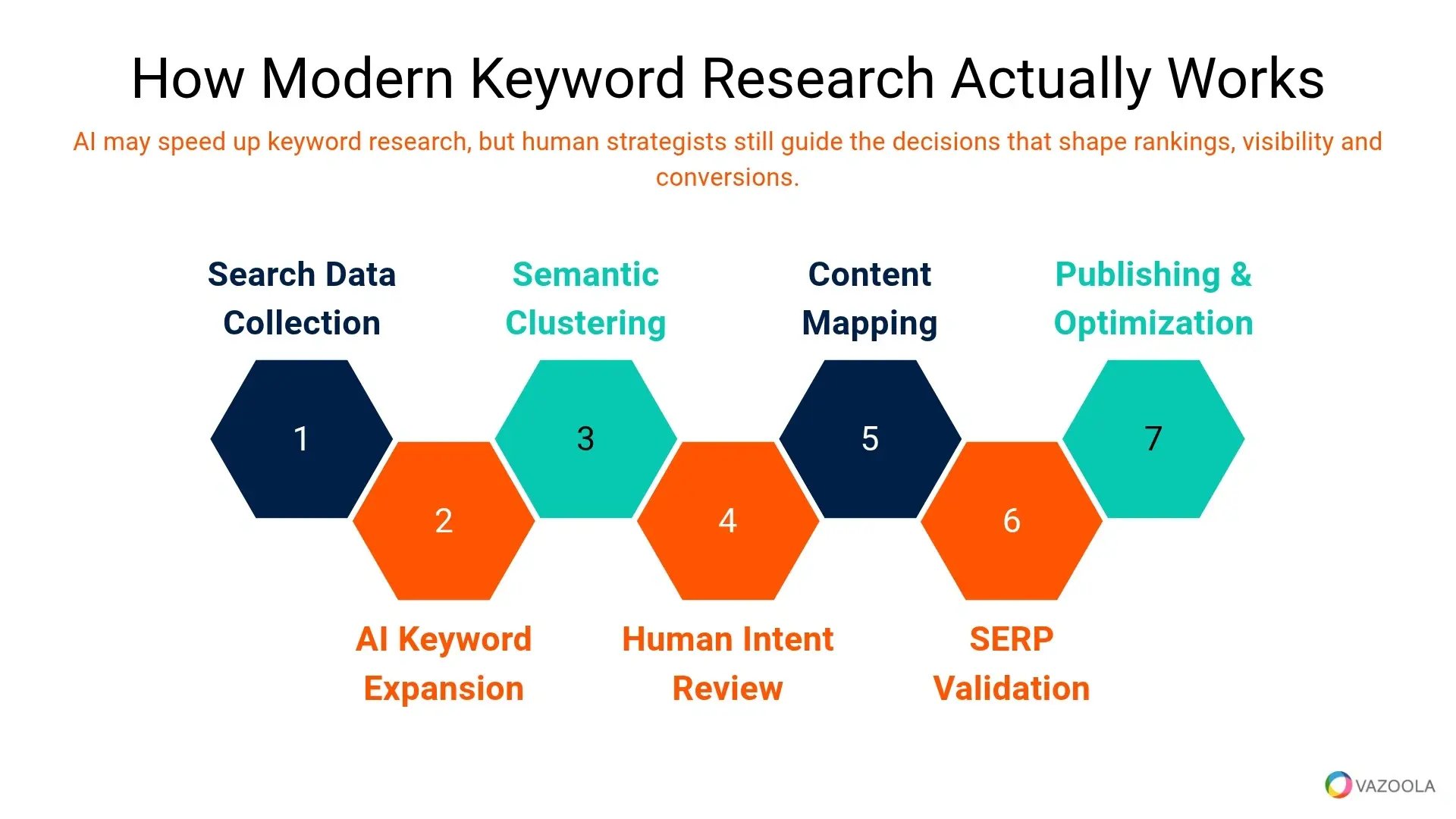
Search behavior has changed, and SERPs changed, too. AI-generated answers have forever altered how people phrase queries. All of that means agencies now need workflows that balance automation with real editorial and search expertise.
Key Takeaways
-
AI dramatically improved keyword expansion, clustering, and pattern recognition across large datasets.
-
Intent mapping remains one of the biggest weaknesses in AI-generated keyword research.
-
Agencies still need strategists to prioritize keywords based on business goals, page fit, and SERP behavior.
-
Modern keyword research now supports SEO, AEO, and GEO visibility at the same time.
Table of Contents
What AI Actually Improved
AI genuinely improved several aspects of keyword research. Agencies that manage multiple clients now process larger keyword sets faster than ever before.
AI keyword research especially improved a few time-consuming tasks:
-
Expanding keyword lists with semantic variations, conversational phrases, and long-tail opportunities
-
Grouping related queries into topical clusters faster than manual workflows
-
Detecting rising search trends and emerging modifiers across large datasets
-
Identifying content gaps between competitors and existing site content
Search trend analysis has also evolved. AI models can detect patterns across rising queries and conversational searches more effectively than older keyword databases. This shift really matters since user discovery habits are already changing rapidly alongside AI-powered search experiences.
In fact, Adobe research found that web traffic from generative-AI-driven referrals increased more than 10 times in the United States between July 2024 and February 2025. That jump illustrates just how quickly AI-driven discovery behavior is reshaping search visibility and early-stage research habits.
None of those AI “improvements” removed strategic thinking. AI might have accelerated processing, but it’s still strategy that determines whether the output actually helps a client grow.
Many agencies now use AI-generated keyword clusters as draft architecture instead of final strategy. Teams that manually rename and refine cluster labels before briefing writers often create cleaner site structures and stronger internal linking later.
Where AI Keyword Research Falls Short
AI sped up research workflows, but several weaknesses still create problems for agencies managing real-world SEO campaigns. Most of the gaps come down to context, interpretation, and strategic decision-making.
Intent
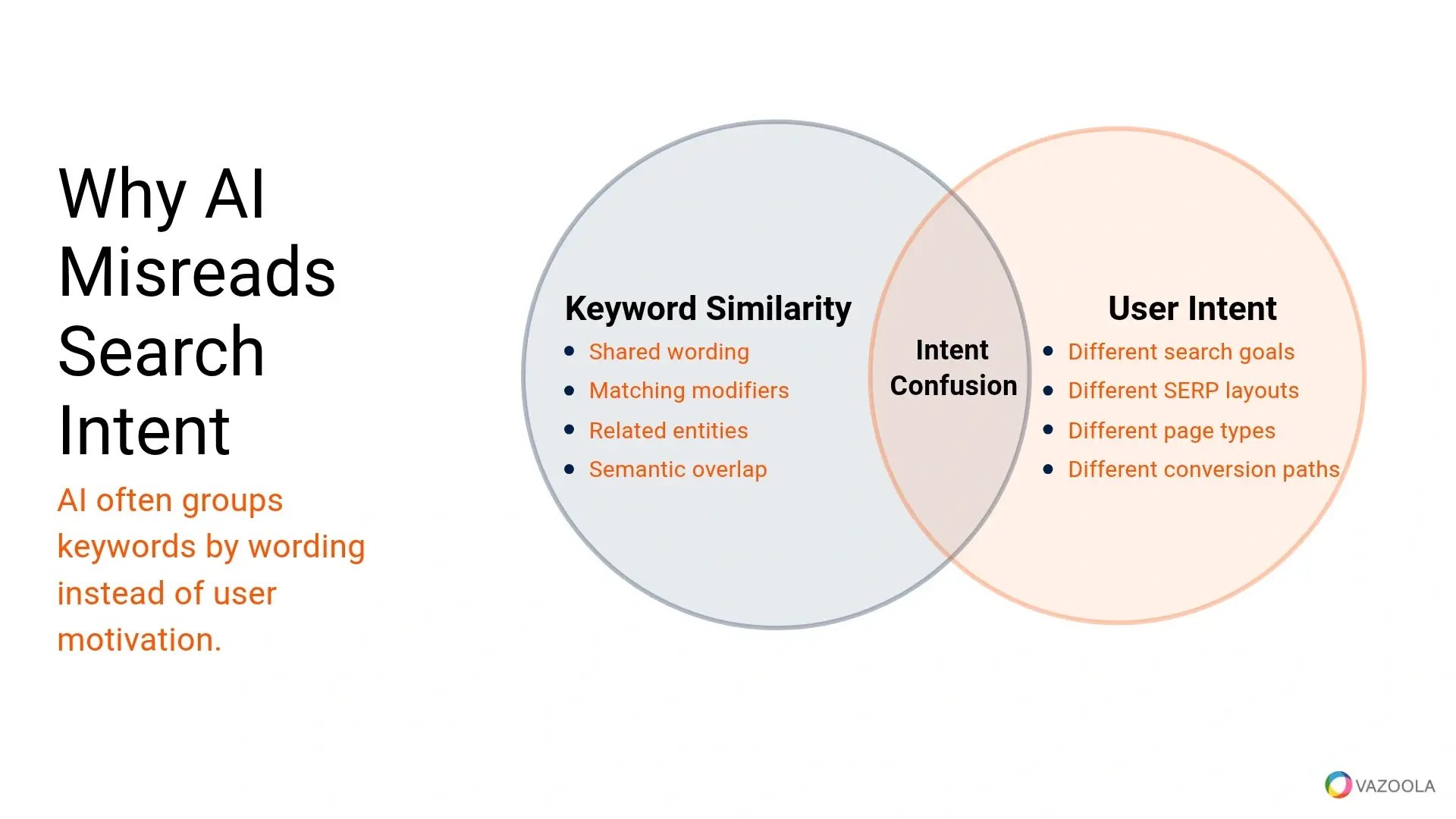
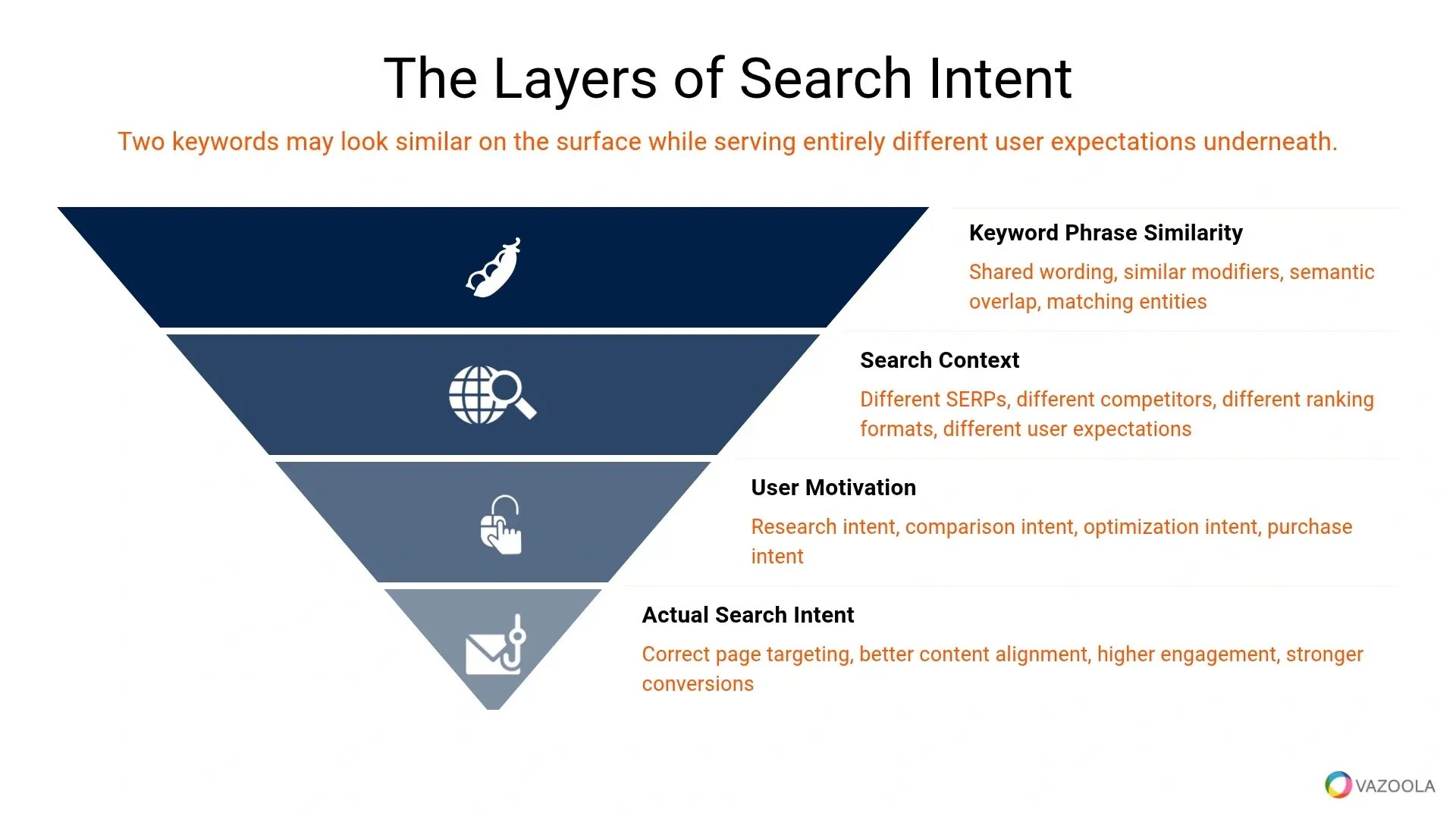
AI groups keywords by similarity. Real search behavior rarely works that neatly.
That’s the difference between keyword vs. search query: the words may match, but the intent behind them doesn’t. One query may signal early-stage research. Another may signal purchase intent. AI clustering often treats both as interchangeable.
Agencies run into problems when AI-generated groups push mismatched keywords onto the same page. Rankings suffer because the page can’t fully satisfy every variation inside the cluster.
What does this mean for keyword research?
Search intent still requires interpretation. AI can effectively recognize language patterns; however, it takes real human strategists to recognize customer motivations.
Prioritization
AI doesn’t understand a client’s actual business priorities unless somebody provides that context directly.
A keyword list might include high-volume terms that look attractive but create little revenue potential, especially when factors like keyword competitiveness make realistic rankings far less achievable.
Instead, a separate lower-volume keyword might convert extremely well because it aligns with the client’s services, margins, or audience.
Strategists understand factors AI tools can’t fully evaluate on their own:
-
Existing authority within a topic
-
Client sales goals
-
Conversion value
-
Internal resource limits
-
Brand positioning
AI can certainly organize data. Agencies still decide what deserves their attention first.
Some lower-volume keywords quietly outperform broad head terms because they attract users closer to a decision. Experienced strategists often evaluate sales-call language, CRM notes, and customer support questions before finalizing keyword priorities.
Page Fit
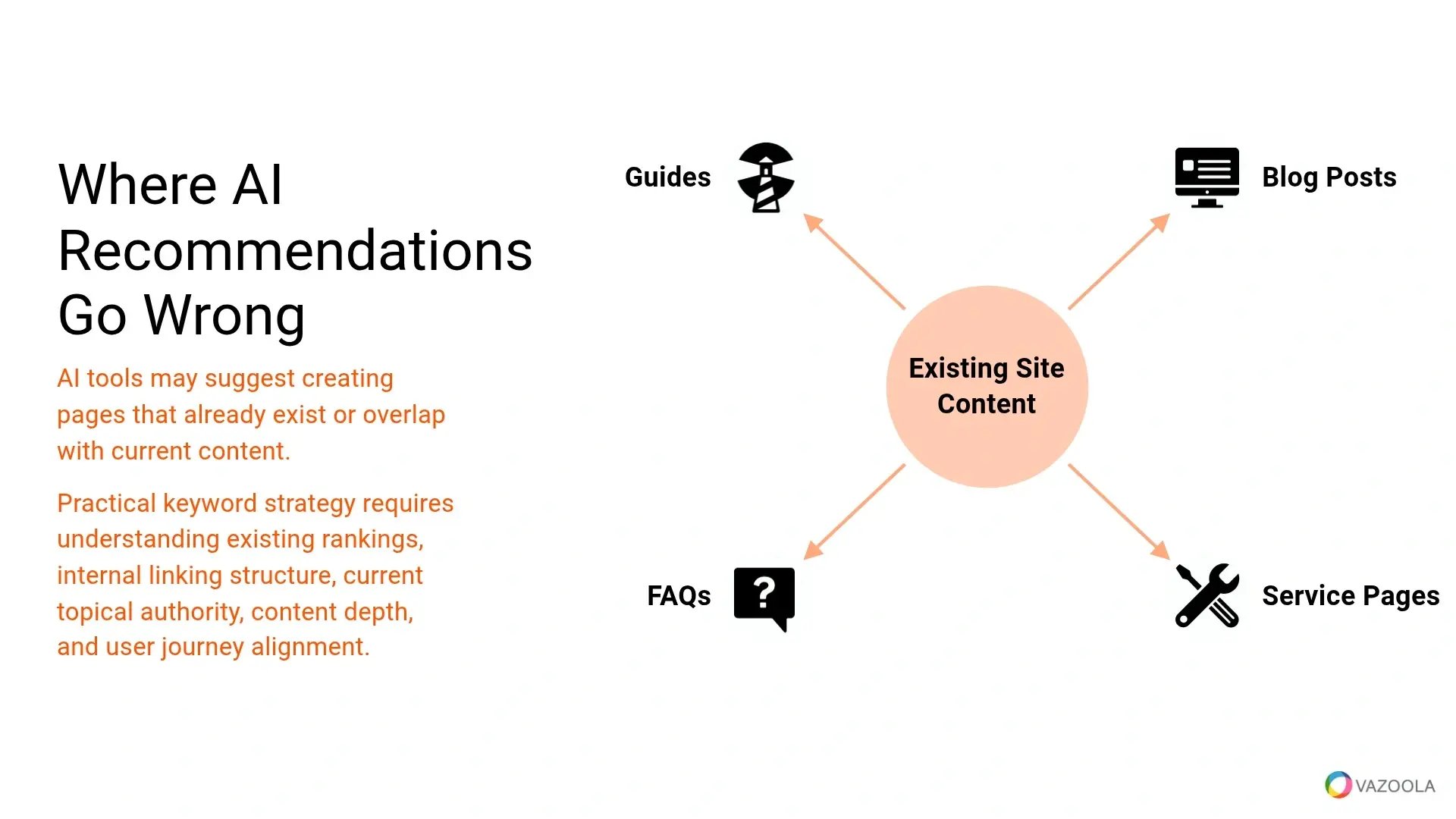
Most AI keyword tools don’t truly understand a site’s current content ecosystem.
A tool may recommend creating a new page even though the site already has a strong asset that simply needs updating or repositioning. Another recommendation might overlap heavily with existing pages and create cannibalization issues.
Practical keyword strategy requires understanding:
-
Existing rankings
-
Internal linking structure
-
Current topical authority
-
Content depth
-
User journey alignment
Many AI tools operate outside that broader editorial context.
SERP Freshness
AI models often rely on historical training data that doesn’t fully reflect today’s SERPs.
Search results now shift faster because of AI Overviews, discussion forums, video integrations, Reddit visibility, and conversational search experiences.
According to a recent report from The Wall Street Journal, AI-driven search increasingly rewards authentic discussions, structured answers, and context-rich content over older keyword-first tactics.
So, agencies relying too heavily on static AI keyword recommendations may optimize for SERPs that no longer exist.
SERP volatility matters more now than raw keyword difficulty for some industries. Agencies tracking weekly layout changes, AI Overview appearances, Reddit visibility, and video carousels often catch ranking opportunities earlier than competitors relying on monthly keyword exports.
Why AI Still Gets Search Intent Wrong
The difference between “keyword research with AI” and “keyword research for AI” highlights a major weakness in AI clustering.
Those searches look nearly identical linguistically, but their intent differs completely.
One user wants AI-powered keyword research tools. Someone else wants to optimize content for AI-driven search experiences.
AI clustering frequently merges those ideas because the wording overlaps so heavily. Agencies that fail to separate them risk building pages that satisfy neither audience particularly well.
Understanding search intent matters even more now because conversational search keeps expanding. Users phrase queries naturally, ask follow-up questions, and search through AI interfaces instead of simple keyword strings.
Modern keyword research indeed depends less on matching phrases and more on understanding what users are actually trying to accomplish.
Where AI Belongs in a Keyword Workflow
AI works best for keyword research as an acceleration layer inside a larger strategic workflow.
The strongest agency workflows usually divide responsibilities between automation and human review:
|
What AI Handles Well |
What Strategists Still Handle Better |
|
Keyword expansion |
Intent mapping |
|
Semantic clustering |
Page assignment |
|
Trend detection |
Business prioritization |
|
Topic discovery |
SERP interpretation |
|
Competitor gap analysis |
Conversion alignment |
|
Large-scale data processing |
Editorial judgment |
Agencies that treat AI as a research assistant often see stronger results than teams trying to automate strategy completely.
Many successful SEO teams now use AI to generate starting points rather than final recommendations. Strategists review the output, validate intent, refine page mapping, and align recommendations with business goals before execution ever begins.
That distinction matters more in AEO and GEO workflows because AI SEO keyword research now supports visibility across AI-driven search systems that interpret meaning differently than traditional search engines.
High-performing SEO teams increasingly treat AI outputs like junior research assistants. The best workflows still require editorial review layers where strategists remove weak clusters, rewrite assumptions, and validate recommendations against live SERPs.
What This Means for How Agencies Work
Agency workflows need adjustments since keyword research no longer ends with search volume and difficulty scores.
Client communication changed first. Agencies now explain visibility across traditional search, AI Overviews, conversational interfaces, and answer engines. Keyword strategy supports all of those environments simultaneously.
Briefing processes also evolved. Content teams increasingly receive guidance around:
-
Query intent
-
Entity relevance
-
Supporting questions
-
Context depth
-
Structured formatting
-
Answer extraction potential
Research workflows became more iterative, as well. Agencies revisit keyword sets more frequently because SERPs shift faster in AI-driven search environments.
Editorial collaboration matters more now, too. Writers, strategists, SEOs, and content managers need tighter alignment because AI-generated keyword recommendations often require substantial refinement before publication.
Agencies that adapt successfully usually treat AI as an operational advantage rather than a replacement for expertise.
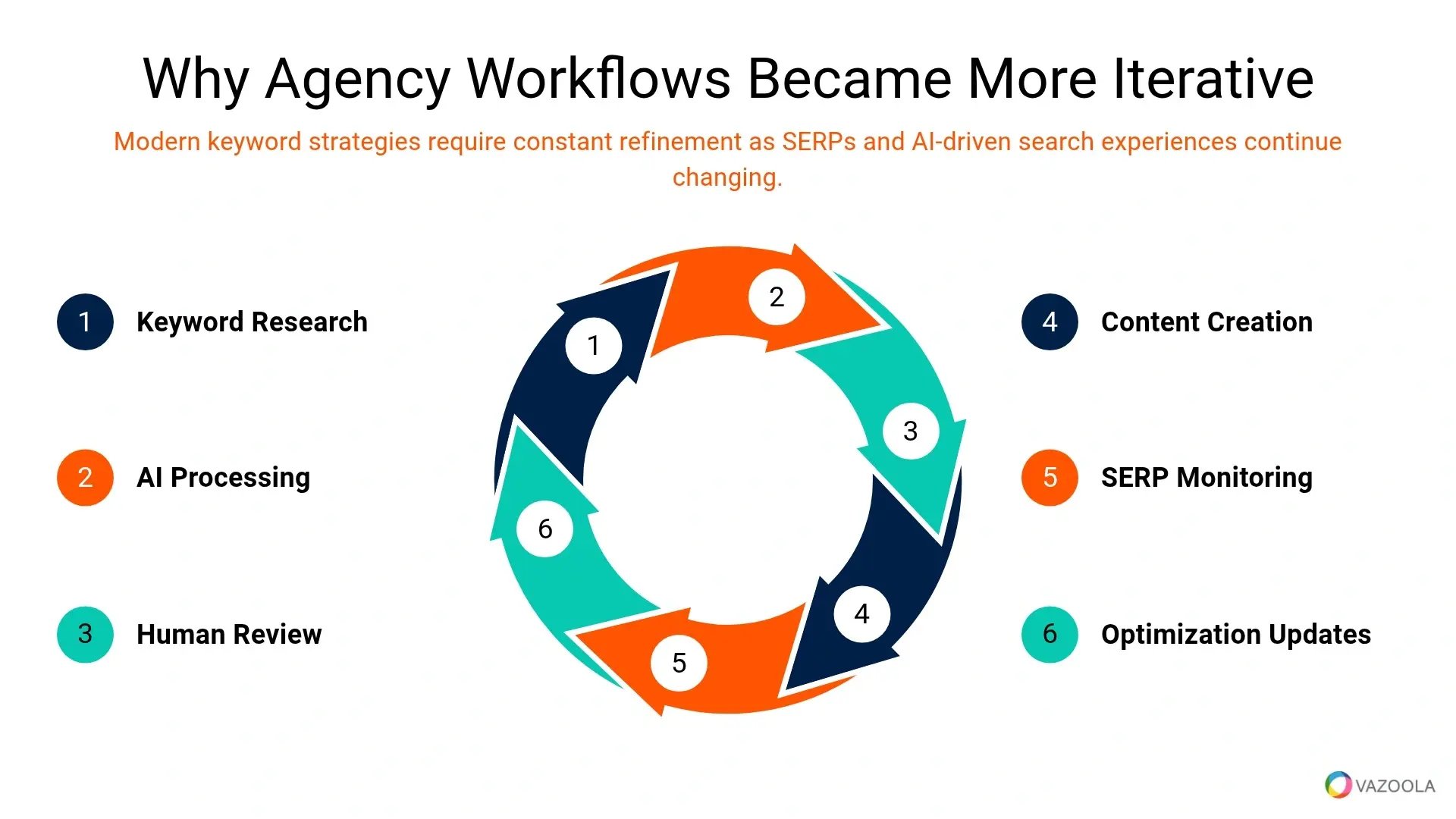
Why Human Strategy Still Defines Successful Keyword Research
AI has changed keyword research permanently. Agencies can analyze larger datasets, discover patterns faster, and build topic relationships far more efficiently than they could before.
But it’s human strategy that still determines whether that research produces meaningful results.
Intent interpretation, prioritization, page fit, and SERP analysis continue to separate strong keyword strategies from bloated spreadsheets filled with disconnected opportunities.
AI may be great at accelerating workflows, though it’s experienced strategists who connect the work to actual business outcomes.
Search keeps moving toward conversational discovery, AI-generated answers, and contextual relevance. Agencies that combine AI efficiency with strong editorial and strategic judgment will remain far more adaptable than teams relying on automation alone.
Does your team want to strengthen its keyword research, align content with evolving search behavior, and build smarter SEO, AEO, and GEO workflows? Why not explore the strategy resources available at Vazoola?
After all, if AI can generate millions of keyword combinations in seconds, what will separate successful brands from invisible ones besides the strategy guiding those decisions?
Keyword data rarely explains why users hesitate, compare options, or abandon pages. Agencies that combine search data with real customer conversations often uncover higher-converting content angles that AI tools never surface on their own.