

Jun 17, 2026

Casey Bjorkdahl is one of the pioneering thought leaders in the SEO community. In 2010, Casey co-founded Vazoola after working for a Digital Marketing Agency for five years in New York City. Vazoola is now one of the fastest growing and most widely recognized SEO marketing firms in the country.


Let’s set the stage.
One agency strategist feeds a simple prompt into ChatGPT and gets 2,000 keyword ideas before lunch.
At the same time, another professional spends three straight weeks building content around the wrong intent cluster and watches rankings flatline.
Welcome to modern SEO, where AI can either sharpen a keyword strategy at scale or quietly flood it with noise.
Many agencies already use tools powered by machine learning to support keyword research with AI across multiple client campaigns. Some teams even combine platforms with prompts built around search intent analysis and large-scale content mapping.
But problems start when teams trust that output too much. After all, AI can generate hundreds of ideas in seconds, but it can’t fully understand a client’s business priorities, sales cycle, or content goals.
So, how has AI changed search behavior and optimization workflows?
According to HubSpot’s 2025 State of AI report, 66% of marketers already use AI or automation in some part of their marketing strategy, with content and SEO among the most common applications.
That means agencies that experiment with AI-assisted keyword research are increasingly using automation to speed up their clustering, SERP analysis, and topic expansion efforts—all while still relying on human review for the final decisions.
Key Takeaways About Using AI for Keyword Research
-
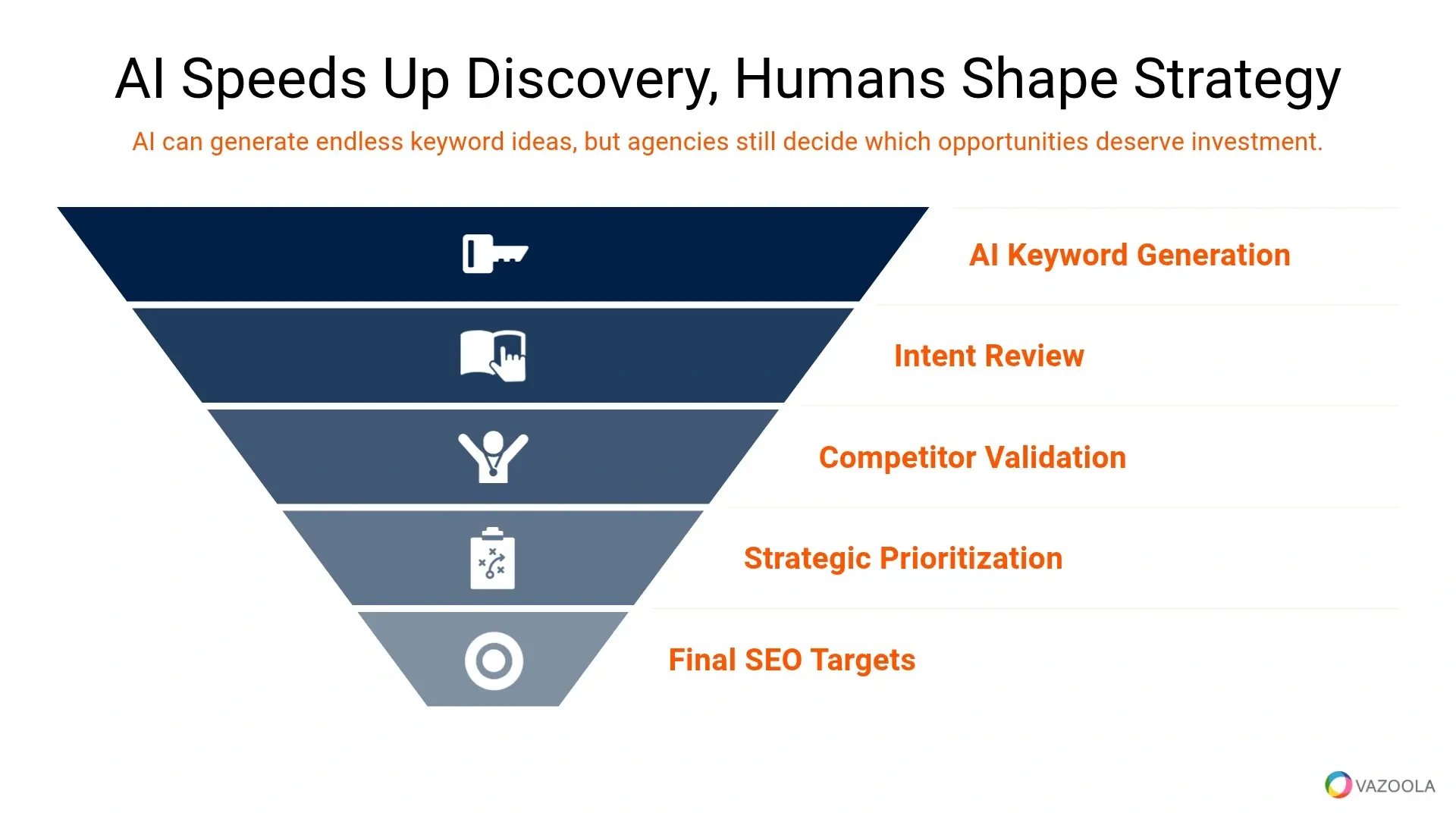
AI works best as a support system for keyword discovery, clustering, and filtering rather than a replacement for SEO strategy.
-
Agency teams can use AI tools for keyword research to scale workflows across multiple client accounts without repeating manual tasks.
-
Human review still matters for intent classification, prioritization, and page assignment.
-
Strong prompts improve output quality and reduce irrelevant keyword suggestions.
-
AI-assisted workflows still require editorial planning and strategic review before implementation.
Table of Contents
What AI Actually Does in a Keyword Research Workflow
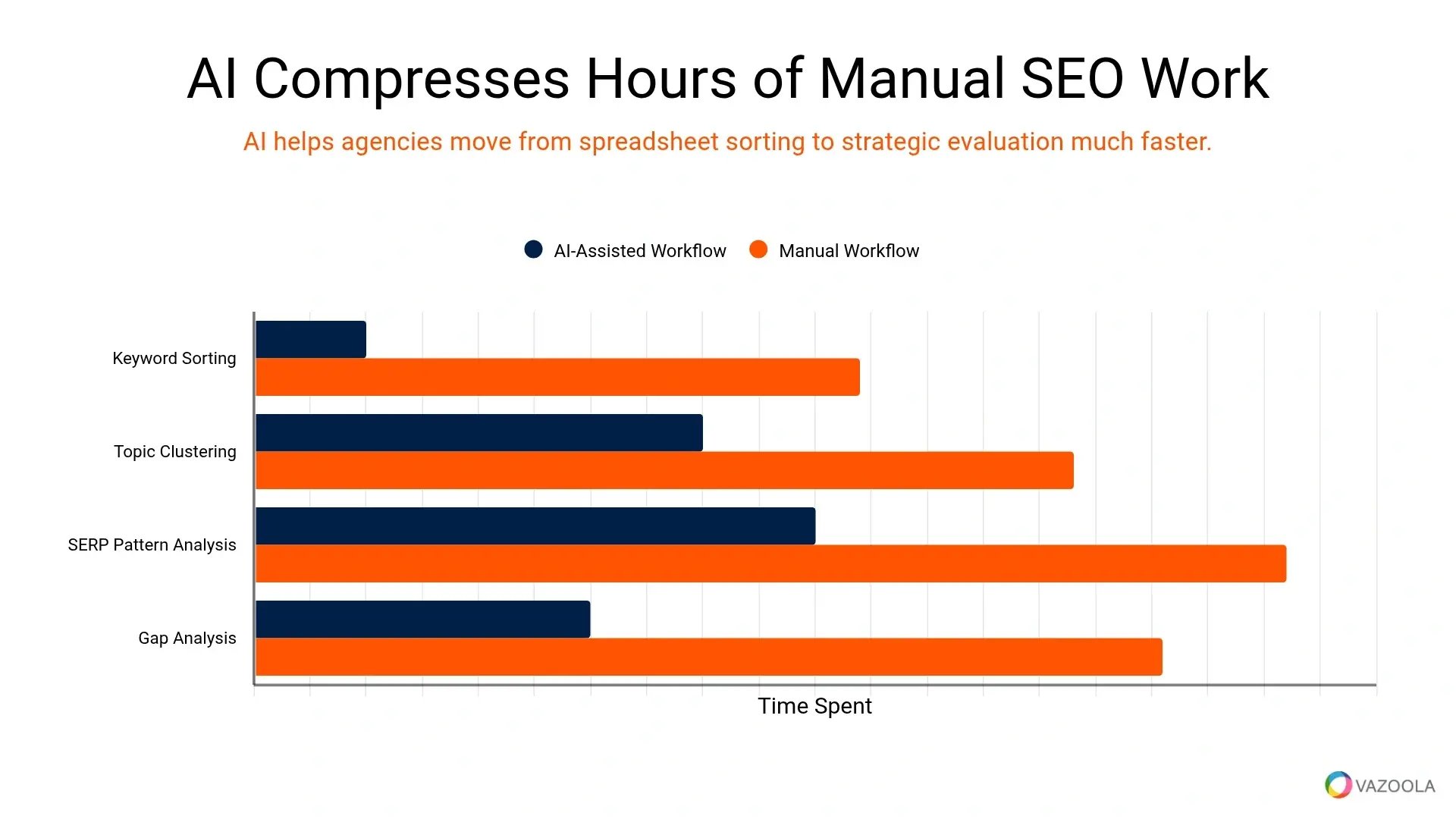
One task AI handles extremely well is repetitive keyword research. Agencies often use an AI tool for SEO keyword research to accelerate processes that previously required hours spent inside spreadsheets.
Most AI-assisted workflows focus on four areas:
-
Seed keyword expansion
-
Semantic clustering
-
Competitor gap analysis
-
Question and topic generation
For example, an agency might input the phrase “enterprise CRM software,” and ask an AI platform to generate related long-tail searches, grouped by intent. The output could include informational queries, transactional phrases, and supporting questions tied to different funnel stages.
Instead of manually sorting through thousands of rows, teams can move directly into evaluation mode.
AI becomes especially valuable when agencies manage multiple client campaigns at once. Large language models can organize keyword themes quickly enough to support faster content production cycles.
Still, raw AI output rarely becomes the final deliverable. Strong SEO teams must validate every cluster against search results, client positioning, and existing content assets before making their recommendations.
Using AI to Build and Expand Keyword Lists
AI may speed up keyword discovery, but the quality of the output depends heavily on the input.
Seed Keyword Expansion
Most agency workflows start off with a seed keyword tied to a client service, product category, or business problem.
A weak AI prompt usually creates noise in these scenarios. Generic requests like “Give me SEO keywords” tend to produce broad, repetitive lists with little strategic value.
A better prompt adds context:
“Generate informational and commercial-intent keyword variations related to enterprise cybersecurity software for mid-sized healthcare companies.”
The difference often boils down to how much context and specificity the prompt includes:
|
Generic AI Prompt |
More Effective AI Prompt |
|
“Give me SEO keywords for accounting software.” |
“Generate informational and commercial-intent keyword variations for cloud accounting software targeting small business owners with fewer than 50 employees.” |
|
“Find keywords for a law firm.” |
“Create a keyword list for a personal injury law firm targeting high-intent searches related to car accidents, insurance claims, and free consultations in competitive metro markets.” |
|
“What keywords should I use for HVAC?” |
“Generate long-tail SEO keywords for a commercial HVAC company targeting property managers searching for preventive maintenance, emergency repair, and energy-efficiency upgrades.” |
|
“Find blog topic keywords for cybersecurity.” |
“Generate question-based and informational keywords related to ransomware prevention for IT directors at mid-sized healthcare organizations.” |
|
“Give me ecommerce keywords.” |
“Create transactional and comparison-intent keywords for a luxury skincare ecommerce brand targeting shoppers comparing anti-aging serums under $100.” |
|
“Find local SEO keywords.” |
“Generate local-intent keywords for a dental practice targeting emergency dental care, Invisalign consultations, and same-day appointments in suburban markets.” |
|
“Give me AI keywords for marketing.” |
“Generate B2B SEO keywords related to AI-powered marketing automation platforms for enterprise marketing managers evaluating workflow integrations.” |
|
“Find competitor keywords.” |
“Identify content gap keyword opportunities between competing SaaS CRM platforms, grouped by awareness, comparison, and purchase-stage search intent.” |
Essentially, specific prompts help AI understand audience type, search intent, and topic scope. Agencies often refine their prompts multiple times before building a final keyword set.
Teams also use AI to generate:
-
Question-based searches
-
Comparison queries
-
Pain-point keywords
-
Long-tail variations
-
Supporting subtopics
Many agencies combine AI suggestions with more traditional tools like Semrush and Ahrefs to validate search volume and competitiveness data. While AI can brainstorm possibilities, it doesn’t reliably provide accurate metrics on its own.
In fact, according to Semrush’s 2024 AI Content and SEO Trends report, 93% of businesses review AI-generated content before publishing it. It goes to show just how heavily human oversight still shapes SEO workflows.
Semantic Clustering
Semantic clustering helps agencies organize related keywords into content groups that are tied to a single page or topic hub.
AI performs this task well because large language models recognize contextual relationships between terms. A clustering prompt might group keywords like:
- “Best CRM for agencies”
- “Agency CRM software”
- “CRM platform for marketing agencies”
Those phrases target similar intent even though the wording differs slightly.
Organized clustering supports cleaner site architecture and stronger topical authority. Agencies managing large websites benefit because clusters help prevent keyword cannibalization across multiple pages.
Keyword clustering tools also help SEO teams map future content opportunities a lot faster. Teams that use keyword research with AI often reduce the amount of manual spreadsheet sorting that’s required before content planning even begins.
Try running the same keyword prompt twice using different audience perspectives. One prompt can target how marketers describe a problem, while another focuses on how actual customers search for it. The gaps between those outputs often reveal overlooked long-tail opportunities.
Competitor Gap Analysis
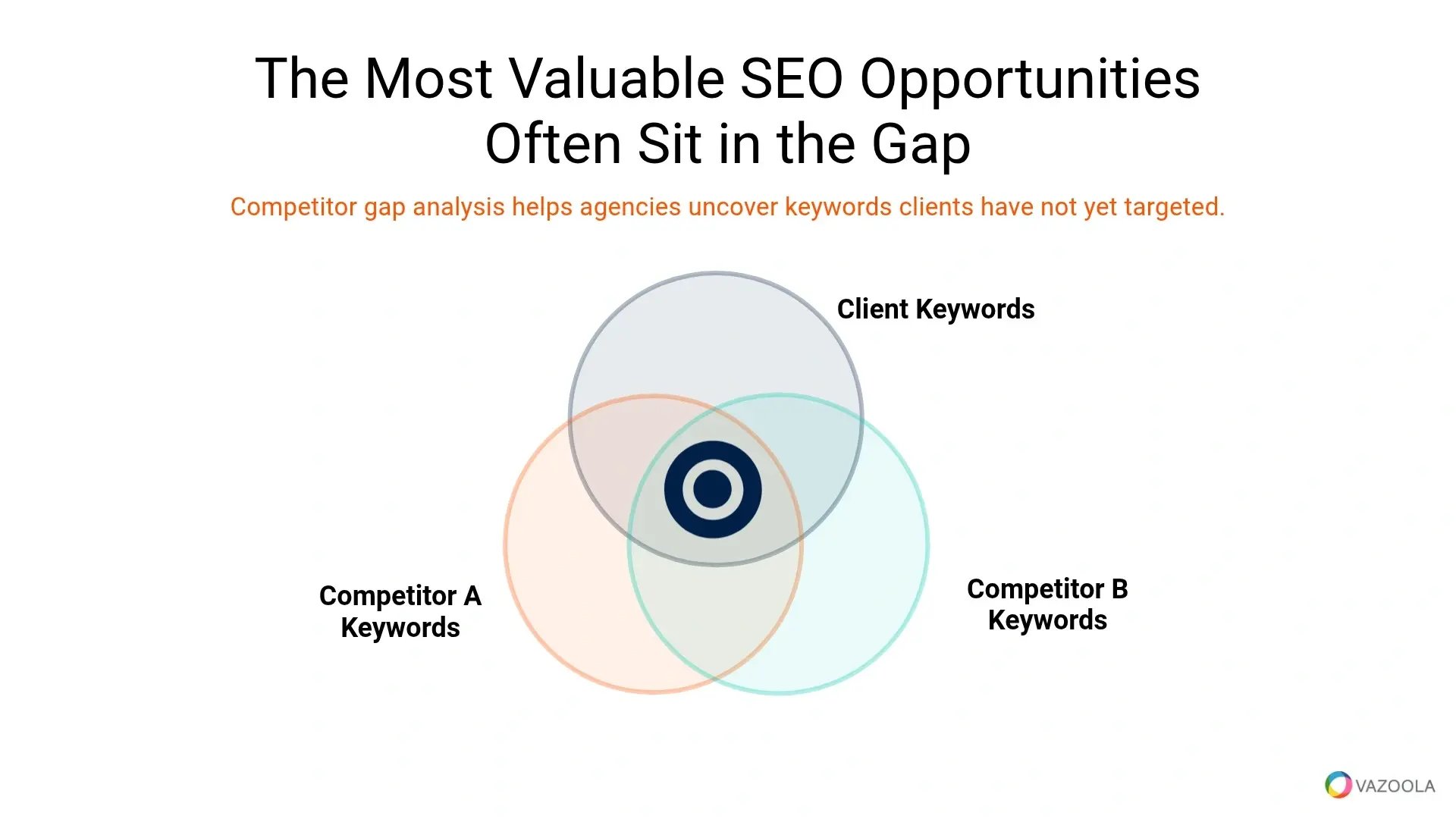
AI also helps agencies identify which keywords competitors are ranking for that clients currently miss.
A workflow often starts with exporting competitor keyword data from SEO platforms. Agencies then use prompts inside an AI tool for keyword research to organize those gaps by topic, funnel stage, or intent type.
The raw output alone doesn’t become a content strategy. Teams still need to evaluate:
-
Ranking difficulty
-
Existing authority
-
Conversion value
-
Content overlap
-
Search intent alignment
Agencies that skip this review stage often create content that attracts traffic but fails to generate leads or conversions.
Using AI to Qualify and Prioritize Keywords
Large keyword lists create another problem: Not every keyword deserves attention.
AI helps agencies filter expansive lists based on criteria like topical relevance, search intent, and funnel stage. Teams often use prompts to identify which keywords align with awareness content versus commercial landing pages.
Many agencies also compare AI-generated opportunities against keyword competitiveness analysis before deciding which topics deserve content investment.
Additionally, AI helps surface patterns humans might otherwise miss. A model may recognize recurring modifiers tied to pricing, comparisons, or urgency signals across thousands of searches.
Problems often emerge when AI lacks business context.
A keyword may appear valuable based on volume alone, but it may not match the client’s authority level or conversion goals. Agencies working with smaller brands often discover that high-volume targets are unrealistic in the short term.
Ultimately, human strategists still decide which opportunities fit the client’s broader content roadmap. Many teams pair AI filtering with practical keyword research tips to avoid chasing traffic without business value.
Some agencies now score AI-generated keyword lists against sales call transcripts, support tickets, and customer reviews before approving topics. Search volume matters, but recurring customer language often uncovers conversion-focused opportunities traditional keyword tools miss completely.
Where Human Judgment Has to Take Over
AI assists strategy, but it can’t replace strategy.
Intent Classification
Search intent remains one of the hardest parts of keyword research.
AI can estimate intent categories, but search behavior changes constantly. That’s why editorial review matters so much. A phrase that looks informational may actually return mostly product pages in Google.
Misclassified intent creates expensive problems for agencies. Teams can waste weeks building blog content for keywords dominated by transactional results.
To overcome this challenge, SEO strategists still need to review live SERPs before approving content direction.
Before approving a keyword cluster, search the topic in an incognito browser and study the first five results like a user instead of an SEO. Sometimes the fastest way to spot bad intent alignment is simply noticing what type of content Google already trusts to rank.
Prioritization Across a Client's Full Content Picture
AI doesn’t fully understand a client’s sales funnel, internal politics, revenue priorities, or historical performance.
A tool might recommend a keyword because of search volume, while the agency knows the topic already underperformed in past campaigns. Another keyword may have lower volume but stronger conversion potential tied to a high-value service.
Experienced agency teams therefore use AI output as a draft, not a final recommendation.
Page Assignment
Page assignment sounds simple until multiple pages target similar topics.
AI can suggest possible page mappings, but agencies still need to evaluate:
-
Existing rankings
-
Internal links
-
Content overlap
-
Search intent
-
URL structure
Wrong assignments often create cannibalization issues that dilute rankings across several pages, but editorial oversight prevents those problems before production ever begins.
Building an Agency Workflow Around AI Keyword Research
Most successful agencies treat AI as part of a larger workflow rather than a standalone solution.
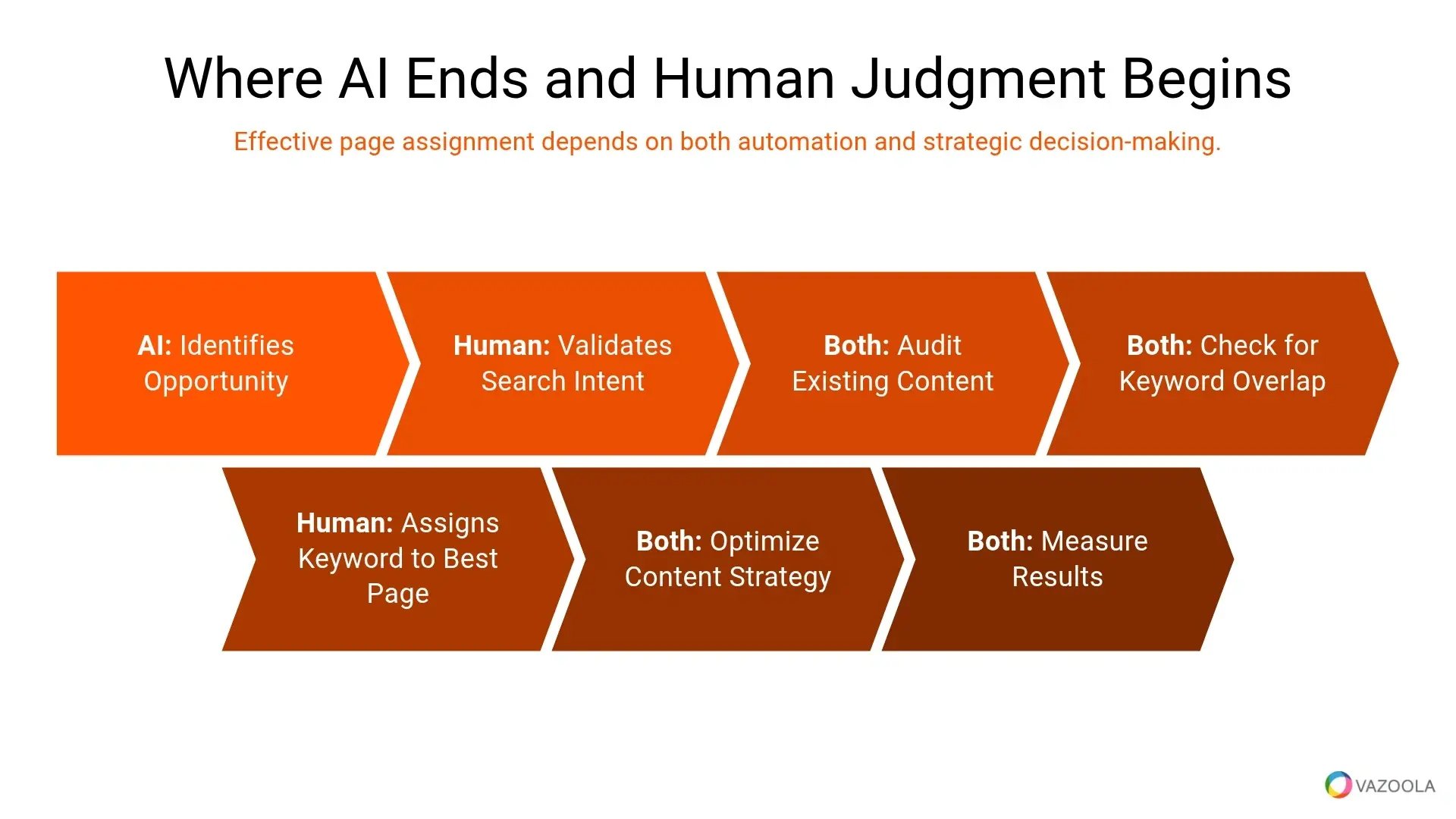
A practical process usually looks like this:
-
Generate seed keyword ideas using AI prompts and client inputs.
-
Validate opportunities with SEO platforms and SERP analysis.
-
Cluster keywords into topical groups and search intent categories.
-
Prioritize opportunities based on authority, competition, and business goals.
-
Assign keywords to existing or future pages.
-
Deliver finalized recommendations with editorial context attached.
The structure lets agencies scale research across multiple accounts without sacrificing quality control.
There’s no question that AI removes much of the repetitive labor. It still takes human strategists to drive the final decisions that shape a campaign’s performance.
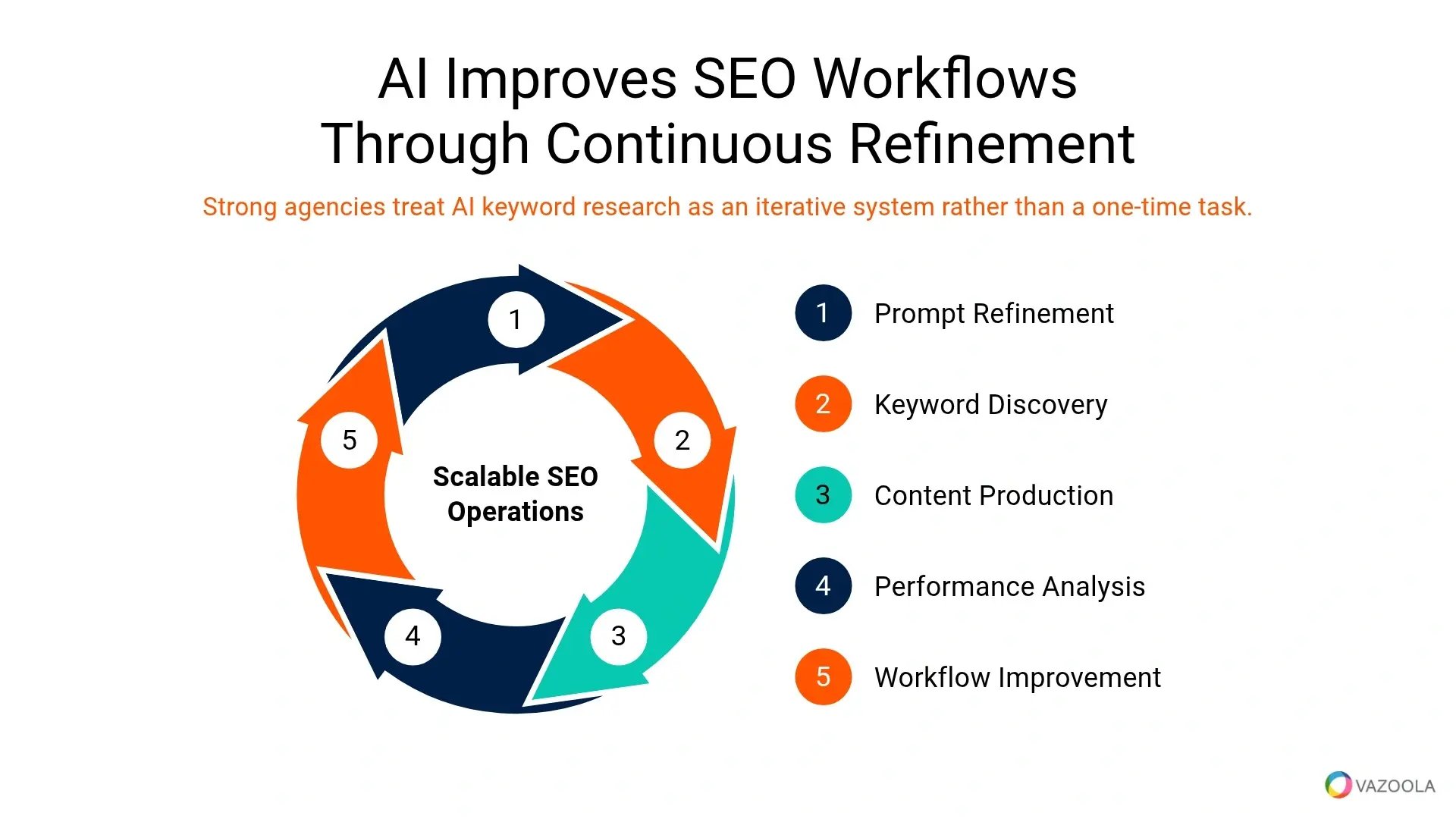
How Agencies Can Scale Smarter Keyword Research With AI
AI has permanently changed keyword research. Agencies that think they can ignore it risk falling behind competitors that move faster and process larger datasets.
An AI tool for SEO keyword research can help agencies organize data faster, uncover semantic relationships, and streamline campaign planning. Speed alone doesn’t create strong SEO strategies, however.
Agencies still need experienced strategists who understand intent, business goals, and content planning.
The strongest workflows combine AI efficiency with human editorial oversight. Agencies that strike that balance can uncover opportunities faster, organize campaigns more effectively, and deliver keyword strategies that connect search visibility with real business outcomes.
Does your agency want to turn AI-assisted keyword research into a sharper, more scalable SEO strategy? Vazoola can help build workflows that connect keyword discovery with real search performance.
Somewhere right now, two agencies are targeting the exact same keyword with the exact same AI tools. One will publish forgettable content. The other will build something people—and search engines—actually remember.
The agencies getting the most value from AI right now are not necessarily producing more content. Many are simply spending less time wrestling with spreadsheets and more time refining positioning, messaging, and search intent strategy before content production even starts.